

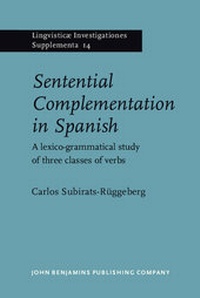
Sentential Complementation in Spanish
A lexico-grammatical study of three classes of verbs
1st Edition
Published on 1. January 1987
XII, 290 pages
978-90-272-7895-1 (ISBN)
Description

The aim of the present work is to study the main distributional and transformational properties of verbs with a non-prepositional sentential complement in the two-argument sentence in Spanish.
More details
Other editions
Additional editions
Carlos Subirats
Sentential Complementation in Spanish
A lexico-grammatical study of three classes of verbs
Book
01/1987
John Benjamins Publishing Co
€127.20
Shipment within 10-15 days
Content
- SENTENTIAL COMPLEMENTATION IN SPANISH
- Editorial page
- Title page
- Copyright page
- Dedication
- Acknowledgements
- Table of contents
- 1. INTRODUCTION
- 1.1. Preliminaries
- 1.2. Nominal value of the sentential complement
- 1.3. The contribution of traditional Spanish grammar towards the study of sentential complementation
- 1.4. Of novelty and obsolescence in Spanish generativism: with regard to a failed attempt to formulate the rule of «Equi»
- 2. CLASS 4 VERBS WITH A SUBJECT COMPLEMENT AND AN INDIRECT OBJECT
- 2.1. Classification
- 2.2. Distributional properties
- 2.2.1. Active and non-active subject
- 2.2.2.elhecho de Qu S
- 2.2.3. Sentential complement in the subjuntive and the indicative
- 2.3. Transformational properties
- 2.3.1. Pronominalization of the sentential complement
- 2.3.2. Reduction of the sentential complement
- 2.3.3. Restructuring of the sentential complement
- 2.3.4. Passive
- 2.3.4.1. Se passive
- 2.3.4.2. Se-de passive and Estar-de passive
- 2.3.5 Permutation
- 2.3.6. Objects referring to parts of the body
- 2.4. Adjectival and nominal derivatives
- NOTES
- 3. CLASS 5 VERBS WITH A SUBJECT COMPLEMENT, WITH OR WITHOUT AN OBJECT
- 3.1. Classification
- 3.2. Distributional properties
- 3.2.1. Active and non-active subject
- 3.2.2. el hecho de Qu S
- 3.2.3. que S and que Ssubj
- 3.3. Transformational properties
- 3.3.1. Reduction of the sentential complement
- 3.3.1.1. Reduction with subject deletion
- 3.3.1.2. Reduction without subject deletion or Subject raising
- 3.3.2. Extraction
- 3.3.3. Restructuring of the subject complement
- 3.3.4. Passive
- 3.3.5. Middle se
- 3.3.6. Permutation
- NOTES
- 4. CLASS 6 VERBS WITH A DIRECT OBJECT SENTENTIAL COMPLEMENT
- 4.1. Classification
- 4.2. Distributional properties
- 4.2.1. Active and non-active subject
- 4.2.2. Det Ncomp de Qu S
- 4.2.3. que S and que Ssubj
- 4.2.4. si S o si S sentential complement
- 4.3. Transformational properties
- 4.3.1. Pronominalization of the sentential complement
- 4.3.2. Reduction of the sentential complement
- 4.3.2.1. Reduction with subject deletion
- 4.3.2.2. Object raising: V-inf raising and V-ndo raising
- 4.3.2.3. A constraint on coreference
- 4.3.3. Passive
- 4.3.4. Clitic climbing
- 4.3.5. Se movement
- NOTES
- 5. THEORETICAL APPLICATIONS OF THE CONSTRUCTION OF SYNTACTICAL CLASSES OF VERBS
- 5.1. Introduction
- 5.2. Clitic climbing: an «explicative» hypothesis
- 5.3. Clitic climbing revisited: additional problems
- 5.4. Conclusion
- NOTES
- 6. ANNEX
- 6.1. TABLES
- 6.2. VERB CLASSIFICATIONS
- 6.3. INDEX OF VERBS
- REFERENCES
