

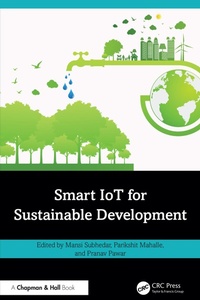
Smart IoT for Sustainable Development
Published on 1. October 2025
338 pages
978-1-040-42504-6 (ISBN)
Description

This book explores the role of the Internet of Things (IoT) in achieving sustainable development goals (SDGs). It provides a comprehensive overview of how IoT technologies enhance energy efficiency, promote clean energy, support environmental monitoring, and facilitate sustainable practices across various sectors. It features real-world case studies, explores key challenges and opportunities, and additionally discusses the integration of machine learning and 5G technology for sustainable development.
Discussion on the fundamental technologies driving smart IoT-based sustainable development, including sensors, data acquisition, and cloud computing
Examination of various aspects of energy efficiency and optimization achieved through IoT, presentation of IoT solutions for monitoring, and managing environmental parameters
Exploration of the scope for integrating machine learning and 5G technologies with IoT for enhanced sustainable development
Analysis of the challenges and solutions related to data privacy and security in smart IoT systems
Inclusion of diverse real-world case studies demonstrating successful IoT applications in various sectors to achieve SDGs using smart IoT and related technologies
This book is a valuable resource for researchers and practitioners interested in the role of the Internet of Things in achieving sustainable development goals.
The Open Access version of this book, available at http://www.taylorfrancis.com, has been made available under a Creative Commons [Attribution-Non Commercial-No Derivatives (CC BY-NC-ND)] 4.0 license.
Discussion on the fundamental technologies driving smart IoT-based sustainable development, including sensors, data acquisition, and cloud computing
Examination of various aspects of energy efficiency and optimization achieved through IoT, presentation of IoT solutions for monitoring, and managing environmental parameters
Exploration of the scope for integrating machine learning and 5G technologies with IoT for enhanced sustainable development
Analysis of the challenges and solutions related to data privacy and security in smart IoT systems
Inclusion of diverse real-world case studies demonstrating successful IoT applications in various sectors to achieve SDGs using smart IoT and related technologies
This book is a valuable resource for researchers and practitioners interested in the role of the Internet of Things in achieving sustainable development goals.
The Open Access version of this book, available at http://www.taylorfrancis.com, has been made available under a Creative Commons [Attribution-Non Commercial-No Derivatives (CC BY-NC-ND)] 4.0 license.
More details
Language
English
Place of publication
London
United Kingdom
Publishing group
Taylor & Francis Ltd
Target group
Professional and scholarly
Illustrations
47 Tables, black and white; 66 Line drawings, black and white; 23 Halftones, black and white; 89 Illustrations, black and white
File size
17,43 MB
ISBN-13
978-1-040-42504-6 (9781040425046)
Copyright in bibliographic data and cover images is held by Nielsen Book Services Limited or by the publishers or by their respective licensors: all rights reserved.
Schweitzer Classification
Other editions
Additional editions
Mansi Subhedar | Parikshit Mahalle | Pranav Pawar
Smart IoT for Sustainable Development
Book
09/2025
1st Edition
Chapman & Hall/CRC
€208.30
Shipment within 10-20 days
Persons
Mansi Subhedar has completed BE (ETC), ME (Electronics Engineering), and Ph.D. in Electronics Engineering in 2019. She has more than 18 years of teaching experience. She is currently working as an Associate Professor and Head at the Department of Electronics and Computer Science at Pillai HOC College of Engineering and Technology, Rasayani, Navi Mumbai, Maharashtra. She has published 49 papers in peer-reviewed international journals and conferences. She is also a reviewer for several international journals and conferences of repute. She was a reviewer and technical committee member of 19 Scopus international conferences. She has received a research grant for three projects from the University of Mumbai and has filed 4 patents. She is a life member of ISTE, IEI, and CSI, a fellow IETE, and a senior member of IEEE. She has been an evaluator and mentor for various state and national-level project competitions, like SIH, Avishkar, Hackathon etc. She is approved PG and PhD Guide in Electronics and Telecommunication Engineering at the University of Mumbai. 12 students have completed ME in Electronics and Telecommunication Engineering under her guidance. Her research interests include Internet of Things, Telecommunication networks, Industry 4.0, and Machine learning. She has received 1179 Google Scholar citations with an h index 12 and i10 index 12. She has delivered several talks and hands-on sessions on research paper writing, IoT, Telecommunication networks, Machine learning and Python. She has several NPTEL, Coursera and Edx certifications in machine learning, high performance computing, Industrial IoT, and Wireless technologies.
Dr. Parikshit Mahalle is a senior IEEE member and currently serves as Professor and Dean of Research and Development at Vishwakarma Institute of Technology, Pune, India. Previously, he held roles such as Dean of Research and Development and Head of the Department of Artificial Intelligence and Data Science at Vishwakarma Institute of Information Technology, Pune, and Head of Computer Engineering at Sinhgad Institutes. He earned his Ph.D. from Aalborg University, Denmark, in 2013 and completed postdoctoral research at CMI, Copenhagen, Denmark. With 25 years of teaching and research experience, he has guided 8 Ph.D. students in IoT and machine learning, with 7 successfully defending their theses, and mentored 2 postdoctoral researchers from NTU, Taiwan. Dr. Mahalle has an impressive academic portfolio, including 52 patents, over 400 research publications (Google Scholar citations: 4000+, H-index: 28; Scopus citations: 2000+, H-index: 21), and 70 authored/edited books with leading global publishers. His research interests span machine learning, data science, IoT, algorithms, and security. He serves as Editor-in-Chief of the Research Journal of Computer Systems and Engineering and holds editorial roles in other prestigious journals. He has received numerous accolades, including the "Best Faculty Award" by Sinhgad Institutes and Cognizant, the International S4DS Distinguished Researcher of the Year 2023, and the IEEE ICTBIG 2024 Distinguished Research Guide Award. His books, such as Design and Analysis of Algorithms and Data Analysis on Pandemic, are widely recognized, with the latter earning two international awards in 2020. Additionally, his edited work Data Science: Techniques and Intelligent Applications won the Choice Outstanding Academic Titles Award for 2024. Dr. Mahalle has delivered over 400 lectures globally and is a certified ISO 27001:2022 Lead Auditor.
Pranav Pawar graduated in Computer Engineering from Dr. Babasaheb Ambedkar Technological University, Maharashtra, India, in 2005, received a Master in Computer Engineering from Pune University, in 2007, and received Ph.D. in Wireless Communication from Aalborg University, Denmark in 2016, his Ph.D. thesis received a nomination for Best Thesis Award from Aalborg University, Denmark. Currently, he is working as an Assistant Professor in the Dept of Computer Science, Birla Institute of Technology and Science, Dubai, before BITS he was a postdoctoral fellow at Bar-Ilan University, Israel from March 2019 to October 2020 in Wireless Communication and Deep Learning. He is the recipient of an outstanding postdoctoral fellowship from the Israel Planning and Budgeting Committee. He worked as an Associate Professor at MIT ADT University, Pune from 2018-to 2019 and as an Associate Professor in the Department of Information Technology, STES's Smt. Kashibai Navale College of Engineering, Pune from 2008-2018. From 2006 to 2007, was working as System Executive in POS-IPC, Pune, India. He received Recognition from Infosys Technologies Ltd. for his contribution to the Campus Connect Program and received different funding for research and attending conferences at the international level. 2 students completed PhD under his supervision in an area of Intelligent Security and Deep Learning from BITS Pilani Dubai Campus. Currently he is supervising 4 PhD students in an area of Digital Privacy, Machine Learning, Adversial attacks on ML models, and Intelligent IoT Security. He published more than 80 papers in Q1, Q2 journals and ranked conferences and filled 3 intellectual property rights in UAE and India. He is an IBM DB2 and IBM RAD certified professional and completed NPTEL certification in different subjects.
Dr. Parikshit Mahalle is a senior IEEE member and currently serves as Professor and Dean of Research and Development at Vishwakarma Institute of Technology, Pune, India. Previously, he held roles such as Dean of Research and Development and Head of the Department of Artificial Intelligence and Data Science at Vishwakarma Institute of Information Technology, Pune, and Head of Computer Engineering at Sinhgad Institutes. He earned his Ph.D. from Aalborg University, Denmark, in 2013 and completed postdoctoral research at CMI, Copenhagen, Denmark. With 25 years of teaching and research experience, he has guided 8 Ph.D. students in IoT and machine learning, with 7 successfully defending their theses, and mentored 2 postdoctoral researchers from NTU, Taiwan. Dr. Mahalle has an impressive academic portfolio, including 52 patents, over 400 research publications (Google Scholar citations: 4000+, H-index: 28; Scopus citations: 2000+, H-index: 21), and 70 authored/edited books with leading global publishers. His research interests span machine learning, data science, IoT, algorithms, and security. He serves as Editor-in-Chief of the Research Journal of Computer Systems and Engineering and holds editorial roles in other prestigious journals. He has received numerous accolades, including the "Best Faculty Award" by Sinhgad Institutes and Cognizant, the International S4DS Distinguished Researcher of the Year 2023, and the IEEE ICTBIG 2024 Distinguished Research Guide Award. His books, such as Design and Analysis of Algorithms and Data Analysis on Pandemic, are widely recognized, with the latter earning two international awards in 2020. Additionally, his edited work Data Science: Techniques and Intelligent Applications won the Choice Outstanding Academic Titles Award for 2024. Dr. Mahalle has delivered over 400 lectures globally and is a certified ISO 27001:2022 Lead Auditor.
Pranav Pawar graduated in Computer Engineering from Dr. Babasaheb Ambedkar Technological University, Maharashtra, India, in 2005, received a Master in Computer Engineering from Pune University, in 2007, and received Ph.D. in Wireless Communication from Aalborg University, Denmark in 2016, his Ph.D. thesis received a nomination for Best Thesis Award from Aalborg University, Denmark. Currently, he is working as an Assistant Professor in the Dept of Computer Science, Birla Institute of Technology and Science, Dubai, before BITS he was a postdoctoral fellow at Bar-Ilan University, Israel from March 2019 to October 2020 in Wireless Communication and Deep Learning. He is the recipient of an outstanding postdoctoral fellowship from the Israel Planning and Budgeting Committee. He worked as an Associate Professor at MIT ADT University, Pune from 2018-to 2019 and as an Associate Professor in the Department of Information Technology, STES's Smt. Kashibai Navale College of Engineering, Pune from 2008-2018. From 2006 to 2007, was working as System Executive in POS-IPC, Pune, India. He received Recognition from Infosys Technologies Ltd. for his contribution to the Campus Connect Program and received different funding for research and attending conferences at the international level. 2 students completed PhD under his supervision in an area of Intelligent Security and Deep Learning from BITS Pilani Dubai Campus. Currently he is supervising 4 PhD students in an area of Digital Privacy, Machine Learning, Adversial attacks on ML models, and Intelligent IoT Security. He published more than 80 papers in Q1, Q2 journals and ranked conferences and filled 3 intellectual property rights in UAE and India. He is an IBM DB2 and IBM RAD certified professional and completed NPTEL certification in different subjects.
Content
Sustainable Future with IoT Applications, Obstacles and Strategies. 2. Case Studies in Smart IoT for Air Pollution Control. 3. IoT-Based Environmental Monitoring: Tracking Climate Change and Promoting Sustainable Development. 4. Leveraging IoT and Smart City Governance Frameworks to Enable Sustainable Urban Development. 5. Comprehensive Study of Wearable Healthcare Devices using IoT. 6. Smart IoT for Mental Health and Well Being. 7. Comprehensive Survey of IoT-AR Integration in Healthcare and Education: From Concepts to Applications. 8. Innovative Approaches to Waste Management: A Technological Framework Utilizing IoT, Blockchain, and AI. 9. Aerial Farming: The Role of Drones in Modern Agriculture. 10. Enhancing Precision Agriculture by Plant Disease Detection using Deep Learning. 11. Intelligent IoT Solutions for Precision Agriculture and Sustainable Resource Optimization. 12. Smart IoT for Precision Agriculture and Sustainable Crop Management. 13. Optimizing Energy Efficiency in Modern Buildings Using IoT and Machine Learning. 14. Enhancing Energy Efficiency in Sustainable Infrastructure with AI-Enabled IoT Systems. 15. Key Challenges and Opportunities in Implementing Smart IoT Solutions for Sustainability in Developing Countries: A Case Study of Nigeria. 16. Building and Applying Internet of Robotics Things (IoRT) Systems: Technology, Applications, and Beyond.
