

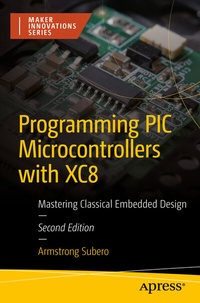
Programming PIC Microcontrollers with XC8
Description

More details
Other editions
Additional editions
Previous edition

Person
Armstrong Subero began learning electronics at the age of 8. One of the happiest memories in his childhood was when he finally figured out how to make a light bulb. It took off from there as he taught himself more advanced topics in electronics, before delving into computer architecture, and eventually discovering the joys of microcontrollers and FPGAs. From there he honed his C programming skills and learned a myriad of languages and technologies.
Armstong currently works for the Ministry of National Security in Trinidad and Tobago, and writes software, design circuits, courses, robots, and software for embedded systems at angelstemlabs.com. He is also a contributing author to Free Code Camp and has degrees in Computer Science and Liberal Arts and Sciences from Thomas Edison State University where he also studies Mathematics and Natural Science. He is the author of Programming PIC Microcontrollers in XC8 , Codeless Data Structures and Algorithms , and Programming Microcontrollers with Python published by Apress Media LLC.
Content
Chapter 1: Preparing For Development.- Chapter 2: The C Programming Language.- Chapter 3: Basic Electronics for Embedded Systems.- Chapter 4: PIC® Microcontrollers..- Chapter 5: Input and Output.- Chapter 6: Interfacing Actuators.- Chapter 7: Interrupts, Timers, Counters and PWM.- Chapter 8: USART, SPI and I2C.- Chapter 9: Interfacing Displays.- Chapter 10: ADC and DAC.- Chapter 11: CLC, NCO, Comparator and FVR.- Chapter 12: Wi-Fi and Bluetooth.- Chapter 13: Watchdog Timer and Low Power.- Chapter 14: PIC® Microcontroller Projects.
