

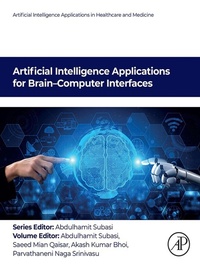
Artificial Intelligence Applications for Brain-Computer Interfaces
Published on 10. January 2025
316 pages
978-0-443-33415-3 (ISBN)
Description

Artificial Intelligence Applications for Brain-Computer Interfaces focuses on the advancements, challenges, and prospects of future technologies involving noninvasive brain-computer interfaces (BCIs). It includes the processing and analysis of multimodal signals, integrated computation-acquisition devices, and implantable neuro techniques. This book not only provides cross-disciplinary research in BCI but also presents divergent applications on telerehabilitation, emotion recognition, neuro-rehabilitation, cognitive workload assessments, and ambient assisted living solutions. In 15 chapters, this book describes how BCIs connect the brain with external devices like computers and electronic gadgets. It analyzes the neural signals from the brain to obtain insights from the brain patterns using multiple noninvasive wearable sensors. It gives insight into how sensor outcomes are processed through machine-intelligent models to draw inferences. Each chapter starts with the importance, problem statement, and motivation. A description of the proposed methodology is provided, and related works are also presented. Each chapter can be read independently, and therefore, the book is a valuable resource for researchers, health professionals, postgraduate students, postdoc researchers, and academicians in the fields of BCI, prosthesis, computer vision, and mental state estimation, and all those who wish to broaden their knowledge in the allied field.
- Focuses on the advancements, challenges, and prospects for future technologies over noninvasive brain computer interfaces (BCIs), including the processing and analysis of multimodal signals, integrated calculation-acquisition devices, and implantable technologies.
- Presents theories, algorithms, realizations, applications, approaches, and challenges that will have their impact and contribution in the design and development of modern and effective BCIs.
- Assists in understanding the predominance of BCI technology in various applications.
More details
Other editions
Additional editions
Abdulhamit Subasi | Saeed Mian Qaisar | Akash Kumar Bhoi
Artificial Intelligence Applications for Brain-Computer Interfaces
Book
01/2025
Academic Press
€160.93
Shipment within 15-20 days
Content
1. Introduction to brain-computer interface: research trends and applicationsSAEED MIAN QAISAR AND ABDULHAMIT SUBASI2. Preprocessing and feature extraction techniques for brain-computer interfaceABDULHAMIT SUBASI AND SAEED MIAN QAISAR3. Emotional state monitoring and applications with brain-computer interfacesEVIN SAHIN SADIK4. Hand kinematics and decoding hindlimb kinematics using local field potentials using a deep neural network decoding frameworkJIGAR SARDA, MILIND SHAH, ROHAN VAGHELA, DARSH VAISHNANI AND HIRVA PATEL5. Closed-loop brain_computer interfaces for musculoskeletal impulse predictionK. RANJINI, POOJA GOUD, AMBESHWAR KUMAR AND R. MANIKANDAN6. Classification of motor imagery tasks in brain-computer interface using ensemble learningABDULHAMIT SUBASI AND SAEED MIAN QAISAR7. The application of brain_computer interface in Alzheimer's disease studies based on machine learning algorithmsHELIA GIVIAN8. Brain_computer interfaces and deep learning methods for cognitive impairmentsSEDA SASMAZ KARACAN9. Prospects and challenges in decoding consumer behavior using neurotechnologyTARA CHAND, VASUNDHARAA S. NAIR, PARVATHANENI NAGA SRINIVASU AND VINOD JANGIR KUMAR10. Electroencephalography-based emotion recognition with empirical mode decomposition and ensemble machine learning methodsABDULHAMIT SUBASI, MUHAMMED ENES SUBASI AND SAEED MIAN QAISAR11. Brain-computer interfaces for security and authenticationMOUMITA CHANDA, OLIVE MAZUMDER, SOUVIK PAUL AND TAWFIKUR RAHMAN12. A case study on artifical intelligence based data processing in passive brain-computer interfacePARVEEN KUMAR SEKHARAMANTRY, USAMA A. SYED, UMER FAROOQ AND DINH DUNG VAN13. Analyzing eyewitness recognition accuracy using event-related potential and eye-tracking analysis: an experimental investigationSAMIKSHA DAS, DERICK H. LINDQUIST, TARA CHAND AND MOHITA JUNNARKAR14. Ambient assisted living through passive brain-computer interface technology for assisting paralyzed peopleSANCHITA GOSWAMI, PRITHU BANIK, ANIKET KUMAR MEENA AND ANJANEYULU BENDI15. Challenges and future directions in brain-computer interface research for exoskeletons usageHEMANTH P.K. SUDHANI, PRABHAKAR VATTIKUTI AND DASARI REKHA
