

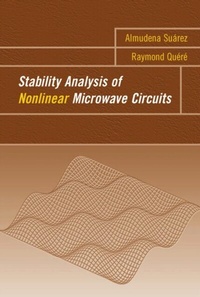
Stability Analysis of Nonlinear Microwave Circuits
1st Edition
Published on 1. January 2002
356 pages
978-1-58053-586-1 (ISBN)
Description

If you are working with circuits based on solid state devices, diodes and transistors, designing radio-frequency circuits, or regularly involved in any area requiring a functional knowledge of nonlinear oscillations and stability concepts, this book provides you with an indepth look at the very complex and often unforeseen behavior of nonlinear circuits. You find detailed coverage of circuits used in power amplifiers, voltage-controlled oscillators, frequency dividers, frequency multipliers, self oscillating mixers, and phased-locked loops.
More details
Other editions
Additional editions
Raymond Quere | Almudena Suarez
Stability Analysis of Nonlinear Microwave Circuits
Book
12/2002
Artech House Publishers
€135.19
Shipment within 10-20 days
Content
- Intro
- Stability Analysis of Nonlinear Microwave Circuits
- Contents v
- Preface xi
- Acknowledgments xv
- 1 Steady-State Solutions of Nonlinear Circuits 1
- 1.1 Autonomous and Nonautonomous Dynamical Systems 2
- 1.2 Oscillations in Linear and Nonlinear Systems 10
- 1.3 Phase-Space Representation of Solutions 16
- 1.4 Stability of Limit Sets 29
- 1.5 Poincare Map 44
- 1.6 Entrainment: Phase-Locked Solutions in the Torus 52
- References 57
- 2 Nonlinear Analysis Techniques 61
- 2.1 Time-Domain Simulation 62
- 2.2 Harmonic Balance for Nonautonomous Circuits 66
- 2.3 Harmonic Balance for Autonomous and Sychronized Circuits 75
- 2.4 Envelope Transient 91
- 2.5 Continuation Techinque for Tracing Solution Curves Versus a Circuit Parameter 96
- 2.6 Analysis of Autonomous and Synchronized Circuits in Closed Harmonic-Balance Programs 100
- References 112
- 3 Local Stability Analysis 117
- 3.1 Stability Concept for Linear and Nonlinear Circuits 118
- 3.2 Derivation of the Characteristic System in the Harmonic-Balance Formulation 131
- 3.3 The Open-Loop Approach 152
- References 171
- Appendix 3A 172
- 4 Bifurcation Analysis of Nonlinear Circuits 177
- 4.1 Local Bifurcations 178
- 4.2 Bifurcations of the Poincare Map 196
- 4.3 Global Bifurcations 211
- 4.4 Analysis of Bifurcations from the Harmoinc-Balance Characteristic System 216
- 4.5 Harmonic-Balance Analysis of Bifurcations with the Aid of an Auxiliary Generator 227
- References 240
- 5 Global Stability of Microwave Circuits 243
- 5.1 Global Behavior of Free-Running Oscillators 244
- 5.2 Global Behavior of Synchronized Oscillators 247
- 5.3 Global Behavior of Frequency Dividers by Two 252
- 5.4 Global Behavior of Self-Oscillating Mixers 266
- 5.5 Global Behavior of Frequency Doublers 273
- 5.6 Global Behavior of Phase-Locked Loops 278
- References 292
- 6 Bifurcaion Routes to Chaos 295
- 6.1 Homoclinicity 296
- 6.2 Quasiperiodic Route to Chaos 301
- 6.3 Period-Doubling Route to Chaos 305
- 6.4 Torus-Doubling Route to Chaos 311
- 6.5 Intermittence 315
- References 320
- About the Authors 323
- Index 325
