

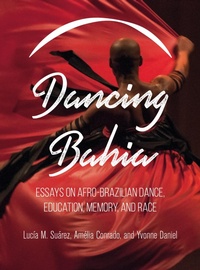
Dancing Bahia
Description

Dancing Bahia is an edited collection that draws together the work of leading scholars, artists and dance activists from Brazil, Canada and the United States to examine the particular ways in which dance has responded to sociopolitical notions of race and community, resisting stereotypes, and redefining African Diaspora and Afro-Brazilian traditions.
Using the Brazilian city of Salvador da Bahia as its focal point, this volume brings to the fore questions of citizenship, human rights and community building. The essays within are informed by both theory and practice, as well as black activism that inspires and grounds the research, teaching and creative output of dance professionals from, or deeply connected to, Bahia.
More details
Other editions
Additional editions
Persons
Lucía M. Suárez is associate professor and director of Latino/a studies in the Department of World Languages and Cultures at Iowa State University.
Amélia Conrado is a professor at the Federal University of Bahia's School of Dance.
Yvonne Daniel is professor emerita of dance and Afro-American studies at Smith College.
Content
Introduction
Part I: Bahian Dance in Action
Chapter 1: Afro-Brazilian Dance as Black Activism
Amélia Conrado
Chapter 2: Dance Artistry and Bahian Forms of Citizenship: Isaura Oliveira and Malinké
Yvonne Daniel
Part II: Memory, Resistance, and Survival through Dance Education
Chapter 3: Pedagogies of the Body within African Matrix Education of Salvador, Brazil: Perspectives and Challenges of an Emancipatory Project
Pilar Echeverry Zambrano
Chapter 4: African Matrix Dance: Repertoire Options for Approaching Race and Ethnic Relations in Brazilian Schools
Piedade Lino Videira
Chapter 5: After-School Samba: Cultural Memory and Ownership in the Wake of UNESCO Recognition as Intangible Heritage of Humanity
Danielle Robinson and Jeff Packman
Part III: Reflections: Paths of Courage and Connections
Chapter 6: Why Not Me? Reflections on Afro-Dance and Law No. 10.639
Nadir Nóbrega Oliveira
Chapter 7: Dancing into the Politics of Race: From Bahia to Kingston
Deborah A. Thomas
Part IV: Defying Erasure through Dance
Chapter 8: Negotiations: Afro-Bahian Memory, Storytelling, and Dance
Lucía M. Suárez
