

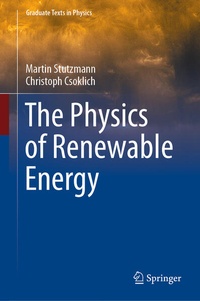
The Physics of Renewable Energy
Description

More details
Other editions
Additional editions
Persons
Martin Stutzmann is Professor at the Technical University of Munich. His education was:
- Habilitation, Philipps-Universität Marburg, Germany, 1990
- Ph.D. in Physics, Philipps-Universität Marburg, Germany, 1983
- Diploma in Physics, Philipps-Universität Marburg, Germany, 1982
- 1980 Licence de Physique, University Paris VII, France.
His professional experience includes:
- 2009-2012 Dean, Physics Department, TUM
- 2000-2002 Dean of Studies, Physics Department, TUM
- 1993-2022 Chair for Experimental Semiconductor Physics, Walter Schottky Institute, TUM
- 1985-1993 Permanent Member of Research Staff, Max Planck Institute for Solid State Research, Stuttgart- 1983-1985 Postdoc, Xerox Palo Alto Research Center, USA
- 1982-1983 Research Scholar, Stanford University, USA.
His scientific interests cover:
- Epitaxy of wide bandgap semiconductors (III-nitrideand II-VI-oxide thin films and nanowires)
- Sustainable materials for photovoltaics and thermoelectrics
- Hybrid organic/inorganic semiconductor systems
- Electronic and optical properties of semiconductors
- Advanced spin resonance techniques for defect spectroscopy and quantum computation
- Carbon-based bioelectronics
- Novel applications of semiconductors for sensors, biosensors, and photo-catalysis.He received the following awards/honors and external offers:
- 1976 Fellow, Studienstiftung des Deutschen Volkes
- 1988 Walter Schottky Prize, German Physical Society
- 1999 Sir Nevill Mott Lecture, Int. Conf. Amorphous and Microcryst. Semiconductors
- 2001 call as Director, Institute of Photovoltaics, Research Center Jülich, and Chair for Photovoltaics, RWTH Aachen, Germany- 2004 call as Senior Kodosky Constellation Chair, Rensselaer Polytechnic Institute, New York, USA
- 2006 Fellow, American Physical Society
- 2015 Werner Heisenberg Medal of the Alexander von Humboldt Foundation for the Promotion of International Scientific Collaborations
- 2017 Chair Professor, Soochow University, Suzhou, China.
He has been Inventor and Co-inventor in 21 patents.
His publication record includes more than 750 papers with an overall number of citations in peer-reviewed journals of 30.000. His current Hirsch index is h=80 (WoS).
Christoph Csoklich is a young scientist and holds a Ph.D. degree from ETH Zurich.
His professional experience includes:
- 2022 scientist, Paul Scherrer Institute, Switzerland- 2018-2021 research scholar, Paul Scherrer Institute, Switzerland
- 2016 Potentiostat development with Prof. Linhardt, TU Wien, Austria
- 2010 Internship in sustainable architecture and construction at GrAT, TU Wien, Austria
His education is:
- 2022 Ph.D.in Chemistry, Eidgenössische Technische Hochschule Zürich, Switzerland- 2016 M.Sc. in Physics, TUM, Germany
- 2015 B.Sc. in Physics, Technische Universität Wien, Austria
His scientific interests concern:
- Functional materials for PEFC gas diffusion layers
- Catalysts for the OER in fuel cells and catalyst activity determination
- Electrochemical energy conversion and storage systems
- Energy and heat storage systems
- Power grid operation and energy market.
