

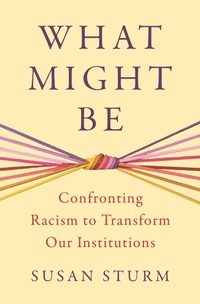
What Might Be
Confronting Racism to Transform Our Institutions
1st Edition
Published on 5. February 2025
328 pages
978-0-691-24675-8 (ISBN)
Description

How to turn the paradoxes built into anti-racism work into drivers of learning and change
Even as anti-racism practices seemed to be gaining momentum, the nation shows signs of falling back into long-standing patterns of racial injustice and inequality. Leaders who introduce anti-racist approaches to their organizations often face backlash from white colleagues and skepticism from colleagues of color, leading to paralysis. In What Might Be, Susan Sturm explores how to navigate the contradictions built into our racialized history, relationships, and institutions. She offers strategies and stories for confronting racism within predominantly white institutions, describing how change agents can move beyond talk to build the architecture of full participation.
Sturm argues that although we cannot avoid the contradictions built into efforts to confront racism, we can make them into engines of cross-racial reflection, bridge building, and institutional reimagination, rather than falling into a Groundhog Day-like trap of repeated failures. Drawing on her decades of experience researching and working with institutions to help them become more equitable and inclusive, Sturm identifies three persistent paradoxes inherent in anti-racism work. These are the paradox of racialized power, whereby anti-racism requires white people to lean into and yet step back from exercising power; the paradox of racial salience, which means that effective efforts must explicitly name and address race while also framing their goals in universal terms other than race; and the paradox of racialized institutions, which must drive anti-racism work while simultaneously being the target of it. Sturm shows how people and institutions can cultivate the capacity to straddle these contradictions, enabling those in different racial positions to discover their linked fate and become the catalysts for long-term change.
The book includes thoughtful and critical responses from Goodwin Liu, Freeman Hrabowski, and Anurima Bhargava.
Even as anti-racism practices seemed to be gaining momentum, the nation shows signs of falling back into long-standing patterns of racial injustice and inequality. Leaders who introduce anti-racist approaches to their organizations often face backlash from white colleagues and skepticism from colleagues of color, leading to paralysis. In What Might Be, Susan Sturm explores how to navigate the contradictions built into our racialized history, relationships, and institutions. She offers strategies and stories for confronting racism within predominantly white institutions, describing how change agents can move beyond talk to build the architecture of full participation.
Sturm argues that although we cannot avoid the contradictions built into efforts to confront racism, we can make them into engines of cross-racial reflection, bridge building, and institutional reimagination, rather than falling into a Groundhog Day-like trap of repeated failures. Drawing on her decades of experience researching and working with institutions to help them become more equitable and inclusive, Sturm identifies three persistent paradoxes inherent in anti-racism work. These are the paradox of racialized power, whereby anti-racism requires white people to lean into and yet step back from exercising power; the paradox of racial salience, which means that effective efforts must explicitly name and address race while also framing their goals in universal terms other than race; and the paradox of racialized institutions, which must drive anti-racism work while simultaneously being the target of it. Sturm shows how people and institutions can cultivate the capacity to straddle these contradictions, enabling those in different racial positions to discover their linked fate and become the catalysts for long-term change.
The book includes thoughtful and critical responses from Goodwin Liu, Freeman Hrabowski, and Anurima Bhargava.
More details
Other editions
Additional editions
Book
02/2025
Princeton University Press
€34.66
Shipment within 10-20 days
Persons
Susan Sturm is the George M. Jaffin Professor of Law and Social Responsibility and the Founding Director of the Center for Institutional and Social Change at Columbia Law School. She is the coauthor (with Lani Guinier) of Who's Qualified? A New Democracy Forum on the Future of Affirmative Action.
Content
- Cover
- Contents
- Author's Note
- Introduction. Earl Lewis and Nancy Cantor
- 1. The Paradoxes of Anti-Racism
- 2. Stuck in Groundhog Day
- 3. The Promise of Paradoxical Possibility
- 4. Forging Linked Fate
- 5. Building Bridges, Weaving Dreams
- 6. Repurposing Power
- 7. Anti-Racism over the Long Haul
- Acknowledgments
- Commentary on Susan Sturm's What Might Be / Freeman Hrabowski
- Commentary: Toward Inclusive Pedagogy / Goodwin Liu
- Commentary: Institutional and Cultural Levers of Racial Transformation: Learnings / Anurima Bhargava
- Notes
- Bibliography
- Index
