

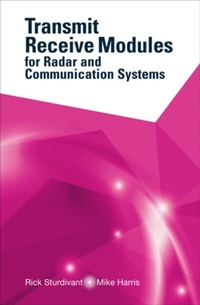
Transmit Receive Modules for Radar and Communication Systems
1st Edition
Published on 30. November 2015
268 pages
978-1-60807-980-3 (ISBN)
Description

The use of electronically scanned phased arrays is increasing in systems such as radar, wireless networks, and satellite ground terminals. An important and necessary component for these systems is the transmit receive (T/R) module, which provides the amplification and electronic beam steering that is required for proper function. This new resource presents a comprehensive overview of all design, fabrication, integration, and implementation issues associated with T/R modules for radar and communications.This book provides engineers and researchers with practical designs and 44 examples of analysis, circuits, and components used in T/R modules. It also provides a solid explanation of the theory for how T/R modules operate and how they can be optimized. In addition, this book shows how the latest technical advances in silicon germanium (SiGe) and gallium nitride (GaN) are allowing levels of performance that were previously unachievable. The book concludes with informative chapters on testing, cost considerations, and the future of next generation T/R modules.
More details
Other editions
Additional editions
Mike Harris | Rick Sturdivant
Transmit Receive Modules for Radar and Communication Systems
Book
11/2015
Artech House Publishers
Unfortunately, price unknown
Available (delivery time upon request)
Content
- Intro
- Contents
- Preface
- Acknowledgments
- 1 Phased Arrays
- 1.1 Phased Arrays in Radar and Communica
- 1.2 Antennas
- 1.3 Antenna Patterns and Line Arrays
- 1.4 Electronically Steerable Antennas
- 1.5 Radar Equation for Targets
- 1.6 Radar Equation for Weather
- 1.7 Phased Arrays for Communication Syst
- 1.8 Conclusions
- Problems
- References
- 2 Transmit/Receive Modules
- 2.1 Introduction to Transmit/Receive Mod
- 2.2 Early T/R Module Development Efforts
- 2.3 MMIC-Based T/R Modules
- 2.4 T/R Module Performance Requirements
- 2.5 T/R Module Components
- 2.5.1 Transmit/Receive Switches
- 2.5.2 Phase Shifter
- 2.5.3 Attenuators
- 2.5.4 Core Chip
- 2.5.5 Driver Amplifier
- 2.5.6 Power Amplifier
- 2.5.7 Circulator or Duplexer
- 2.5.8 Limiter or Receive Protect Circuit
- 2.5.9 Low-Noise Amplifier
- 2.6 Module Control and Power Conditionin
- 2.7 Conclusions
- Problems
- References
- 3 Semiconductors for T/R Modules
- 3.1 Introduction
- 3.2 Semiconductor Materials
- 3.2.1 GaAs
- 3.2.2 Heterostructures
- 3.2.3 SiC
- 3.2.4 GaN
- 3.2.5 InP
- 3.2.6 SiGe
- 3.3 RF Semiconductor Wafer Fabrication P
- 3.3.1 Isolation
- 3.3.2 Ohmic Contacts
- 3.3.3 Gate Formation
- 3.3.4 Dielectric Deposition
- 3.3.5 Electroplating
- 3.3.6 Air Bridges
- 3.4 Active Devices
- 3.4.1 GaAs MESFETs
- 3.4.2 GaAs PHEMTs
- 3.4.3 GaN HEMTs
- 3.5 MMICs
- 3.6 Conclusions
- Problems
- References
- 4 Signal Integrity Issues in T/R Modules
- 4.1 Introduction to Signal Integrity
- 4.2 Chip-Level Interconnects
- 4.2.1 Wire Bonding Methods
- 4.2.2 Wire Bond Modeling
- 4.2.3 Flip-Chip Methods
- 4.3 Package/Module-Level Interconnect
- 4.3.1 Module Interconnects
- 4.3.2 SMT Package Interconnects
- 4.4 Transmission Line Interconnects
- 4.5 Coupling Between Interconnects
- 4.6 Vertical Transition Interconnects
- 4.7 Module Resonances
- 4.8 Conclusions
- Problems
- References
- 5 Materials for T/R Modules
- 5.1 Introduction to Materials
- 5.2 Electrical Parameters and Their Meas
- 5.2.1 Dielectric Constant
- 5.2.2 Loss Tangent
- 5.2.3 Measurement of Dielectric Constant
- 5.2.4 Metal Electrical Conductivity
- 5.3 Mechanical Parameters
- 5.3.1 Thermal Conductivity
- 5.4 Ceramic Materials
- 5.4.1 Thin-Film Ceramic
- 5.4.2 Thick-Film Ceramic
- 5.4.3 Thermally Enhanced Thick-Film Proc
- 5.4.4 High-Temperature Co-Fired Ceramic
- 5.4.5 Low-Temperature Co-Fired Ceramic (
- 5.5 Laminate Packaging
- 5.5.1 Laminate Board Fabrication
- 5.5.2 High-Performance Laminate Material
- 5.5.3 Liquid Crystal Polymers
- 5.5.4 MCM-L Laminate Multichip Modules
- 5.6 Conclusions
- Problems
- References
- 6 Heat Issues and Solutions for T/R Module
- 6.1 Introduction to Thermal Issues and Solutions
- 6.2 Heat Flux in MMIC High-Power Amplifiiers
- 6.3 Amplifier Efficiency and Dissipated Thermal Power
- 6.4 Thermal Resistance and Device Junction Temperature
- 6.5 Example of Heat Dissipated by Componentss in a T/R Module
- 6.6 Reliability Calculations
- 6.7 Diamond-Enhanced GaN High-Power Amplifers for T/R Modules
- 6.8 Thermal Simulations Using SPICE
- 6.9 Thermal Measurements
- 6.9.1 Electrical Test Methods
- 6.9.2 Optical Methods
- 6.9.3 Temperature Measurements Using Liquid Crystal Thermography
- 6.9.4 Thermal Design Using Surrogate Validation Chips
- 6.10 Conclusions
- Problems
- References
- 7 MMIC Fabrication and T/R Module Manufact
- 7.1 Introduction
- 7.2 MMIC Fabrication
- 7.2.1 MMIC Facilities
- 7.2.2 MMIC Fabrication Processes
- 7.2.3 MMIC Foundry Procedures
- 7.3 T/R Module Manufacturing
- 7.3.1 T/R Module Manufacturing Facilities
- 7.3.2 T/R Module Manufacturing Processes
- 7.4 Conclusions
- Problems
- References
- 8 Testing of MMICs and T/R Modules
- 8.1 Introduction to Testing
- 8.2 MMIC Testing
- 8.2.1 Incoming Materials Testing
- 8.2.2 In-Process Testing
- 8.2.3 On-Wafer RF Testing
- 8.2.4 MMIC Screening Tests
- 8.2.5 MMIC Reliability Testing
- 8.3 T/R Module Specifications
- 8.4 T/R Module Testing
- 8.4.1 Key Electrical Parameters
- 8.4.2 Example of Key Parameter Requirements on an X-Band T/R Module
- 8.4.3 Automated Electrical Test Set
- 8.5 Conclusions
- Problems
- References
- 9 MMIC and T/R Module Cost
- 9.1 Introduction
- 9.2 MMIC Cost
- 9.2.1 MMIC Wafer Fabrication Cost
- 9.2.2 Wafer Fabrication Process Yield
- 9.2.3 Wafer Diameter Impact on MMIC Cost
- 9.2.4 Impact of MMIC Fabrication Facility Loading on Cost
- 9.2.5 MMIC Cost Based on Area or Output Power
- 9.3 T/R Module Cost
- 9.4 Cost Reduction
- 9.4.1 MMIC Cost Reduction
- 9.4.2 T/R Module Cost Reduction
- 9.5 Conclusions
- Problems
- References
- 10 Next-Generation T/R Modules
- 10.1 Introduction
- 10.2 Single-Chip T/R Module
- 10.3 Wafer-Scale Phased Array
- 10.4 Si-CMOS: The Lowest-Cost Single-Chip T/R
- 10.5 Digital Beamforming
- 10.6 Hybrid Digital/Analog Beam Forming
- 10.7 Switch Beam and Butler Matrix Phased Arrays
- 10.8 Highly Integrated Packaging of T/R Modules
- 10.9 Path to Low-Cost Systems: Open Architectures
- 10.10 Conclusions
- Problems
- References
- About the Authors
- Index
