

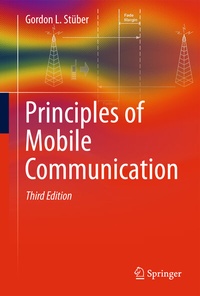
Principles of Mobile Communication
3rd Edition
Published on 8. September 2011
XXIII, 830 pages
978-1-4614-0364-7 (ISBN)
Description

Principles of Mobile Communication, Third Edition, is an authoritative treatment of the fundamentals of mobile communications. This book stresses the "fundamentals" of physical-layer wireless and mobile communications engineering that are important for the design of "any" wireless system. This book differs from others in the field by stressing mathematical modeling and analysis. It includes many detailed derivations from first principles, extensive literature references, and provides a level of depth that is necessary for graduate students wishing to pursue research on this topic. The book's focus will benefit students taking formal instruction and practicing engineers who are likely to already have familiarity with the standards and are seeking to increase their knowledge of this important subject.
Major changes from the second edition:
1. Updated discussion of wireless standards (Chapter 1).
2. Updated treatment of land mobile radio propagation to include space-time correlation functions, mobile-to-mobile (or vehicle-to-vehicle) channels, multiple-input multiple-output (MIMO) channels, improved simulation models for land mobile radio channels, and 3G cellular simulation models.
3. Updated treatment of modulation techniques and power spectrum to include Nyquist pulse shaping and linearized Gaussian minimum shift keying (LGMSK).
4. Updated treatment of antenna diversity techniques to include optimum combining, non-coherent square-law combining, and classical beamforming.
5. Updated treatment of error control coding to include space-time block codes, the BCJR algorithm, bit interleaved coded modulation, and space-time trellis codes.
6. Updated treatment of spread spectrum to include code division multiple access (CDMA) multi-user detection techniques.
7. A completely new chapter on multi-carrier techniques to include the performance of orthogonal frequency division multiplexing (OFDM) on intersymbol interference (ISI) channels, OFDM residual ISI cancellation, single-carrier frequency domain equalization (SC-FDE), orthogonal frequency division multiple access (OFDMA) and single-carrier frequency division multiple access (SC-FDMA).
8. Updated discussion of frequency planning to include OFDMA frequency planning.
9. Updated treatment of CDMA cellular systems to include hierarchical CDMA cellular architectures and capacity analysis.
10. Updated treatment of radio resource management to include CDMA soft handoff analysis.
Includes numerous homework problems throughout.
Major changes from the second edition:
1. Updated discussion of wireless standards (Chapter 1).
2. Updated treatment of land mobile radio propagation to include space-time correlation functions, mobile-to-mobile (or vehicle-to-vehicle) channels, multiple-input multiple-output (MIMO) channels, improved simulation models for land mobile radio channels, and 3G cellular simulation models.
3. Updated treatment of modulation techniques and power spectrum to include Nyquist pulse shaping and linearized Gaussian minimum shift keying (LGMSK).
4. Updated treatment of antenna diversity techniques to include optimum combining, non-coherent square-law combining, and classical beamforming.
5. Updated treatment of error control coding to include space-time block codes, the BCJR algorithm, bit interleaved coded modulation, and space-time trellis codes.
6. Updated treatment of spread spectrum to include code division multiple access (CDMA) multi-user detection techniques.
7. A completely new chapter on multi-carrier techniques to include the performance of orthogonal frequency division multiplexing (OFDM) on intersymbol interference (ISI) channels, OFDM residual ISI cancellation, single-carrier frequency domain equalization (SC-FDE), orthogonal frequency division multiple access (OFDMA) and single-carrier frequency division multiple access (SC-FDMA).
8. Updated discussion of frequency planning to include OFDMA frequency planning.
9. Updated treatment of CDMA cellular systems to include hierarchical CDMA cellular architectures and capacity analysis.
10. Updated treatment of radio resource management to include CDMA soft handoff analysis.
Includes numerous homework problems throughout.
More details
Series
Edition
Third Edition 2012
Language
English
Place of publication
New York
United States
Publishing group
Springer US
Target group
Primary & secondary/elementary & high school
Illustrations
XXIII, 830 p.
File size
16,97 MB
ISBN-13
978-1-4614-0364-7 (9781461403647)
DOI
10.1007/978-1-4614-0364-7
Schweitzer Classification
Other editions
Additional editions
Gordon L. Stüber
Principles of Mobile Communication
Book
09/2011
3rd Edition
Springer
€119.99
Article exhausted; check for reprint
Person
Dr. Gordon Stuber
has over 250 refereed publications in journals and conferences in these areas. He is author of the textbook Principles of Mobile Communication, Springer 2nd Edition 2001. Since 1986, he has been with the School of Electrical and Computer Engineering, Georgia Institute of Technology. He is an internationally recognized leader in wireless physical communications and wireless systems with numerous refereed publications in these areas.
Content
Introduction.- Propagation Modeling.- Co-channel Interference.- Digital Modulation with Power Spectrum.- Digital Signaling on Flat Fading Channels.- Multi-antenna Techniques.- Equalization and Interference Cancelation.- Error Control Coding.- Spread Spectrum Techniques.- Multi-carrier Techniques.- Frequency Planning Techniques.- CDMA Cellular Systems.- Radio Resource Management.- Appendix: Probablitiy and Random Processes.
