

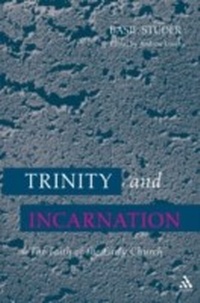
Trinity and Incarnation
The Faith of the Early Church
1st Edition
Published on 1. February 1994
290 pages
978-0-567-24809-1 (ISBN)
Description

A fresh examination of the history of early Christian doctrine, by one of the world's leading authorities, which sets its development in the political and cultural context of the Roman Empire.
More details
Edition
1. Auflage
Language
English
Place of publication
London
United Kingdom
Publishing group
Bloomsbury Publishing PLC
ISBN-13
978-0-567-24809-1 (9780567248091)
Copyright in bibliographic data and cover images is held by Nielsen Book Services Limited or by the publishers or by their respective licensors: all rights reserved.
Schweitzer Classification
Other editions
Additional editions
Book
02/1994
T.& T.Clark Ltd
€79.30
Shipment within 3-4 weeks
Content
- Intro
- Contents
- Foreword to the English Edition
- Preface
- Abbreviations
- Introduction
- 1. Theologia' and 'Oikonomia'
- 2. The basis of a historical and at the same time theological answer
- Part One: THE PRE-NICENE PERIOD
- 1 A SURVEY OF PRE-NICENE CHRISTOLOGICAL PROCLAMATION
- I. The pre-Nicene period in general
- II. The essential features of the pre-Nicene proclamation of Christ
- III. The cultural background of the pre-Nicene proclamation of Christ
- 2 THE MYSTERY OF CHRIST IN PRAYER AND EXHORTATION
- I. Narratio
- II. Doxology
- III. Epiclesis
- IV. The beginnings of the baptismal creed
- 3 THE BEGINNINGS OF THEOLOGICAL REFLECTION ON GOD AND HIS SALVATION
- I. The perspective of the history of salvation in general
- II. The victorious ascension of the Saviour
- III. The theology of the names
- IV. Early Christian conceptions of pre-existence
- 4 THE SOTERIOLOGICAL VISION OF THE GREEK APOLOGISTS
- I. The salvation-historical vision of the Logos-theology
- II. Towards a deeper philosophical understanding of the Logos-theology
- III. The doctrine of the prophetic Spirit and the messianic gift
- 5 IRENAEUS' ANTIGNOSTIC DOCTRINE OF SALUS CARNIS
- I. The incarnation as the foundation of the unity of the history of salvation
- II. The trinitarian structure of the history of salvation
- 6 THE ANTIMONARCHIAN CONCEPTION OF THE HISTORY OF SALVATION IN TERTULLIAN, HIPPOLYTUS AND NOVATIAN
- I. The incarnation as the basis of resurrection in Tertullian
- II. Rooting the history of salvation in the eternal Trinity
- 7 ORIGEN'S CHRISTIAN GNOSIS
- I. Origen's systematic answer to the questions of his time
- II. Supplements necessitated by the 'regula fidei'
- 8 THE APPROACH TO NICEA
- I. The search for a balanced distinction of the hypostases
- II. The beginnings of the Logos-Sarx Christology
- III. The crisis of the cosmological Logos-theology
- Part Two: THE NICENE TURNING POINT
- 9 NICE A - STARTING POINT FOR A NEW THEOLOGY
- I. The solution of the Origenist crisis
- II. The consequences for further trinitarian discussion
- III. The Nicene attempt at the christological question
- 10 THE NICENE THEOLOGY OF ATHANASIUS AND HILARY
- I. The deifying incarnation according to Athanasius
- II. The glorifying incarnation according to Hilary
- 11 THE SPIRITUALITY OF THE IMPERIAL CHURCH
- I. Christus - Imperator
- II. Christus - Rex gloriae
- III. Christus - Omnia
- 12 THE FORMULATION OF TRINITARIAN FAITH BY THE CAPPADOCIANS
- I. Historical orientation
- II. The dogmatic formula mia ousia - treis hypostaseis
- III. The search for a further explanation of the divine unity
- IV. The unfolding of pneumatology
- 13 THE GENERAL RECEPTION OF THE NICENE FAITH IN ABOUT 380
- I. The interpretation of the Nicene faith by the council of Constantinople (381)
- II. The acceptance of the Nicene faith by the Western Churches
- III. The acceptance of the Nicene faith by the Eastern Churches
- 14 THE REVELATION OF THE LOVE OF THE HUMBLE GOD ACCORDING TO AUGUSTINE
- I. The most important writings on the Trinity and on Christ
- II. The main lines of Augustine's doctrine of the Trinity
- III. St. Augustine's Christocentrism
- IV. The trinitarian and christological terminology
- Part Three: UNDER THE SWAY OF CHALCEDON
- 15 THE BEGINNINGS OF THE CHRISTOLOGICAL QUESTION
- I. The heritage of the first three centuries
- II. The development of the christological problem from 360
- 16 THE GREAT CHRISTOLOGICAL TRADITIONS
- I. The Antiochene Tradition
- II. The Alexandrine Tradition
- III. The Latin Tradition
- 17 THE FAITH OF CHALCEDON
- I. The council of Chalcedon as historical event
- II. The Definition of Chalcedon (DS 300ff)
- III. The sources of the faith of Chalcedon
- IV. The theological significance of the faith of Chalcedon
- 18 POST-CHALCEDONIAN THEOLOGY
- I. The unfolding of Chalcedonian Christology up to 553
- II. The christological controversies of the seventh century
- III. The repercussions of the christological controversies on the doctrine of the Trinity
- RETROSPECT AND PROSPECT
- I. A complex history
- II. Dogma as the result of 'negative' demarcation
- III. The ever-fresh reinterpretation of the baptismal faith
- Bibliography
- Index of Modern Authors
- A
- B
- C
- D
- E
- F
- G
- H
- I
- J
- K
- L
- M
- N
- O
- P
- Q
- R
- S
- T
- U
- V
- W
- Y
- Z
- Index of Names
- A
- B
- C
- D
- E
- F
- G
- H
- I
- J
- L
- M
- N
- O
- P
- R
- S
- T
- V
- Z
- Subject Index
- A
- B
- C
- D
- E
- F
- G
- H
- I
- J
- K
- L
- M
- N
- O
- P
- Q
- R
- S
- T
- U
- V
- W
