

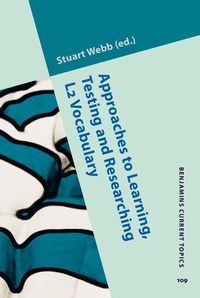
Approaches to Learning, Testing and Researching L2 Vocabulary
1st Edition
Published on 6. August 2020
240 pages
978-90-272-6086-4 (ISBN)
Description

This volume brings together a collection of chapters focused on the learning, testing, and researching of L2 vocabulary by leading international researchers including Paul Nation, Batia Laufer, Frank Boers, Elke Peters, Ana Pellicer-Sanchez, Anna Siyanova-Chanturia, and Stuart Webb. Questions that are examined include: Is it useful to read a book to learn vocabulary? Which types of input encountered outside of the classroom contribute most to vocabulary knowledge? What are the most useful words to learn to understand the academic spoken language in mathematics, biology, and engineering lectures? Does writing words contribute to vocabulary learning? What should a test measuring the skill of guessing from context consist of? Should loan words be included in vocabulary tests? How should we evaluate vocabulary learning that occurs through watching captioned video? How has eye-tracking been used in vocabulary research? Together, the chapters in this volume highlight innovation in vocabulary studies and many directions for researching, testing, and learning words. Originally published as special issue of ITL - International Journal of Applied Linguistics 169:1 (2018)
More details
Other editions
Additional editions
Book
08/2020
John Benjamins Publishing Co
€114.09
Shipment within 10-15 days
Content
- Intro
- Approaches to Learning, Testing and Researching L2 Vocabulary
- Editorial page
- Title page
- Copyright page
- Table of contents
- Guest editorial
- References
- Eye movements in vocabulary research
- 1.Introduction
- 2.The eye-tracking methodology
- 3.Processing of single words
- 3.1Cross-language activation: Cognates, interlingual homographs and orthographic neighbourhood
- 4.Processing of formulaic language
- 4.1Processing of figurative formulaic sequences
- 4.1.1L1 influence on L2 idiom processing
- 4.2Processing of compositional formulaic sequences
- 5.Learning of single words
- 6.Learning of formulaic language
- 7.Conclusions and directions for future research
- 7.1Processing of words and formulaic sequences
- 7.2Learning of words and formulaic sequences
- References
- Reading a whole book to learn vocabulary
- 1.Vocabulary learning from reading
- 2.Arguments against reading a whole book
- 3.How many words do you have to know before reading becomes easier?
- 4.Are there any books that make it easier to learn new vocabulary?
- 5.Arguments in favour of working your way through a difficult book
- 6.What can you do to make it easier to read an unsimplified text which is really important for you to read?
- 7.Is re-reading the same book a good idea?
- 8.Conclusion
- References
- A Hard Science Spoken Word List
- 1.Introduction
- 1.1Why do we need a specialized spoken wordlist for hard science students?
- 1.2How are existing wordlists for hard science students adaptable to learners' proficiency?
- 1.3Research questions
- 2.Methodology
- 2.1Developing the corpora
- 2.2Determining the unit of counting for the HSWL
- 2.3Developing and validating the HSWL
- 2.4Determining the potential coverage for different groups of learners
- 3.Results
- 4.Discussion
- 4.1The HSWL is a useful resource for hard science students
- 4.2Wordlists should suit the context
- 4.3Model of learning sequence for EAP learners
- 5.Limitations and future research
- 6.Conclusion
- Acknowledgements
- References
- Re-examining the effects of word writing on vocabulary learning
- 1.Introduction
- 2.Background
- 3.The present study
- 3.1Research questions
- 4.Methodology
- 4.1Participants
- 4.2Target words
- 4.3Design
- 4.4Dependent measures
- 5.Results
- 6.Discussion
- 7.Conclusion
- References
- Loanword proportion in vocabulary size testsDoes it make a difference?
- 1.Introduction
- 2.The study
- 2.1Research aim and questions
- 2.2Participants
- 2.3Instruments, procedure and data analysis
- The original - the 'random number of loanwords' version
- The 'non loanword' test version
- The 'representative number of loanwords' version
- 3.Results
- 4.Discussion
- 5.Concluding remarks
- References
- The guessing from context test
- 1.Introduction
- 2.Features of the GCT
- 2.1What clues are included?
- 2.2How is the guessing skill measured?
- 3.Development of two equivalent forms
- 3.1Materials preparation
- 3.2Participants
- 3.3Materials
- 3.4Item analysis
- 3.5Creating equivalent forms
- 4.Test evaluation
- 4.1Content aspect of construct validity
- 4.2Substantive aspect of construct validity
- 4.3Structural aspect of construct validity
- 4.4Generalizability aspect of construct validity
- 4.5External aspect of construct validity
- 4.6Qualitative investigation
- 4.7Score interpretation
- 5.Conclusion
- Acknowledgements
- References
- The effect of out-of-class exposure to English language media on learners' vocabulary knowledge
- 1.Introduction
- 2.Background
- 2.1Reading
- 2.2TV viewing
- 2.3Playing computer games, the Internet, and social media
- 3.Aim
- 4.Method
- 4.1Participants
- 4.2Test instruments
- 4.2.1Vocabulary test
- 4.2.2Questionnaire
- 4.3Data analysis
- 5.Results
- 5.1Vocabulary test
- 5.2Research question 1
- 5.3Research question 2
- 5.4Research question 3
- 6.Discussion
- 6.1Learners' exposure to English language input outside of the classroom
- 6.2The relationship between out-of-class exposure and learners' vocabulary knowledge
- 6.3Factors affecting learners' vocabulary knowledge
- 6.4Limitations and suggestions for future research
- 7.Conclusion
- Acknowledgements
- References
- Appendix 1.Contingency tables
- Examining incidental vocabulary acquisition from captioned videoDoes test modality matter?
- 1.Introduction
- 2.Literature review
- 3.Research questions
- 4.Method
- 4.1Participants
- 4.2Materials
- 4.3Procedures
- 5.Results and discussion
- 5.1Comprehension of the video content
- 5.2Word recognition
- 5.3Orthographic representations
- 5.4Word meaning
- 6.Conclusion and limitations
- References
- Appendix 1:Vocabulary test
- Appendix 2:Comprehension test
- The images in television programs and the potential for learning unknown wordsThe relationship between on-screen imagery and vocabulary
- 1.Introduction
- 2.Background
- 2.1The role of imagery in vocabulary learning
- 2.2Unknown vocabulary when reading, listening, and viewing
- 3.Research questions
- 4.Methodology
- 4.1The television programs
- 4.2Selection of target items
- 4.3Analysis
- 5.Results
- 6.Discussion
- 7.Limitations and future research
- 8.Conclusion
- References
- Appendix A.Target nouns (n?=?24) and their frequency of occurrence in Once Upon a Time
- Appendix B.Target nouns (n?=?66) and their frequency of occurrence in Planet Earth
- Vocabulary knowledge and listening comprehension at an intermediate level in English and French as foreign languagesAn approximate replication study of Stæhr (2009)
- 1.Background
- 1.1The original study
- 1.2Importance of the problem
- 1.3Relevant scholarship
- 1.4Statement of purpose
- 2.Research questions
- 3.Experiment 1: English
- 3.1Method
- 3.1.1Participants
- 3.1.2Materials
- 3.1.2.1Listening comprehension test for English: Preliminary English Test for schools (PET)
- 3.1.2.2Receptive vocabulary test
- 3.1.3Procedure
- 3.1.4Scoring and analyses
- 3.2Results
- 3.2.1Descriptive statistics
- 3.2.2To what extent is vocabulary knowledge associated with listening comprehension?
- 3.2.3How much vocabulary is needed for adequate listening comprehension?
- 4.Experiment 2: French
- 4.1Method
- 4.1.1Participants
- 4.1.2Materials
- 4.1.2.1Listening comprehension test for French: Diplôme d'études en langue française (DELF)
- 4.1.2.2Receptive vocabulary test
- 4.1.3Procedure
- 4.1.4Scoring and analyses
- 4.2Results
- 4.2.1Descriptive statistics
- 4.2.2To what extent is vocabulary knowledge associated with listening comprehension?
- 4.2.3How much vocabulary is needed for adequate listening comprehension?
- 4.3The relationship between vocabulary and listening comprehension
- 4.4How much vocabulary is needed for adequate listening comprehension?
- 5.Limitations
- 6.Conclusion
- References
- Index
