

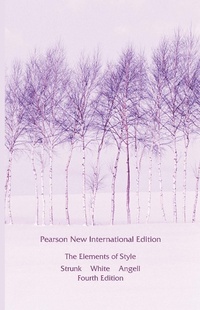
Elements of Style, The
Pearson New International Edition
4th Edition
Published on 20. March 2014
105 pages
978-1-292-03902-2 (ISBN)
Description

Elements of Style, The
More details
Edition
4th edition
Language
English
Place of publication
Harlow
United Kingdom
Target group
College/higher education
ISBN-13
978-1-292-03902-2 (9781292039022)
Copyright in bibliographic data and cover images is held by Nielsen Book Services Limited or by the publishers or by their respective licensors: all rights reserved.
Schweitzer Classification
Other editions
Additional editions
Book
08/2013
4th Edition
Pearson Education Limited
€21.99
Shipment within 10-20 days
Content
FOREWORD.
INTRODUCTION.
I.ELEMENTARY RULES OF USAGE.
1.Form the Possessive Singular of Nouns by Adding 's.
2.In a Series of Three or More Terms with a Single Conjunction, Use a Comma after Each Term except the Last.
3.Enclose Parenthetic Expressions between Commas.
4.Place a Comma before a Conjunction Introducing an Independent Clause.
5.Do Not Join Independent Clauses with a Comma.
6.Do Not Break Sentences in Two.
7.Use a Colon after an Independent Clause to Introduce a List of Particulars, an Appositive, an Amplification, or an Illustrative Question.
8.Use a Dash to Set Off an Abrupt Break or Interruption and to Announce a Long Appositive or Summary.
9.The Number of the Subject Determines the Number of the Verb.
10.Use the Proper Case of Pronoun.
11.A Participial Phrase at the Beginning of the Sentence Must Refer to the Grammatical Subject.
II.ELEMENTARY PRINCIPLES OF COMPOSITION.
12.Choose a Suitable Sesign and Hold to It.
13.Make the Paragraph the unit of Composition.
14.Use the Active Voice.
15.Put Statements in Positive Form.
16.Use Definite, Specific, Concrete Language.
17.Omit Needless Words.
18.Avoid a Succession of Loose Sentences.
19.Express Coordinate Ideas in Similar Form.
20.Keep Related Words Together.
21.In Summaries, Keep to One Tense.
22.Place the Emphatic Words of a Sentence at the End.
III.A FEW MATTERS OF FORM.
IV.WORDS AND EXPRESSIONS COMMONLY MISUSED.
V.AN APPROACH TO STYLE (WITH A LIST OF REMINDERS).
1.Place Yourself in the Background.
2.Write in a Way That Comes Naturally.
3.Work From a Suitable Style.
4.Write with Nouns and Verbs.
5.Revise and Rewrite.
6.Do Not Overwrite.
7.Do Not Overstate.
8.Avoid the Use of Qualifiers.
9.Do Not Affect a Breezy Manner.
10.Use Orthodox Spelling.
11.Do Not Explain Too Much.
12.Do Not Construct Awkward Adverbs.
13.Make Sure the Reader Knows Who is Speaking.
14.Avoid Fancy Words.
15.Do Not Use Dialect Unless Your Ear Is Good.
16.Be Clear.
17.Do Not Inject Opinion.
18.Use Figures of Speech Sparingly.
19.Do Not Take Shortcuts at the Cost of Clarity.
20.Avoid Foreign Languages.
21.Prefer the Standard to the Offbeat.
Afterword.
Glossary.
INTRODUCTION.
I.ELEMENTARY RULES OF USAGE.
1.Form the Possessive Singular of Nouns by Adding 's.
2.In a Series of Three or More Terms with a Single Conjunction, Use a Comma after Each Term except the Last.
3.Enclose Parenthetic Expressions between Commas.
4.Place a Comma before a Conjunction Introducing an Independent Clause.
5.Do Not Join Independent Clauses with a Comma.
6.Do Not Break Sentences in Two.
7.Use a Colon after an Independent Clause to Introduce a List of Particulars, an Appositive, an Amplification, or an Illustrative Question.
8.Use a Dash to Set Off an Abrupt Break or Interruption and to Announce a Long Appositive or Summary.
9.The Number of the Subject Determines the Number of the Verb.
10.Use the Proper Case of Pronoun.
11.A Participial Phrase at the Beginning of the Sentence Must Refer to the Grammatical Subject.
II.ELEMENTARY PRINCIPLES OF COMPOSITION.
12.Choose a Suitable Sesign and Hold to It.
13.Make the Paragraph the unit of Composition.
14.Use the Active Voice.
15.Put Statements in Positive Form.
16.Use Definite, Specific, Concrete Language.
17.Omit Needless Words.
18.Avoid a Succession of Loose Sentences.
19.Express Coordinate Ideas in Similar Form.
20.Keep Related Words Together.
21.In Summaries, Keep to One Tense.
22.Place the Emphatic Words of a Sentence at the End.
III.A FEW MATTERS OF FORM.
IV.WORDS AND EXPRESSIONS COMMONLY MISUSED.
V.AN APPROACH TO STYLE (WITH A LIST OF REMINDERS).
1.Place Yourself in the Background.
2.Write in a Way That Comes Naturally.
3.Work From a Suitable Style.
4.Write with Nouns and Verbs.
5.Revise and Rewrite.
6.Do Not Overwrite.
7.Do Not Overstate.
8.Avoid the Use of Qualifiers.
9.Do Not Affect a Breezy Manner.
10.Use Orthodox Spelling.
11.Do Not Explain Too Much.
12.Do Not Construct Awkward Adverbs.
13.Make Sure the Reader Knows Who is Speaking.
14.Avoid Fancy Words.
15.Do Not Use Dialect Unless Your Ear Is Good.
16.Be Clear.
17.Do Not Inject Opinion.
18.Use Figures of Speech Sparingly.
19.Do Not Take Shortcuts at the Cost of Clarity.
20.Avoid Foreign Languages.
21.Prefer the Standard to the Offbeat.
Afterword.
Glossary.
