

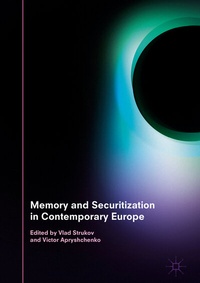
Memory and Securitization in Contemporary Europe
Description

The volume is the first study to explore the intersection of memory and securitisation in the European context. By analysing a variety of practices ranging from film to art and new media, the book expands the existing theoretical framework of securitisation. The authors consider memory as a precondition for contemporary integration projects such as the European Union, and also showcase how memory is used to stage international conflicts. Following this memory-securitisation nexus, the European Union, and Europe more generally, emerges as an on-going cultural, political and social project. The book also examines developments outside the EU such as the conflict in Ukraine and the creation of the Eurasian Economic Union, which, the authors argues, have a profound impact on Europe. From a consideration of historical contexts such as national referenda the discussion proceeds to media and film analysis, artistic practice and more transient phenomena such as climate change.
Reviews / Votes
"It provides a useful framework for understanding some of the security mechanisms for those students who are interested in broadening their understanding on the subject." (Priya Sara Mathews, Interdisciplinary Political Studies, Issue 6, July, 2020)
More details
Other editions
Additional editions
Persons
Vlad Strukov is an Associate Professor in Film and Digital Cultures, University of Leeds, UK. He specialises in world cinemas, digital media and cultural theory. He is the author of 'Contemporary Russian Cinema: Symbols of a New Era' (2016) and other books on visual culture. He is the founder of Studies in Russian, Eurasian and Central European New Media.
Victor Apryshchenko is a Professor of History at the Southern Federal University, Rostov-na-Donu, Russia. His research focuses on construction and transformation of European identities and historical memory management in Europe. He is the author of monographs and articles on historical and social memory and European intellectual culture. He is the editor-in-chief of The New Past/Novoe Proshloe journal.
