

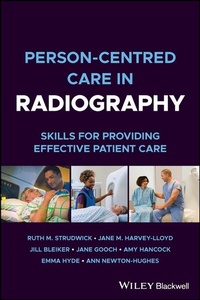
Person-centred Care in Radiography
Description

A helpful guide to patient and person-centered care in radiography, with a particular focus on interpersonal and communication skills
Person-centred Care in Radiography: Skills for Providing Effective Patient Care explores the complex interpersonal skills that are required of practitioners and medical imaging professionals which ensure high-quality service is given to person-centred care in radiography. The textbook is also written by a team of expert authors, and grounded in the team's own research, as well as their involvement with the Heads of Radiography Group, the Association of Radiography Educators, the Collaborating Centre for Values-based Practice in Health and Social Care, and the College of Radiographers.
The textbook contains a broad range of additional learning features, including case studies, student exercises, annotated further readings, and chapter summaries. Diagrams and illustrations are used throughout the book to provide visual representation of the concepts presented. Learning activities are also included throughout the book to encourage readers to self-discover and reflect and then apply their learning to their own role.
Person-centred Care in Radiography includes detailed information on and discussion of:
- Values, developing resilience, defining compassion, pain and suffering, and professional behaviors and culture
- Scenarios developed by service users based on real-life practice, to demonstrate the impact of the professional's behavior on the care received
- Diversity of service users, the role of carers, conceptual frameworks, interpersonal communication skills and communicating with patients beyond introductions
- Values-based practice, compassionate practice, theoretical models for patient-centered care in radiography and reflections to help readers move forward
Targeted at all staff working within diagnostic and therapeutic radiography clinical departments and educational institutions, Person-centred Care in Radiography, can be used in both radiography education by students and educators and by qualified staff who wish to reflect on their own patient care and develop their skills.
More details
Other editions
Additional editions
Persons
Ruth M. Strudwick, Professor in Diagnostic Radiography, School of Health & Sports Sciences, University of Suffolk, UK.
Jane M. Harvey-Lloyd, Associate Professor, School of Health and Sports Sciences, University of Suffolk, UK.
Jill Bleiker, Associate Senior Lecturer (Medical Imaging), Retired clinical and academic radiographer, University of Exeter Medical School, UK.
Jane Gooch, Senior Lecturer in Diagnostic Radiography, University of Derby, UK.
Amy Hancock, Senior Lecturer Medical Imaging, University of Exeter, Department of Health and Care Professions, UK.
Emma Hyde, Associate Professor, Provost for Learning & Teaching, University of Derby, UK.
Ann Newton-Hughes, Retired Lecturer (Medical Imaging), University of Salford, UK.
Content
List of Contributors v
Chapter 1 Introduction 1
Ruth M. Strudwick and Emma Hyde
Section I Understanding Ourselves 7
Chapter 2 Exploration of Your Own Values 9
Ruth M. Strudwick, Ann Newton-Hughes, and Jane M. Harvey-Lloyd
Chapter 3 Developing Resilience 16
Jane M. Harvey-Lloyd
Chapter 4 What Is Compassion? 24
Amy Hancock, Jane Gooch, and Jill Bleiker
Chapter 5 Pain and Suffering 34
Ann Newton-Hughes, Amy Hancock, and Jill Bleiker
Chapter 6 Professional Behaviours and Culture 46
Ruth M. Strudwick and Amy Hancock
Section II Understanding the Service User 59
Chapter 7 Diversity of Service Users 61
Jane M. Harvey-Lloyd, Jane Gooch, and Ruth M. Strudwick
Chapter 8 The Role of Carers 68
Jane M. Harvey-Lloyd and Ruth M. Strudwick
Chapter 9 A Conceptual Framework for Understanding Compassion in Radiography 73
Amy Hancock and Jill Bleiker
Chapter 10 Interpersonal Communication Skills 82
Jane M. Harvey-Lloyd and Emma Hyde
Chapter 11 Is There More to Communicating with Patients than #Hellomynameis? 94
Jane Gooch
Chapter 12 Values-Based Practice 101
Ruth M. Strudwick and Ann Newton-Hughes
Chapter 13 Compassion in Practice 109
Amy Hancock and Jill Bleiker
Chapter 14 Theoretical Models for Person-centred Care in Radiography 124
Emma Hyde
Chapter 15 Reflection on the Books and Skills Learned 137
Ruth M. Strudwick
Appendix A Organisational Measures of Patient Centred Care in Imaging Departments 139
Appendix B Pause and Check Audit Tool for Measuring Patient-Centred Care in Diagnostic Radiography (for use in Projection Radiography, Including Mammography) 144
Index 151
CHAPTER 2
Exploration of Your Own Values
Ruth M. Strudwick, Ann Newton-Hughes, and Jane M. Harvey-Lloyd
Values and beliefs are intrinsically linked and form a part of who we are as a person. Beliefs are things that we hold as true and are usually formed in our childhood and are reinforced by our family, friends, and experiences throughout life. Often, they are not necessarily factually correct or can be proven (even if we believe them to be true) but they do influence who we are, what motivates us, and how we behave. They can often cause emotional turmoil within, and this can drive individuals to fight for what they believe.
Values are closely linked to our beliefs and often support these beliefs. We are usually less aware of our values than our beliefs, however they are just as important and help us to form our identity. They can be expressed in the form of our needs, wishes, preferences, and the things that are important to us. Our values are our principles or standards of behaviour; our judgement of what is important in life. Understanding our own values allows us to increase not only our self-awareness but to be more sensitive to recognising the values of others and how this influences their behaviour and the decisions that they may make. Having an awareness of values and in particular core values enable us to care more effectively for people as practitioners.
The Iceberg Model (Iceberg Principle 2011) (Figure 2.1) illustrates how values and beliefs directly influence our behaviour. It is important to recognise that behaviour is only the tip of the iceberg, but as a person it is the very thing we are continuously judged on. Under the tip of the iceberg are values, beliefs, purpose, capabilities, and identity. This represents the internal dialogue, thoughts, and feelings, that each individual has that guide and controls our behaviour. Unfortunately, we are often too quick to judge others on their behaviour without fully understanding what lies beneath the tip of the iceberg. Being able to appreciate this and the effect that beliefs and values may have on your own behaviour will only enhance the way in which you practise and care for others.
FIGURE 2.1 Iceberg model (Iceberg Principle 2011).
WHY ARE VALUES IMPORTANT?
Values are important as they influence our thought processes and our priorities. Our values are unique and individual to us, and they may change in different circumstances. We see this in healthcare when patients are faced with life-changing events, and decisions need to be made about treatment options.
WHAT ARE YOUR VALUES - FORCED CHOICE EXERCISE
You choose:
- Imagine you have developed early symptoms of a potentially fatal disease .
- The National Institute of Health and Care Excellence (NICE) has approved two possible treatments.
- TREATMENT A - gives you a guaranteed period of remission but no cure.
- TREATMENT B - gives you a 50:50 chance of 'kill or cure'.
- Your decision - how long a period of remission would you want from Treatment A to choose that treatment rather than go for the 50:50 'kill or cure' from Treatment B?
It is your decision .
"How long a period of remission would I want from Treatment A to choose that treatment rather than go for the 50:50 "kill or cure" from Treatment B?'
- Write down your own answer, thinking about your decision from your own point of view and in your own particular circumstances.
The way that people answer this question can be surprisingly different. It might be assumed that younger people would choose a longer time span and older people would choose a shorter time span. The choice of the length of time is very dependent upon the individuals' values. Some younger people chose one year with a rationale that they would live their life to the full during that time, others chose 70 years as they wish to see what the future holds for them.
Examples
Choice: 15 years
Rationale: I have two children and I want to know if they meet their career and personal aspirations. 15 years should be enough to know this.
This reflects one of my core values which is my family.
Choice: Three years
Rationale: I have always wanted to travel and see some of the world. Three years would allow me to finish my degree and travel with my friends.
This reflects my core values of friends and new experiences.
Identifying and reflecting on your core values, allows you to understand who you are as a person and what life means to you. People who are aware of their values and honour them in the way in which they live on a regular basis will lead a more fulfilling life. There will be many times as a practitioner that you will have your values challenged and will be asked to do something which does not align with your values. This can frequently make you feel uncomfortable and at times you might be unsure about how to react. The important thing to acknowledge about values is that they are not morals, there is no sense of right/wrong or of positive/negative. They are also intrinsic to the individual and not consciously chosen. They do, however, underpin everything that we do and play a significant role in our life.
Each person has a hierarchy of values which are reinforced by a range of beliefs. Fundamentally, this affects our decision-making and the way in which we behave.
There is a range of exercises that you can undertake to establish your values. Start with undertaking the exercise below:
Establishing values exercise:
Identify three people who have had the greatest impact on your life. What specific advice or value has remained with you?
Name: Value: Name: Value: Name: Value:List three books, films, poems, sayings, or music tracks that have contributed to your values. What insight has stuck with you?
Resource: Insight: Resource: Insight: Resource: Insight:List five peak experiences that have profoundly shaped your life/career direction:
Experience Value: Experience Value: Experience Value: Experience Value: Experience Value:Now, you have begun to start thinking about your values, it is important to identify your core values - those that matter to you the most. This will help you to understand what drives and motivates you and allow you to consider that from another person's perspective. Complete the following exercise:
Core values exercise:
For each value you identify, consider what that value gives you, what does it mean to you? It is also important to establish where the value came from and how long you have had that value.
Finally, evaluate each of your values in terms of how important it is, then rank each value in order of personal significance.
Is there anything that has surprised you at all about undertaking this exercise and what do you think you can take forward from this?
If you have found it difficult to identify your values, there is a list at the end of the chapter which you may find useful as a prompt.
Values-based Practice (VBP) is the consideration of the individual patient's values in making decisions about their care. By patient's values we mean the unique preferences, concerns, and expectations each patient brings to a practice encounter which must be integrated into any decisions about the care of the patient. VBP takes into account and highlights what matters, and therefore is important to the patient (Fulford et al. 2012). As practitioners, we should not be making assumptions about what the patient wants, or indeed, reflect our own values upon the patients we image or treat as radiographers.
We can do this in practice by asking the patient to tell us what is important to them and providing them with enough information so that they can make informed choices. This is a critical aspect of true person-centred care and VBP.
Values can, and do vary, sometimes widely between individuals and between patient and practitioner. They are not fixed and may change over time and as life experiences accumulate. The crucial thing to remember is that as a practitioner you should not make assumptions about your patient's values, instead take the time if needed to ascertain what matters to them at that moment in time with regard to the task in hand, be that acquisition of a diagnostic image or delivery of a treatment fraction.
Other people's values need to be respected. In Chapter 5 of this book, we discuss the impact of pain on a patient and how this affects their judgement, and we also discuss values-based practice in more detail in Chapter 12 of the book.
We have recognised that our behaviours are based on beliefs and as such the values we display in our personal...
