

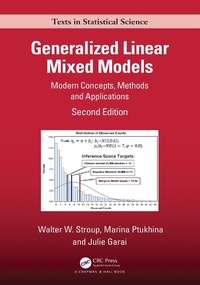
Generalized Linear Mixed Models
Modern Concepts, Methods and Applications
2nd Edition
Published on 21. May 2024
668 pages
978-1-4987-5558-0 (ISBN)
Description

Generalized Linear Mixed Models: Modern Concepts, Methods, and Applications (2nd edition) presents an updated introduction to linear modeling using the generalized linear mixed model (GLMM) as the overarching conceptual framework. For students new to statistical modeling, this book helps them see the big picture - linear modeling as broadly understood and its intimate connection with statistical design and mathematical statistics. For readers experienced in statistical practice, but new to GLMMs, the book provides a comprehensive introduction to GLMM methodology and its underlying theory.
Unlike textbooks that focus on classical linear models or generalized linear models or mixed models, this book covers all of the above as members of a unified GLMM family of linear models. In addition to essential theory and methodology, this book features a rich collection of examples using SAS (R) software to illustrate GLMM practice. This second edition is updated to reflect lessons learned and experience gained regarding best practices and modeling choices faced by GLMM practitioners. New to this edition are two chapters focusing on Bayesian methods for GLMMs.
Key Features:
Most statistical modeling books cover classical linear models or advanced generalized and mixed models; this book covers all members of the GLMM family - classical and advanced models
Incorporates lessons learned from experience and on-going research to provide up-to-date examples of best practices
Illustrates connections between statistical design and modeling: guidelines for translating study design into appropriate model and in-depth illustrations of how to implement these guidelines; use of GLMM methods to improve planning and design
Discusses the difference between marginal and conditional models, differences in the inference space they are intended to address and when each type of model is appropriate
In addition to likelihood-based frequentist estimation and inference, provides a brief introduction to Bayesian methods for GLMMs
Unlike textbooks that focus on classical linear models or generalized linear models or mixed models, this book covers all of the above as members of a unified GLMM family of linear models. In addition to essential theory and methodology, this book features a rich collection of examples using SAS (R) software to illustrate GLMM practice. This second edition is updated to reflect lessons learned and experience gained regarding best practices and modeling choices faced by GLMM practitioners. New to this edition are two chapters focusing on Bayesian methods for GLMMs.
Key Features:
Most statistical modeling books cover classical linear models or advanced generalized and mixed models; this book covers all members of the GLMM family - classical and advanced models
Incorporates lessons learned from experience and on-going research to provide up-to-date examples of best practices
Illustrates connections between statistical design and modeling: guidelines for translating study design into appropriate model and in-depth illustrations of how to implement these guidelines; use of GLMM methods to improve planning and design
Discusses the difference between marginal and conditional models, differences in the inference space they are intended to address and when each type of model is appropriate
In addition to likelihood-based frequentist estimation and inference, provides a brief introduction to Bayesian methods for GLMMs
Reviews / Votes
"This is an excellent textbook on GLMMs. It provides a unified framework for GLMMs by extending linear models to GLMMs and redefining them with fixed and random effects for Gaussian and non-Gaussian response variables. It will be of great interest to graduate students in statistics and practitioners who have a background in classical linear and generalized linear models and would like to learn about GLMMs. Although this book focuses on SAS as a learning tool, the topics will also be beneficial to non-SAS users. Due to its in-depth coverage, it will be an invaluable resource for those who would like to apply the methodology of GLMMs and conduct analysis in their research."- Xing Liu, Journal of the American Statistical Association, May 2025
More details
Series
Edition
2nd edition
Language
English
Place of publication
Philadelphia, PA
United States
Publishing group
Taylor & Francis Inc
Target group
College/higher education
Illustrations
35 Tables, black and white; 8 Line drawings, color; 103 Line drawings, black and white; 8 Illustrations, color; 103 Illustrations, black and white
File size
124,17 MB
ISBN-13
978-1-4987-5558-0 (9781498755580)
Copyright in bibliographic data and cover images is held by Nielsen Book Services Limited or by the publishers or by their respective licensors: all rights reserved.
Schweitzer Classification
Other editions
Additional editions
Walter W. Stroup | Marina Ptukhina | Julie Garai
Generalized Linear Mixed Models
Modern Concepts, Methods and Applications
Book
05/2024
2nd Edition
Chapman & Hall/CRC
€109.90
Shipment within 15-20 days
Persons
Walt Stroup is an Emeritus Professor of Statistics. He served on the University of Nebraska statistics faculty for over 40 years, specializing in statistical modeling and statistical design. He is a Fellow of the American Statistical Association, winner of the University of Nebraska Outstanding Teaching and Innovative Curriculum Award and author or co-author of three books on mixed models and their extensions.
Marina Ptukhina (Pa-too-he-nuh), PhD, is an Associate Professor of Statistics at Whitman College. She is interested in statistical modeling, design and analysis of research studies and their applications. Her research includes applications of statistics to economics, biostatistics and statistical education. Ptukhina earned a PhD in Statistics from the University of Nebraska-Lincoln, a Master of Science degree in Mathematics from Texas Tech University and a Specialist degree in Management from The National Technical University "Kharkiv Polytechnic Institute."
Julie Garai, PhD, is a Data Scientist at Loop. She earned her PhD in Statistics from the University of Nebraska-Lincoln and a bachelor's degree in Mathematics and Spanish from Doane College. Dr Garai actively collaborates with statisticians, psychologists, ecologists, forest scientists, software engineers, and business leaders in academia and industry. In her spare time, she enjoys leisurely walks with her dogs, dance parties with her children and playing the trombone.
Marina Ptukhina (Pa-too-he-nuh), PhD, is an Associate Professor of Statistics at Whitman College. She is interested in statistical modeling, design and analysis of research studies and their applications. Her research includes applications of statistics to economics, biostatistics and statistical education. Ptukhina earned a PhD in Statistics from the University of Nebraska-Lincoln, a Master of Science degree in Mathematics from Texas Tech University and a Specialist degree in Management from The National Technical University "Kharkiv Polytechnic Institute."
Julie Garai, PhD, is a Data Scientist at Loop. She earned her PhD in Statistics from the University of Nebraska-Lincoln and a bachelor's degree in Mathematics and Spanish from Doane College. Dr Garai actively collaborates with statisticians, psychologists, ecologists, forest scientists, software engineers, and business leaders in academia and industry. In her spare time, she enjoys leisurely walks with her dogs, dance parties with her children and playing the trombone.
Content
Preface to the Second Edition
Part 1: Essential Background
1. Modeling Basics
2. Design Matters
3. Setting the Stage
Part 2: Estimation and Inference Theory
4. Pre-GLMM Estimation and Inference Basics
5. GLMM Estimation
6. Inference, Part I
7. Inference, Part II
Part 3: Applications
8. Treatment and Explanatory Variable Structure
9. Multi-Level Models
10. Best Linear Unbiased Prediction
11. Counts
12. Rates and Proportions
13. Zero-inflated and Hurdle Models
14. Multinomial Data
15. Time-to-Event Data
16. Smoothing Splines and Additive Models
17. Correlated Errors, part 1: Repeated Measures
18. Correlated Errors, part 2: Spatial Variability
19. Bayesian Implementation of GLMM
20. Four Bayesian GLMM Examples
21. Precision, Power, Sample Size and Planning
Part 1: Essential Background
1. Modeling Basics
2. Design Matters
3. Setting the Stage
Part 2: Estimation and Inference Theory
4. Pre-GLMM Estimation and Inference Basics
5. GLMM Estimation
6. Inference, Part I
7. Inference, Part II
Part 3: Applications
8. Treatment and Explanatory Variable Structure
9. Multi-Level Models
10. Best Linear Unbiased Prediction
11. Counts
12. Rates and Proportions
13. Zero-inflated and Hurdle Models
14. Multinomial Data
15. Time-to-Event Data
16. Smoothing Splines and Additive Models
17. Correlated Errors, part 1: Repeated Measures
18. Correlated Errors, part 2: Spatial Variability
19. Bayesian Implementation of GLMM
20. Four Bayesian GLMM Examples
21. Precision, Power, Sample Size and Planning
