

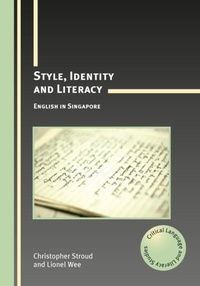
Style, Identity and Literacy
English in Singapore
Published on 28. November 2011
240 pages
978-1-84769-598-7 (ISBN)
Description

Style, Identity and Literacy: English in Singapore is a qualitative study of the literacy practices of a group of Singaporean adolescents, relating their patterns of interaction - both inside and outside the classroom - to the different levels of social organization in Singaporean society (home, peer group and school). Combining field data gathered through a series of detailed interviews with available classroom observations, the study focuses on six adolescents from different ethnic and social backgrounds as they negotiate the learning of English against the backdrop of multilingual Singapore. This book provides social explanations for the difficulties and challenges these adolescents face by drawing on current developments in sociolinguistics, literacy studies, English language teaching and language policy.
Reviews / Votes
Style, Identity and Literacy is a remarkable achievement: it brings together the close analysis of the ethnography of communication with a broader political economy of literacy based on Bourdieu's models of capital and exchange. * Allan Luke, Queensland University of Technology, Australia * This book is unique in its consideration of language issues in Singapore in the way that it invites us to think about how multilingual complexities are reshaping debates and concerns with language both here and elsewhere in the globalised world. It is an absorbing and theoretically informed account and offers an important model of how sociolinguistic research might be done in other multilingual contexts. It concludes with a carefully-made call for a revised approach to language policy and will hopefully provoke much interest and debate, in Singapore and elsewhere. * Mastin Prinsloo, University of Cape Town, South Africa * "Style, Identity and Literacy" represents an accomplished and well-written example of qualitative ethnographic methods applied to sociolinguistic research, which might be of interest to anyone teaching research methodologies or pursuing qualitative research. It also contributes to the understanding of "style" as a significant factor in literacy practices and linguistic identity. * Carolina I. Viera, University of California-Davis, USA on the Linguist List 23.3361 * The material is thought provoking and interesting, and it raises some profound issues that should be considered by language planners. Indeed, many readers from Singapore and elsewhere will find the book both interesting and important. -- David Deterding, University of Brunei Darussalam, Brunei in World Englishes, Vol. 32, No. 4, pp. 551-563, 2013More details
Series
Language
English
Place of publication
Bristol
United Kingdom
Publishing group
Channel View Publications Ltd
Target group
Professional and scholarly
Product notice
Reflowable
ISBN-13
978-1-84769-598-7 (9781847695987)
Copyright in bibliographic data and cover images is held by Nielsen Book Services Limited or by the publishers or by their respective licensors: all rights reserved.
Schweitzer Classification
Other editions
Additional editions
Book
11/2011
Multilingual Matters
€42.00
Shipment within 10-20 days
Persons
Christopher Stroud is a Senior Professor at the University of the Western Cape and Professor of Bilingual Research at Stockholm University. He has researched and written widely on multilingualism, language planning and policy and language education in contexts as diverse as Papua New Guinea, South East Asia, Scandinavia and Southern Africa. He is currently working on elaborating the idea of linguistic citizenship.
Lionel Wee is an Associate Professor and Head of the Department of English Language & Literature at the National University of Singapore. He is the author of Language Without Rights (Oxford University Press, 2011), and is currently working on a book about organizational styling.
Lionel Wee is an Associate Professor and Head of the Department of English Language & Literature at the National University of Singapore. He is the author of Language Without Rights (Oxford University Press, 2011), and is currently working on a book about organizational styling.
Content
Chapter 1: Social Practices and Linguistic Markets
Chapter 2: Multilingualism in Late-Modern Singapore: A Portrait
Chapter 3: Multilingualism in Late Modernity: Literacy as a Reflexive Performance of Identity
Chapter 4: Some Data about our Data
Chapter 5: Fandi and Ping: Literacy Practices and the Performance of Identities on Ambivalent Markets
Chapter 6: Edwin, Wen and Yan: Styling Literacy Practices Inside and Outside the Classroom
Chapter 7: Sha: A Comparison
Chapter 8: Pedagogy, Literacy And Identity
Chapter 9: The Dynamics of Language Distribution in Late-Modern Multilingual Singapore
Chapter 2: Multilingualism in Late-Modern Singapore: A Portrait
Chapter 3: Multilingualism in Late Modernity: Literacy as a Reflexive Performance of Identity
Chapter 4: Some Data about our Data
Chapter 5: Fandi and Ping: Literacy Practices and the Performance of Identities on Ambivalent Markets
Chapter 6: Edwin, Wen and Yan: Styling Literacy Practices Inside and Outside the Classroom
Chapter 7: Sha: A Comparison
Chapter 8: Pedagogy, Literacy And Identity
Chapter 9: The Dynamics of Language Distribution in Late-Modern Multilingual Singapore
