

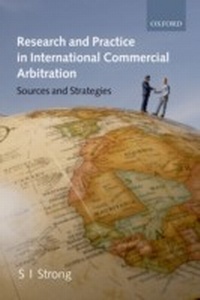
Research and Practice in International Commercial Arbitration: Sources and Strategies
Sources and Strategies
1st Edition
Published on 5. February 2009
166 pages
978-0-19-102853-3 (ISBN)
Description

This book provides both experienced and inexperienced practitioners, as well as advanced students, with a guide to the strategies associated with researching international commercial arbitration as well as the sources associated with that field of law. Up until very recently, the field of international commercial arbitration was populated solely by specialists who knew the sources and strategies for researching relevant authorities. However, as the practice and business of law hasbecome more international and more diversified, generalists have begun to enter the field while the number of specialized sources associated with international commercial arbitration has grown exponentially. The book combines instructional text with a bibliography of sources to teach readers whereto find relevant material. The instructional chapters discuss the most important methods by which one conducts research in international arbitration, while the bibliography provides guidance on where to find that material. Furthermore, the book will offer tips on how to present a case to an international tribunal, which is quite different than presenting a case to a national court. In effect, the book walks the reader through the steps associated with researching and presenting issues in international commercial arbitration. For example, the book covers: Where to find reported international arbitral awards (as opposed to judicial decisions) Where to find specialist treatises and journal articles on international arbitration How to use the various sources and evaluate the weight of competing authority How to present one's findings to an international arbitral panel How to consider the special issues that relate to international arbitrationAdditionally, the book takes advantage of empirical research into the conduct of arbitration, giving an insider's view of the process.
More details
Other editions
Additional editions
Book
02/2009
Oxford University Press
€74.50
Available immediately
Content
- Intro
- Contents
- Table of Cases
- Table of Legislation, Treaties, and Conventions
- Table of Codes, Rules, and Model Laws
- 1. Research and Practice in International Commercial Arbitration
- A. Introduction
- B. Unique Concerns Related to Research and Practice in International Commercial Arbitration
- C. Why Special Research and Practice Methodologies are Necessary in International Commercial Arbitration
- D. Benefits Associated with Learning Special Research and Practice Methodologies for International Commercial Arbitration
- E. How to Use This Book
- 2. Sources of Law in International Commercial Arbitration
- A. Introduction
- B. Legal Authorities in International Commercial Arbitration
- (1) Sources of law-state sources versus private sources
- (2) Sources of law-international conventions and treaties
- (3) Sources of law-national laws
- (4) Sources of law-arbitral rules
- (5) Sources of law-law of the dispute (procedural orders and agreements between the parties)
- (6) Sources of law-arbitral awards
- (7) Sources of law-case law
- (8) Sources of law-treatises and monographs
- (9) Sources of law-legal articles
- C. How Experienced Advocates Use Legal Authorities
- D. How Experienced Arbitrators Weigh Legal Authorities
- E. Conclusion
- 3. Researching Common Areas of Dispute
- A. Introduction
- B. Finding Legal Authorities in International Commercial Arbitration
- (1) Location of law-international conventions and treaties
- (2) Location of law-national laws
- (3) Location of law-arbitral rules
- (4) Location of law-law of the dispute (procedural orders and agreements between the parties)
- (5) Location of law-arbitral awards
- (6) Location of law-case law
- (7) Location of law-treatises and monographs
- (8) Location of law-legal articles
- C. Researching Common Areas of Interest in International Commercial Arbitration
- (1) Researching arbitration agreements
- (2) Researching arbitral procedure
- (3) Researching challenges to the arbitrator
- (4) Researching recognition, enforcement, and challenge of an award
- 4. How to Use Your Research
- A. Introduction
- B. Adapting Written Pleadings and Memoranda of Law
- C. Citing Supporting Authority
- D. Submitting Testimony from Expert Witnesses
- 5. Legal Authorities in International Commercial Arbitration-Bibliographic Sources
- A. Introduction
- B. Specialized Electronic Databases
- (1) Free online services
- (2) Subscription services
- C. Conventions and Treaties
- D. National Laws
- E. Arbitral Rules
- F. Law of the Dispute (Procedural Orders and Agreements Between the Parties)
- G. Arbitral Awards
- H. Case Law
- I. Treatises and Monographs
- J. Legal Articles
- (1) Specialized arbitration and dispute resolution journals and periodicals
- (2) Specialized journals on international, regional, and comparative law
- (3) General journals that may carry articles on international commercial arbitration
- (4) Scholarly and practitioner collections
- Index
- A
- B
- C
- D
- E
- F
- G
- H
- I
- J
- K
- L
- M
- N
- O
- P
- R
- S
- T
- U
- V
- W
