

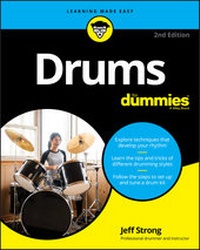
Drums For Dummies
Description

Drumming is natural to all of us--after all, it mimics the regular beat of our hearts. But some of us want to go further and really lay down a big beat. And no wonder--whether you want to become the powerful backbone of a band or just learn how to play a hand drum for pleasure, drumming is a lot of fun. Oh, and it's scientifically proven to make you smarter. Bonus: healthier!
Drums For Dummies gets you going on the road to becoming the drummer you want to be. Get started with the basics--what drums to buy, exercises that build your skills, and playing simple rhythms. Then move into more complex topics, explore drumming styles from around the world, and add other percussion instruments to your repertoire.
Written in an easy-to-follow step-by-step style by respected instructor Jeff Strong, you'll go from banging out basic rhythms--with or without sticks--to acquiring versatility with different styles and types of drum. The book also provides online audio files to drum along with, as well as suggestions for solo approaches to wow your bandmates.
* Understand fundamental techniques.
* Hone your technique with exercises.
* Explore other percussion instruments.
* Care for your drums.
The all-time drumming great Neal Peart of the band Rush once said that when he saw a good drummer, all he wanted to do was practice. Drums For Dummies is your best way to do just that--and start hitting your perfect groove.
P.S. If you think this book seems familiar, you're probably right. The Dummies team updated the cover and design to give the book a fresh feel, but the content is the same as the previous release of Drums For Dummies (9780471794110). The book you see here shouldn't be considered a new or updated product. But if you're in the mood to learn something new, check out some of our other books. We're always writing about new topics!
More details
Other editions
Additional editions
Person
Content
Introduction
All the drummers I've ever met (and I've met quite a few) started out by tapping or pounding on just about anything they could get their hands on. Chances are that if you picked up this book, you fit into this category as well. So, even if you've never played an actual drum or studied drumming in any formal sense, you're a drummer.
With drumming, you've chosen the world's oldest and most popular musical instrument. There isn't a place on this planet that doesn't have some sort of drumming tradition. In fact, as you'll discover in the following pages, playing drums is a universal pastime that anyone can enjoy, regardless of his or her taste in music.
My purpose with this book is to introduce you to as many types of drums and drumming styles as I can in 384 pages. If you're like me, you can find joy in each of them. And by knowing a variety of playing techniques, you can end up being a much better and more versatile drummer.
About This Book
This book allows the drumset player to develop all the skills needed to play a variety of drumming styles from rock to Latin and jazz to R&B. I also expose you to traditional techniques that you can easily incorporate into your drumset playing.
Unlike most drum books, Drums For Dummies, 2nd Edition goes beyond the modern drumset and also includes a variety of traditional drums and percussion instruments. For the traditionalist or drum circle enthusiast, Drums For Dummies, 2nd Edition includes descriptions of how to play a variety of traditional hand and stick-played drums as well as some common percussion instruments. So, whether you're interested in playing a drumset in popular music or being involved in drumming ensembles using traditional drums and percussion instruments, this book is for you.
Drums For Dummies, 2nd Edition is able to contain all this information because you won't find any exercises that you can't use in real-world situations. The result: You can learn how to actually play the drums much sooner and without learning unnecessary stuff.
This book is also a handy reference for drumming. You can find a variety of drums from around the world that you may not have ever seen or heard of before now. I explain each of these drums, and I describe their technique so that you can play them in the traditional way using traditional rhythms. I also discuss how you can use each of these drums in a musical situation today.
By no means does this book cover all the different drums and percussion instruments played today, but it does cover more than a dozen of the drums that I see most often. And, with the techniques that I describe, you can easily play any drum that I don't present in this book. Just find a drum that looks similar to yours and start there.
Conventions Used in This Book
I use a few conventions in this book to make it easier for you to understand and navigate. Here's a list of those conventions:
- You'll see many of the rhythms in this book marked with a track bar that tells you where to find that rhythm on the book's companion website when you play it as standard music. The website and book together allow you to hear as well as see how to play each rhythm, making the learning process that much quicker. All the rhythms are now available as audio files.
- All the drumset grooves are written for the right-handed player. Well, not exactly right-handed people, but rather people who set up and play their drums in a right-handed way. I do this because it's the most common way to play a drum. Lefties take heart - playing right-handed can actually be better for you. You end up having an advantage because your left hand is as strong as your right (trust me on this one - I'm a lefty who plays right-handed, and so are a lot of other great drummers).
- The musical notation in this book is written so that you can read drumming music. I don't cover those areas (key signatures, melodies, and so on) that are present in music notation unless they specifically apply to the drum rhythm presented.
What You're Not to Read
If you're pressed for time (for example, you have an audition tomorrow), you don't have to read this entire book word-for-word. I can't promise that you'll nail that audition, but I do make it easy for you to know which parts of this book you can skip. Don't read the following unless you have ample time and a real thirst for drumming knowledge:
- Sidebars: These gray-shaded boxes are filled with fun, interesting information, but it's all nonessential.
- Technical stuff: You can skip any paragraph marked with a Technical Stuff icon (see "Icons Used in This Book" later in this introduction). This information may be too technical the first time you read through this book, but come back to it as you get more comfortable with your drumming - it will only enhance your knowledge of the subject.
- Drum history: Don't worry; I don't give you any quizzes on the history of drumming. If you're one of those rare souls who finds history fascinating, dive right in. If you're like the rest of us, this icon lets you know that you don't have to read these sections.
Foolish Assumptions
I really don't make any assumptions about you, the reader. I don't assume that you're interested in a certain type of drum. I don't assume that you want to play a specific style of music. I don't even assume that you already have a drum or that you know what kind of drumming you want to do. In fact, if you don't know these things, this book can help you decide.
The only assumption I make is that you're reading this book because you want to learn how to turn your aimless tapping into music.
How This Book Is Organized
This book is organized so that you can get the information you want quickly and not be burdened with stuff you don't need or want to know. Each section contains chapters that cover a specific area of drumming.
Part 1: Setting a Solid Foundation
Part 1 contains four chapters that cover the basics of drumming. Chapter 1 introduces you to the world of drums and shows you some of the most common drums used today. Chapter 2 provides you with a vocabulary that allows you to read drumming music quickly (you don't need to read music in order to play the rhythms in this book if you don't want to - you can go to the website and listen to some of the rhythms, or download the audio files and listen to all the rhythms). Chapter 3 introduces you to the proper way to hit the drums with a stick, and Chapter 4 explores many ways that you can play a drum with your hands.
Part 2: Digging into the Drumset
Part 2 explores the modern drumset. In Chapter 5, you discover how to set up your drumset as well as some basic drumset skills that will help you move your limbs independently of one another. Chapter 6 shows you how to play the drumset in the rock style, and Chapter 7 introduces you to blues drumming. Chapter 8 presents the way to drum in the R&B and funk drumming techniques, and Chapter 9 explores jazz and fusion styles. In Chapter 10, you uncover the secrets to playing Latin and Caribbean rhythms. And, in Chapter 11, you can expand on your rock skills by looking at the rhythms of some great drummers.
Part 3: Dressing up Your Drumset Skills
Part 3 helps you express your own personality on the drumset. Chapter 12 examines what makes a rhythm groove and how to put together a beat that fits your musical situation. In Chapter 13, you can explore how to use licks and fills to complement the music and make a personal statement. Chapter 14 gives you some ideas and guidelines to help you solo effectively.
Part 4: Pounding Out the Beat: Traditional Drums and Percussion
Part 4 presents a variety of drums and percussion instruments from around the world. In Chapter 15, you get a chance to discover a bunch of drums that you play with your hands. Chapter 16 explores some drums that you play with either a stick or a combination of a stick and your hand. Chapter 17 presents other percussion instruments, such as the cowbell and the triangle. Chapter 18 builds on Chapters 15, 16, and 17 and shows you how you can combine these instruments to create polyrhythms.
Part 5: Choosing, Tuning, and Caring for Your Drums
Part 5 provides information to help you choose, tune, and care for your drums. Chapter 19 shows you what to look for when buying a drum or drumset. Chapter 20 explains how to tune and take care of your drums so that they sound their best and last a long time.
Part 6: The Part of Tens
Part 6 is a staple of For Dummies books. Chapter 21 shows you ten ways that you can continue on in the world of drumming, and Chapter 22 offers some tips on choosing a private drum instructor.
Appendix
The appendix explains the organization of the website that accompanies this book.
Icons Used in This Book
As with all...
