

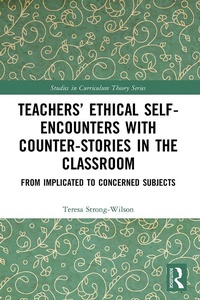
Teachers' Ethical Self-Encounters with Counter-Stories in the Classroom
From Implicated to Concerned Subjects
1st Edition
Published on 21. April 2021
178 pages
978-1-000-34366-3 (ISBN)
Description

Offering unique theoretical perspectives, autobiographical insights and narrative accounts from elementary and secondary educators, this monograph illustrates the need for teachers to engage critically with counter-stories as they teach to issues including colonization, war, and genocide.
Juxtaposing Pinar's concept of ethical self-encounters with theories of subjective reconstruction, multidirectional memory, and autobiographical narration, this rich volume considers teachers' ethical responsibility to interrogate the curriculum via self-reflection and self-formation. Using cases from workshops and classrooms conducted over five years, Strong-Wilson traces teachers' and students' movement from "implicated subjects" to "concerned subjects." In doing so, she challenges the neoliberal dynamics which erode teacher agency.
By working at the intersections of pedagogy, literary theory and memory studies, this book introduces timely arguments on subjectivity and ethical responsibility to the field of education in the Global North. It will prove to be an essential resource for post-graduate researchers, scholars and academics working with curriculum theory and pedagogical theory in contemporary education.
Juxtaposing Pinar's concept of ethical self-encounters with theories of subjective reconstruction, multidirectional memory, and autobiographical narration, this rich volume considers teachers' ethical responsibility to interrogate the curriculum via self-reflection and self-formation. Using cases from workshops and classrooms conducted over five years, Strong-Wilson traces teachers' and students' movement from "implicated subjects" to "concerned subjects." In doing so, she challenges the neoliberal dynamics which erode teacher agency.
By working at the intersections of pedagogy, literary theory and memory studies, this book introduces timely arguments on subjectivity and ethical responsibility to the field of education in the Global North. It will prove to be an essential resource for post-graduate researchers, scholars and academics working with curriculum theory and pedagogical theory in contemporary education.
Reviews / Votes
"Strong-Wilson insightfully wrestles with complexities of ethical subjectivity, remembrance, and witnessing in the context of teachers' autobiographical and classroom encounters with Holocaust and post-colonial counter-stories. She originally interweaves these encounters with dialogic reflections on curriculum theorizing (particularly the work of W.F. Pinar), multidirectional memory work, hermeneutics, and the literature of W.G. Sebald. A compelling and enriching contribution to 'complicated conversations' in the fields of curriculum studies and English language arts education!"Claudia Eppert, Associate Professor, Faculty of Education
University of Alberta
"Vividly exemplifying the complicated conversation that is the curriculum, Teresa Strong-Wilson reads through one another the varied histories infusing the texts of classroom teachers, fiction and creative non-fiction writers, curriculum theorists, philosophers, and her own reflexive interrogations. Prioritizing study alongside teachers, Strong-Wilson deftly portrays ways that teaching with and to counter-stories might function to both inspire and support ethical self-encounters, wherein one can become conscious of one's relations with, and responsibility toward, others. Emanating from her elongated and collaboratively enacted research, Strong-Wilson thus theorizes a notion of "concerned subjects," who, although conscious of themselves as implicated, are able to respond to calls to act, to work toward repair.
By threading aspects of currere, multidimensionality, and auto/biography, Teresa Strong-Wilson offers powerful and timely illustrations of ways that educators might fully examine relations among the subjects that we teach to, the stories we choose to invoke, and ourselves as teachers. In so doing, Strong-Wilson clearly embodies and enlivens curriculum as lived-experience, thus offering a compelling contribution to the field's complicated conversation."
Janet L. Miller, Teachers College
Columbia University, New York City
More details
Series
Edition
1. Auflage
Language
English
Place of publication
London
United Kingdom
Publishing group
Taylor & Francis Ltd
Target group
College/higher education
Product notice
Reflowable
ISBN-13
978-1-000-34366-3 (9781000343663)
Copyright in bibliographic data and cover images is held by Nielsen Book Services Limited or by the publishers or by their respective licensors: all rights reserved.
Schweitzer Classification
Other editions
Additional editions
Teresa Strong-Wilson
Teachers' Ethical Self-Encounters with Counter-Stories in the Classroom
From Implicated to Concerned Subjects
Book
01/2023
1st Edition
Routledge
€59.90
Shipment within 15-20 days
Teresa Strong-Wilson
Teachers' Ethical Self-Encounters with Counter-Stories in the Classroom
From Implicated to Concerned Subjects
Book
04/2021
1st Edition
Routledge
€207.30
Shipment within 15-20 days
Person
Teresa Strong-Wilson is Associate Professor in the Department of Integrated Studies in Education at McGill University, Canada.
Content
1. Introduction; 2. Allegory and Juxtaposition; 3. Look-alikes; 4. Memory-work; 5. Mobilizing Memory-work; 6. Ethical Self-encounters; 7. Periscopic Narratives; 8. Recognition and Understanding; 9. From Implicated to Concerned Subjects
