

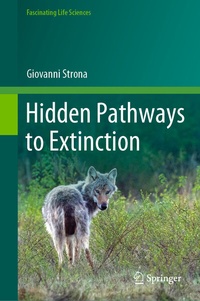
Hidden Pathways to Extinction
Description

This book provides, for the first time, a comprehensive overview of the fundamental roles that ecological interactions play in extinction processes, bringing to light an underground of hidden pathways leading to the same dark place: biodiversity loss.
We are in the midst of the sixth mass extinction. We see species declining and vanishing one after another. Poached rhinos, dolphins and whales slaughtered, pandas surviving only in captivity are strong emotional testimonials of what is happening. Yet, the main threat to natural communities may be overshadowed by the disappearance of large species, with most extinctions happening unnoticed and involving less eye-catching organisms, such as parasites and pollinators. Ecosystems hide countless, invisible wires connecting organisms in dense networks of ecological interactions. Through these networks, perturbations can propagate from one species to another, producing unpredictable effects. In worst case scenarios, the lossof one species might doom many others to extinction. Ecologists now consider such mechanisms as a fundamental - and still poorly understood - driver of the ongoing biodiversity crisis. Hidden Pathways to Extinction makes the invisible links connecting the fates of species and organisms evident, exploring why complexity can enhance ecosystem stability and yet accelerate species loss. Page after page, Strona provides convincing evidence that we are primarily responsible for the fall in biodiversity, that we are falling too, and that we need to redouble our conservation efforts now, or it won't be long before we hit the ground.
Reviews / Votes
"This undoubtedly leads to a slight dissipation of the core take-home message, structuring things in this way does provide valuable and almost overwhelming examples for where this broad family of ecological models and techniques can take you, and the range of research questions you might begin answering with them. For an ambitious student of ecology, Hidden Pathways to Extinction provides a strong conceptual background, a number of clearly worked examples, and a truly excellent set of references." (Simon A. F. Darroch, The Quarterly Review of Biology, Vol. 99 (3), September, 2024)
More details
Other editions
Additional editions
Person
Content
1. Introduction
2. We are Chicxulub
3. Ecological networks
4. Integrating interaction types
5. Modelling co-extinctions
6. Extinction sequences
7. The specialization paradox
8. Nestedness and ecological network stability
9. Life cycle complexity
10. Planetary life annihilation
11. Higher-order interactions
12. Biological invasions
13. Artificial Intelligence and the future of biodiversity
