

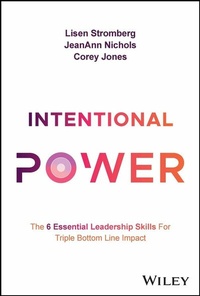
Intentional Power
Description

Intentional Power: The 6 Essential Leadership Skills for Triple Bottom Line Impact explores how the transition from shareholder capitalism to stakeholder capitalism has created an urgent need for a new model of leadership; a model that enables leaders to navigate competing demands from both internal and external stakeholders including the most racially and age-diverse workforce in history, activist investors, purpose-driven customers, and global government regulators.
Intentional Power argues persuasively for a more inclusive, comprehensive approach to leadership disrupting the conventional approach that has been taught for decades in business books, management courses, and by traditional leaders themselves. It is a guide for delivering triple bottom-line impact: enhancing profits, people, and the planet.
Written by Lisen Stromberg, JeanAnn Nichols, and Corey Jones, three leadership experts who bring a wealth of experience from their decades of working within companies and alongside leaders as advisors, coaches, and corporate consultants, Intentional Power is a call to action for the next generation of leaders to move beyond an entirely individual focus toward a more sustainable approach to lead and succeed.
Deeply researched, the authors draw on an extensive review of the latest literature and insights on leadership development, cognitive and positive psychology, organizational design, and performance management, as well as extensive interviews with leaders across several industries to highlight the most critical skills required by today's executives and managers. They offer a new model of leadership, the HEARTI® model, built on six core competencies: Humility, Empathy, Accountability, Resiliency, Transparency, and Inclusivity. These 6 leadership skills are essential for success in today's new world of work.
You'll also find:
* A comprehensive, inclusive, and effective approach to leading organizations through the rest of the 21st century
* Examples from leaders across numerous industries who are driving impact for the teams, the companies, and the world at large
* Practical "How-To's" and actionable Leader Tool Kit activities to help you learn and apply the skills discussed in the book
An essential and exciting new resource for next-generation and practicing leaders ready to create profitable companies full of meaning and purpose, Intentional Power is the hands-on leadership guide that founders, entrepreneurs, directors, executives, managers, and impact-driven employees everywhere have been waiting for.
More details
Other editions
Additional editions
Content
Chapter 1 Everything's Changed 1
Chapter 2 Intentional Power Skills for Stakeholder Success 19
Chapter 3 Be Humble: "Lead from Behind" 39
Chapter 4 Be Empathetic: It's Not How You Feel, It's What You Do 57
Chapter 5 Be Accountable: To Yourself, Your Company, and the World at Large 83
Chapter 6 Be Resilient: Because the World Needs You 107
Chapter 7 Be Transparent: It's the Foundation of Trust 129
Chapter 8 Be Inclusive: It's a Win for All 149
Chapter 9 Live Your Impact 177
Acknowledgments 191
Notes 193
About the Authors 219
Index 223
1
Everything's Changed
When their faces popped on to the screen as they joined our virtual classroom, you could see the eagerness and the anxiety. Thirty-seven students, mid-career professionals, had signed up for our winter 2023 Stanford Continuing Studies seminar on "Modern Leadership in the New World of Work." These up-and-coming leaders would be logging on to Zoom one night a week for the next eight weeks. In this class, like previous classes, we have students from around the world: San Francisco, New York, Toronto, London, Mumbai, Singapore, Jakarta, Sao Paulo, and many places in between. This means they'll be forced to stay up or wake up just to show up. And they do.
Why?
Much like the hundreds of students we have taught through Stanford and the thousands of leaders we engage with through our global leadership labs and our daily work, employees at every level are struggling with the complexity of today's new world of work. They, like all of us, are facing tectonic shifts in where, how, and even why we work. As one of our new students, Abel,* a senior director for a well-established tech company based in the San Francisco Bay Area shared, "I'm taking this class because I'm trying to understand how to be a good leader in the midst of this chaos."
Abel is zooming in from Atlanta. He moved back home mid-pandemic to be near family. Like him, his team of over 100 designers and engineers are now spread across the United States. Abel's boss wants everyone back in the office. He believes it will boost productivity, but Abel's teammates enjoy their newfound flexibility. He's already lost two high-performing employees to remote-first companies, and he worries he'll lose more if his company leaders stick to their plans. On top of that, with a looming recession, the company just cut funds for a deeply valued initiative: a program that offers technical skills training to minority students who can't afford a four-year college degree. His team is upset, morale is low. "I feel like I'm between a rock and a hard place," Abel admitted, bringing a vulnerability that is not unusual among our students.
Another student, a chief people officer for a fast-growing start-up, sympathized with Abel, "I'm taking this class because our managers are unsure how to lead in this environment. I need tools to help them."
At the beginning of each semester, we do our best to help our students put the challenges they are facing into context. We explain that to lead today, you need to understand the unprecedented forces that are putting pressure on companies and the people who run them. From employees who are challenging previous assumptions and expectations about the nature of work, to external stakeholders who are demanding companies step up to solve critical societal issues, to the underlying question of what is the essential purpose of a corporation, more is being asked of leaders than ever before.
It starts by understanding that everything has changed.
What Used to Work at Work No Longer Does
We don't need to belabor the reality that workplaces have seen a radical evolution these past few years. Global forces such as Covid-19, supply chain disruption, rampant inflation, rising interest rates, a labor shortage, and the threat of recession have amped up the stress level in today's businesses. Then, of course, the culture wars brought on by movements such as Black Lives Matter and #MeToo, the heightened political wedge between left and right, and the stark generational differences, only compound the disruption. Mashing together employees who bring different attitudes and beliefs about their relationship to work and the workplace has created a potential cauldron of cultural divisiveness.
Consider this: Millennials-those born between 1980 and 2000-already make up over 50% of the global workforce, and by 2025, Gen Z-those born between 1997 and 2012-will account for 27%.1 As has been well-documented, millennials and Gen Zs see work through a very different lens than their predecessors. Rather than work-first, they are decidedly work-adjacent. In other words, work isn't their singular focus, it is part of the many things that make up their identity and only one of the things that gives them purpose.
Demographically, when combined, millennials and Gen Zs are the most diverse and the most educated workforce in history. Contrast this up-and-coming talent pool with the typical Fortune 500 CEO: Based on averages,2 he's a man, around 60 years old, white, straight, and very likely has a spouse at home caring for the needs of the family. He has singularly devoted his life to rising up the corporate ladder and, in doing so, resembles the "ideal worker."3 That's the person who is available at the drop of a hat, can work 24/7, and whose identity is defined by their job and title.
This ideal worker's experience in the midst of Covid has been decidedly different from the vast majority of his employees. A mid-pandemic study of over 31,000 knowledge workers worldwide revealed that 66% of them reported they were "struggling"-burned out, overworked, experiencing unprecedented levels of stress. Leaders? Nearly two in three said they were "thriving"-feeling more connected to their colleagues, earning more income, and enjoying increased time with family.4
This Covid chasm between leadership and employees has landed squarely on the shoulders of our students-next-gen leaders who are caught in the middle between old-school (we call them "Traditional") leaders who consider work to be their end-all be-all and are enjoying its benefits, and rising talent who definitely do not and are shouldering most of the load.
We've heard again and again in our research, "What used to work at work no longer does."
They're right. The traditional approach to how, where, and why we work has fundamentally shifted because of the significant internal and external demands on leaders, as well as the rapid pace of change. Businesses, and the leaders who run them, must either adapt or die. For instance, hierarchical, autocratic leadership is out; collaboration and democratic approaches are in. As we've seen from Abel and so many others, in-person, every day, all-day work is a failing strategy. Millennials and Gen Zs want more flexibility in the workplace, despite the dogged efforts of Traditional Leaders. And if your business focus is on productivity at all costs but lacks a clarity of purpose or mission, you probably already know that's a recipe for failure, sending employees into quiet quitting or loud resignations.
It's not just about how we work that is under fire, it's about why. Today's employees and job seekers want more from work than a paycheck, they want to work to be the vehicle through which they can make an impact on the world. They want their companies to be driven by more than the bottom line.
And it's not just employees demanding change. It is consumers, too. A recent study surveying 8,000 individuals across eight global markets revealed that consumers are four times more likely to buy from a company that they perceive as purpose-driven. And if they didn't think the company was "walking the talk," 76% said they took action including no longer buying from the brand, switching to a competitor, or discouraging others from buying from or supporting that brand.5
The expectation on business as a tool for social good has increased significantly over the last five years. Public relations powerhouse Edelman reported in a recent study that 70% of consumers wanted the brands they buy to address social and environmental issues. The report revealed that business is now the sole institution seen as competent and ethical; government is viewed as unethical and incompetent. Meanwhile, six times as many respondents said business is not doing enough (vs. overstepping) on societal issues such as climate change, economic inequality, energy shortages, health care access, and reskilling the workforce.6
This puts leaders, as Abel made clear, between a rock and a hard place. Why? Because the stakes have never been greater for leaders like himself to improve the overall health of the business, all the while satisfying increased employee expectations for meaning, purpose, inclusion, and societal good.
The purpose of the corporation must evolve, but Traditional Leaders are struggling to adapt.
Corporate Purpose: It's Not (Only) Profits
A brief history of corporate purpose reveals that sentiments have swung back and forth over the past 100 years. In the early days of the 20th century, companies were exclusively focused on profits, but by the mid-20th century opinions had changed. In 1957, Harvard economist Carl Kaysen wrote that management should see "itself as responsible to stockholders, employees, customers, the general public, and, perhaps most important, the firm itself as an institution."7 However, all of that changed in 1970 when economist Milton Friedman redefined the role of the corporation to be exclusively focused on shareholder value.8 His philosophy became embedded into how companies have been run these past 50 years. This...
