

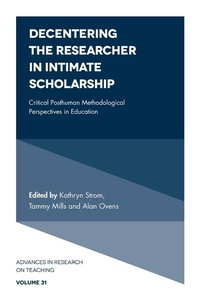
Decentering the Researcher in Intimate Scholarship
Critical Posthuman Methodological Perspectives in Education
Published on 17. October 2018
248 pages
978-1-78754-637-0 (ISBN)
Description

"Intimate
scholarship" refers to qualitative methodologies, such as self-study and autoethnography, that directly engage the personal
experience, knowledge, and/or practices of the researcher(s) as the focus of
inquiry. While intimate scholarship offers entrypoints into non-binary thinking
by blurring the line between researcher/researched, much work in this genre
continues to reinforce a humanist "I". In this volume, we ask what happens when
the researcher in forms of intimate scholarship is decentered, or is considered
as merely one part of an entangled material-discursive formation.
Chapters in this volume highlight ways that researchers
of teaching and teacher education can advance conversations in education while exploring theories with an ontological view of the
world as fundamentally multiple, dynamic, and fluid. Drawing on a range of methods, authors "put to work" posthuman, non-linear, and multiplistic theories and concepts to
disrupt and decenter the "I" in intimate methodologies. Also featured in this volume
are conversations with leading posthuman scholars, who
highlight the possibilities and challenges of decentering the researcher in
intimate scholarship as a practice of social justice research.
scholarship" refers to qualitative methodologies, such as self-study and autoethnography, that directly engage the personal
experience, knowledge, and/or practices of the researcher(s) as the focus of
inquiry. While intimate scholarship offers entrypoints into non-binary thinking
by blurring the line between researcher/researched, much work in this genre
continues to reinforce a humanist "I". In this volume, we ask what happens when
the researcher in forms of intimate scholarship is decentered, or is considered
as merely one part of an entangled material-discursive formation.
Chapters in this volume highlight ways that researchers
of teaching and teacher education can advance conversations in education while exploring theories with an ontological view of the
world as fundamentally multiple, dynamic, and fluid. Drawing on a range of methods, authors "put to work" posthuman, non-linear, and multiplistic theories and concepts to
disrupt and decenter the "I" in intimate methodologies. Also featured in this volume
are conversations with leading posthuman scholars, who
highlight the possibilities and challenges of decentering the researcher in
intimate scholarship as a practice of social justice research.
Reviews / Votes
Researchers mostly in education but also other social sciences address the problem that intimate research-qualitative research directly engaging the personal experience, knowledge, and/or practice of the researchers in the research-risks the self becoming sole focus of the research. They explore ways for researchers to decenter themselves, so they are just one part in a larger process that they are studying. Their topics include an autoethnographic literature review of experiences in doctoral education programs, new materialist auto-ethico-ethnography: agential-realist authenticity and objectivity in intimate scholarship, the rhizomes of academic practice: culturally and linguistically diverse students negotiating learning and belonging, becoming-with/in educational research: minor accounts as care-full inquiry, and Deleuzo-Guattarian decentering of the I/eye: a conversation with Jessica Ringrose and Shiva Zarabadi. -- Annotation (c)2018 * (protoview.com) * Researchers mostly in education but also other social sciences address the problem that intimate research--qualitative research directly engaging the personal experience, knowledge, and/or practice of the researchers in the research--risks the self becoming sole focus of the research. They explore ways for researchers to decenter themselves, so they are just one part in a larger process that they are studying. Their topics include an autoethnographic literature review of experiences in doctoral education programs, new materialist auto-ethico-ethnography: agential-realist authenticity and objectivity in intimate scholarship, the rhizomes of academic practice: culturally and linguistically diverse students negotiating learning and belonging, becoming-with/in educational research: minor accounts as care-full inquiry, and Deleuzo-Guattarian decentering of the I/eye: a conversation with Jessica Ringrose and Shiva Zarabadi. -- Annotation (c)2019 * (protoview.com) *More details
Series
Language
English
Place of publication
Bingley
United Kingdom
Target group
Professional and scholarly
File size
0,60 MB
ISBN-13
978-1-78754-637-0 (9781787546370)
Copyright in bibliographic data and cover images is held by Nielsen Book Services Limited or by the publishers or by their respective licensors: all rights reserved.
Schweitzer Classification
Other editions
Additional editions
Kathryn Strom | Tammy Mills | Alan Ovens
Decentering the Researcher in Intimate Scholarship
Critical Posthuman Methodological Perspectives in Education
Book
10/2018
Emerald Publishing Limited
€157.50
Shipment within 10-20 days
Persons
Kathryn
Strom is an Assistant Professor of Educational Leadership at
California State University, East Bay, USA. Her research interests include preparing
educators to work for social justice in classrooms and school systems, posthuman/materialist
theories, and post-qualitative methods of inquiry. Her recent work includes the
book Becoming-Teacher: A Rhizomatic Look
at First-Year Teaching and the development of a complex framework for
teacher learning-practice for the International Consortium of Multilingual
Excellence in Education.Tammy
Mills is an Assistant Professor
in the College of Education at the University of Maine, USA. Since joining the
University of Maine, she has taught a variety of teacher education courses with
an emphasis on access, equity, and assessment. Tammy focuses her research on
pre-service teachers preparing to teach in rural settings, and their (and her
own) experiences growing up and experiencing schooling in rural contexts, using
non-linear perspectives to guide her thinking and methodologies.
Alan Ovens is an Associate Professor in the School of
Curriculum and Pedagogy at the University of Auckland, New Zealand. His research
investigates the complex nature of educational practice, with particular
attention to critical pedagogy and social justice. His interests include
embodied learning, democratic forms of teaching, and digital technologies in
teacher education.
Strom is an Assistant Professor of Educational Leadership at
California State University, East Bay, USA. Her research interests include preparing
educators to work for social justice in classrooms and school systems, posthuman/materialist
theories, and post-qualitative methods of inquiry. Her recent work includes the
book Becoming-Teacher: A Rhizomatic Look
at First-Year Teaching and the development of a complex framework for
teacher learning-practice for the International Consortium of Multilingual
Excellence in Education.Tammy
Mills is an Assistant Professor
in the College of Education at the University of Maine, USA. Since joining the
University of Maine, she has taught a variety of teacher education courses with
an emphasis on access, equity, and assessment. Tammy focuses her research on
pre-service teachers preparing to teach in rural settings, and their (and her
own) experiences growing up and experiencing schooling in rural contexts, using
non-linear perspectives to guide her thinking and methodologies.
Alan Ovens is an Associate Professor in the School of
Curriculum and Pedagogy at the University of Auckland, New Zealand. His research
investigates the complex nature of educational practice, with particular
attention to critical pedagogy and social justice. His interests include
embodied learning, democratic forms of teaching, and digital technologies in
teacher education.
Content
Introduction: Decentering the Researcher in Intimate Scholarship; Kathryn Strom, Tammy Mills, & Alan OvensAffective Reverberations: The Methodological Excesses of a Research Assemblage; Adrian D. Martin
Teaching in, Relating in, and Researching in Online Teaching: The Desiring Cartographies of Two Second Language Teacher Educator Becomings; Francis Bangou and Stephanie Arnott
We, Monsters: An Autoethnographic Literature Review of Experiences in Doctoral Education Programs; Jordan Corson and Tara Schwitzman
Decentering the 'Self' in Self-Study of Professional Practices: A Working Research Assemblage; Mats Melvold Hordvik, Lars Tore Ronglan, Ann MacPhail and Deborah Tannehill
New Materialist Auto-ethico-ethnography: Agential-realist Authenticity and Objectivity in Intimate Scholarship; Chau Vu
Narrative Mining: A Poststructural Autoethnographic Method for Exploring Race and Identity in the Urban Classroom; John Wamsted
The Luxury of Vulnerability: Reflexive Inquiry as Privileged Praxis; Tricia M. Kress & Kimberly J. Frazier-Booth
The Rhizomes of Academic Practice: Culturally and Linguistically Diverse Students Negotiating Learning and Belonging; Radha Iyer
Pedagogy, Naked and Belated: Disappointment as Curriculum Inquiry; Brandon Sams
Art as a 'Thing that Does': Creative Assemblages, Expressive Lines of Flight, and Becoming-Cosmic-Artisan in Teacher Education; Kay Sidebottom and David Ball
Becoming-with/in Educational Research: Minor Accounts as Care-Full Inquiry; Maria Wallace
Affirmative Ethics, Posthuman Subjectivity, and Intimate Scholarship: A Conversation with Rosi Braidotti; Rosi Braidotti
Decentering Subjectivity After Descartes: A Conversation with Michael Peters; Michael Peters
Encounters and Materiality in Intimate Scholarship: A Conversation with Maggie MacLure; Maggie MacLure
Deleuzoguattarian Decentering of the Eye/I: A Conversation with Jessica Ringrose and Shiva Zarabadi; Jessica Ringrose and Shiva Hassan-Zarabadi
Teaching in, Relating in, and Researching in Online Teaching: The Desiring Cartographies of Two Second Language Teacher Educator Becomings; Francis Bangou and Stephanie Arnott
We, Monsters: An Autoethnographic Literature Review of Experiences in Doctoral Education Programs; Jordan Corson and Tara Schwitzman
Decentering the 'Self' in Self-Study of Professional Practices: A Working Research Assemblage; Mats Melvold Hordvik, Lars Tore Ronglan, Ann MacPhail and Deborah Tannehill
New Materialist Auto-ethico-ethnography: Agential-realist Authenticity and Objectivity in Intimate Scholarship; Chau Vu
Narrative Mining: A Poststructural Autoethnographic Method for Exploring Race and Identity in the Urban Classroom; John Wamsted
The Luxury of Vulnerability: Reflexive Inquiry as Privileged Praxis; Tricia M. Kress & Kimberly J. Frazier-Booth
The Rhizomes of Academic Practice: Culturally and Linguistically Diverse Students Negotiating Learning and Belonging; Radha Iyer
Pedagogy, Naked and Belated: Disappointment as Curriculum Inquiry; Brandon Sams
Art as a 'Thing that Does': Creative Assemblages, Expressive Lines of Flight, and Becoming-Cosmic-Artisan in Teacher Education; Kay Sidebottom and David Ball
Becoming-with/in Educational Research: Minor Accounts as Care-Full Inquiry; Maria Wallace
Affirmative Ethics, Posthuman Subjectivity, and Intimate Scholarship: A Conversation with Rosi Braidotti; Rosi Braidotti
Decentering Subjectivity After Descartes: A Conversation with Michael Peters; Michael Peters
Encounters and Materiality in Intimate Scholarship: A Conversation with Maggie MacLure; Maggie MacLure
Deleuzoguattarian Decentering of the Eye/I: A Conversation with Jessica Ringrose and Shiva Zarabadi; Jessica Ringrose and Shiva Hassan-Zarabadi
