

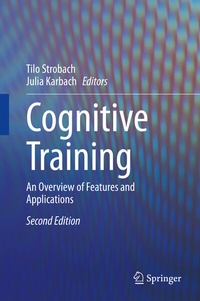
Cognitive Training
An Overview of Features and Applications
2nd Edition
Published on 20. October 2020
XIII, 420 pages
978-3-030-39292-5 (ISBN)
Description

The second edition of this book brings together a cutting edge international team of contributors to critically review the current knowledge regarding the effectiveness of training interventions designed to improve cognitive functions in different target populations. Since the publication of the first volume, the field of cognitive research has rapidly evolved. There is substantial evidence that cognitive and physical training can improve cognitive performance, but these benefits seem to vary as a function of the type and the intensity of interventions and the way training-induced gains are measured and analyzed. This book will address the new topics in psychological research and aims to resolve some of the currently debated issues.
This book offers a comprehensive overview of empirical findings and methodological approaches of cognitive training research in different cognitive domains (memory, executive functions, etc.), types of training (working memory training, video game training, physical training, etc.), age groups (from children to young and older adults), target populations (children with developmental disorders, aging workers, MCI patients etc.), settings (laboratory-based studies, applied studies in clinical and educational settings), and methodological approaches (behavioral studies, neuroscientific studies). Chapters feature theoretical models that describe the mechanisms underlying training-induced cognitive and neural changes.
Cognitive Training: An Overview of Features and Applications, Second Edition will be of interest to researchers, practitioners, students, and professors in the fields of psychology and neuroscience.
This book offers a comprehensive overview of empirical findings and methodological approaches of cognitive training research in different cognitive domains (memory, executive functions, etc.), types of training (working memory training, video game training, physical training, etc.), age groups (from children to young and older adults), target populations (children with developmental disorders, aging workers, MCI patients etc.), settings (laboratory-based studies, applied studies in clinical and educational settings), and methodological approaches (behavioral studies, neuroscientific studies). Chapters feature theoretical models that describe the mechanisms underlying training-induced cognitive and neural changes.
Cognitive Training: An Overview of Features and Applications, Second Edition will be of interest to researchers, practitioners, students, and professors in the fields of psychology and neuroscience.
More details
Series
Edition
Second Edition 2021
Language
English
Place of publication
Cham
Switzerland
Publishing group
Springer International Publishing
Target group
Professional and scholarly
Product notice
Reflowable
Illustrations
XIII, 420 p. 18 illus., 8 illus. in color.
File size
9,83 MB
ISBN-13
978-3-030-39292-5 (9783030392925)
DOI
10.1007/978-3-030-39292-5
Schweitzer Classification
Other editions
Additional editions
Book
10/2020
2nd Edition
Springer
€160.49
Shipment within 7-9 days
Previous edition

E-Book
11/2016
Springer
€96.29
Available for download
Persons
Tilo Strobach
finished his doctoral degree at Humboldt University of Berlin. After that, he held postdoc positions at this university and at Ludwig Maximilians University Munich. Currently, Tilo Strobach is full professor for cognitive psychology at the Medical School Hamburg. His research focuses on the analysis of cognitive plasticity as a result of training (e.g., video-game, dual-task, working memory, and task-switching training) and cognitive aging. Furthermore, he aims at specifying the cognitive processing architecture in situations that demand executive functions as well as the perception of complex objects.
Julia Karbach completed her PhD on the lifespan plasticity of cognitive development in 2008. She held positions at Saarland University and at Goethe-University Frankfurt. Since 2017, she serves as full professor for Developmental and Educational Psychology at the University of Koblenz-Landau. Her research focuses on neurocognitive development and plasticity across the lifespan. She currently investigates individual differences in executive control training (working memory, inhibition, flexibility) and physical training across a wide range of ages and populations (children, older adults, patients with cognitive impairments).
Julia Karbach completed her PhD on the lifespan plasticity of cognitive development in 2008. She held positions at Saarland University and at Goethe-University Frankfurt. Since 2017, she serves as full professor for Developmental and Educational Psychology at the University of Koblenz-Landau. Her research focuses on neurocognitive development and plasticity across the lifespan. She currently investigates individual differences in executive control training (working memory, inhibition, flexibility) and physical training across a wide range of ages and populations (children, older adults, patients with cognitive impairments).
Content
Chapter 1. Introduction.-
Section I: Basic concepts and methodology
.- Chapter 2. Methods and designs.- Chapter 3. Theoretical models of training and transfer effects.- Chapter 4. Statistical modeling of latent change.- Chapter 5. Training-related neural plasticity.- Chapter 6. Cognitive plasticity and brain stimulation.- Chapter 7. Individual differences and motivational effects.- Chapter 8. Genetics of neurocognitive plasticity.-
Section II: Plasticity in different age groups
.- Chapter 9. Childhood and adolescence.- Chapter 10. Middle & late adulthood.- Chapter 11. Very old age.-
Section III:
Plasticity of different cognitive domains
.- Chapter 12. Working memory.- Chapter 13. Episodic memory.- Chapter 14. Prospective memory.- Chapter 15. Executive functions.- Chapter 16. Speed of processing.- Chapter 17. Socio-cognitive processes.-
Section IV:
Multidomain trainings
.- Chapter 18. Action video-game training and its effects on perception and attentional control.- Chapter 19. Video-game training and effects on executive functions.- Chapter 20. Mindfulness and meditation training.- Chapter 21. Meta-cognitive training.- Chapter 22. Commercial brain games.- Chapter 23. Music training.- Chapter 24. Physical training.-
Section V:
Cognitive training in applied contexts
.- Chapter 25. Educational application of working-memory training.- Chapter 26. Cognitive training in children with neurodevelopmental disorders.- Chapter 27. Training-related neurophysiological changes in older age: senior workers and drivers.- Chapter 28. Cognitive training in MCI patients.-
Section VI: Outlook
.- Chapter 29. The future of cognitive training.
