

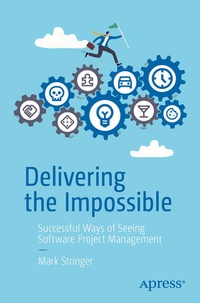
Delivering the Impossible
Description

Software is consuming nearly every aspect of our lives - from dating and finance to delivering food. There's never been a more important time to get better at delivering software. To stay competitive, to survive, we need our software projects to succeed. But far too often, projects that should have succeeded fail. They fail because we can't see what is going on in them. They fail because we are seeing them in the wrong way.
The message of this book is that we need to adopt the right point of view. Seeing things from the right point of view will make us smarter. It will allow us to successfully deliver projects, even when they seem impossible. Part 1 discusses seven ways of seeing software development projects that can make us smarter. Part 2 talks about unhelpful ways of seeing, if we aren't careful they can make us dumb.
The conclusion draws a map. It shows how we can pull ourselves away from unhelpful default thinking. It shows the ways of seeing that can help us move our projects in small, definite steps, in the right direction - towards success and delivering value for users and owners.
What You Will Learn
- Why commitment and consistency can be harmful in project management
- How to move in a conscious, principled, way, away from unhelpful perspectives
- How to avoid common mistakes that can either harm a project, or kill it entirely
Who This Book is For
Project managers who need to deliver software development initiatives. And their bosses - people who fund projects, people who have the ideas, and people whose businesses need new software to succeed, thrive and survive.
More details
Other editions
Additional editions
Person
Mark Stringer has worked in the software development industry for 30 years. He's been a programmer, applications researcher and, for the last 15 years, a project manager. He's worked with organizations such as IBM, Xerox and Cambridge University.
Mark wrote this book because of a realization. He seemed to be repeatedly reading the same book about project management, but with different titles. This book claimed that, if only you follow some prescribed methodology, everything would be lovely. His experience was that, no matter what methodology you used, things very often weren't lovely.
In recent years, as well as writing this book, he has written and performed a one-man show - "Delivering the Impossible," at the Brighton and Edinburgh Fringe Festivals. This is possibly the only fringe show on the subject of project management - ever! He has an honors degree in philosophy from the University of St. Andrews, Scotland.
Content
Introduction
Part One - Helpful ways of seeing
Chapter 1 Stream
Chapter2 Swamp
Chapter 3 Escape
Chapter4 Ship
'Chapter 5 Car
Chapter 6 BetChapter7 Not Bet
Part Two - Unhelpful ways of seeing
Chapter 8 Commit
Chapter 9 All
Chapter 10 Some
Chapter 11 Boss
Chapter 12 Conclusion
