

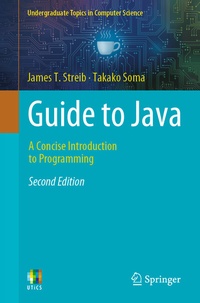
Guide to Java
Description

This textbook presents a focused and accessible primer on the fundamentals of Java programming, with extensive use of illustrative examples and hands-on exercises.
Addressing the need to acquire a good working model of objects in order to avoid possible misconceptions, the text introduces the core concepts of object-oriented programming at any stage, supported by the use of contour diagrams. Each chapter has one or more complete programs to illustrate the various ideas presented, and to help readers learn how to write programs on their own. Chapter summaries and practical exercises also are included to help the reader to review their progress and practice their skills.
This substantially updated second edition has been expanded with additional exercises, and includes new material on bit manipulation and parallel processing.
Topics and features:
- Introduces computing concepts in Chapter 0 for new programmers
- Adds new chapters on bit-manipulation and parallel processing
- Contains exercises at the end of each chapter with selected answers
- Supports both text-based and GUI-based Input/Output
- Objects can be introduced first, last, or intermixed with other material
- Uses contour diagrams to illustrate objects and recursion
- Discusses OOP concepts such as overloading, class methods, and inheritance
- Introduces string variables and illustrates arrays and array processing
- Discusses files, elementary exception processing, and the basics of Javadoc
This concise and easy-to-follow textbook/guide is ideal for students in an introductory programming course. It is also suitable as a self-study guide for both practitioners and academics.
More details
Other editions
Additional editions
Persons
Dr. James T. Streib is Professor Emeritus of Computer Science and Dr. Takako Soma is Associate Professor of Computer Science, and both are at Illinois College, Jacksonville, IL, USA. They are also co-authors of the follow-up text Guide to Data Structures.
Content
1. Variables, Input / Output and Arithmetic.- 2. Objects: An Introduction.- 3. Selection Structures.- 4. Iteration Structures.- 5. Objects: Revisited.- Strings.- 6. Arrays.- Recursion.- 7. Objects: Inheritance and Polymorphism.- 8. Elementary File Input and Output.- 9. Simple Graphical Input and Output.- 9. Exceptions.- 10. Java doc Comments.- 11. Glossary.- 12. Answers to Selected Exercises.
