
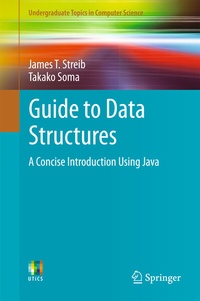
Guide to Data Structures
Description
Alles über E-Books | Antworten auf Fragen rund um E-Books, Kopierschutz und Dateiformate finden Sie in unserem Info- & Hilfebereich.
This clearly-written work is an ideal classroom text for a second semester course in programming using the Java programming language, in preparation for a subsequent advanced course in data structures and algorithms. The book is also eminently suitable as a self-study guide in either academe or industry.
Reviews / Votes
"This text is intended to provide undergraduates using Java with a concise, focused, and relatively simple coverage of some of the basic data structures in use. These include arrays, linked lists, trees, heaps (in arrays), and hash tables. . The book covers the algorithms and data structures well with clear language, abundant diagrams, and good exercises. It could be a good introduction for curricula using Java as a primary teaching language." (Jeffrey Putnam, Computing Reviews, July, 2018)More details
Other editions
Additional editions
Persons
Dr. James T. Streib
is a Professor of Computer Science at Illinois College, Jacksonville, IL, USA.
Dr. Takako Soma
is an Associate Professor of Computer Science at the same institution.
Content
Preliminary Concepts.- Stacks Using Arrays.- Queues Using Arrays.- Lists Using Arrays.- Lists Using Objects and References.- Ordered Linked Lists.- Stacks and Queues Using References.- Binary Trees.- Sorting.- Heaps.- Hashing.

System requirements
File format: PDF
Copy protection: Watermark-DRM (Digital Rights Management)
System requirements:
- Computer (Windows; MacOS X; Linux): Use the free software Adobe Reader, Adobe Digital Editions, or any other PDF viewer of your choice (see eBook Help).
- Tablet/Smartphone (Android; iOS): Install the free app Adobe Digital Editions or another reading app for eBooks, e.g., PocketBook (see eBook Help).
- E-reader: Bookeen, Kobo, Pocketbook, Sony, Tolino and many more (only limited: Kindle).
The file format PDF always displays a book page identically on any hardware. This makes PDF suitable for complex layouts such as those used in textbooks and reference books (images, tables, columns, footnotes). Unfortunately, on the small screens of e-readers or smartphones, PDFs are rather annoying, requiring too much scrolling.
This eBook uses Watermark-DRM, a „soft” copy protection. This means that there are no technical restrictions to prevent illegal distribution. However, there is a personalised watermark embedded in the eBook that can be used to identify the purchaser of the eBook in the event of misuse and to provide evidence for legal purposes.
For more information, see our eBook Help page.