

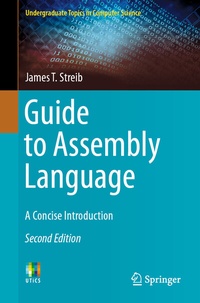
Guide to Assembly Language
Description

This concise guide is designed to enable the reader to learn how to program in assembly language as quickly as possible. Through a hands-on programming approach, readers will also learn about the architecture of the Intel processor, and the relationship between high-level and low-level languages.
This updated second edition has been expanded with additional exercises, and enhanced with new material on floating-point numbers and 64-bit processing.
Topics and features: provides guidance on simpli?ed register usage, simpli?ed input/output using C-like statements, and the use of high-level control structures; describes the implementation of control structures, without the use of high-level structures, and often with related C program code; illustrates concepts with one or more complete program; presents review summaries in each chapter, together with a variety of exercises, from short-answer questions to programming assignments; covers selection and iteration structures, logic,shift, arithmetic shift, rotate, and stack instructions, procedures and macros, arrays, and strings; includes an introduction to floating-point instructions and 64-bit processing; examines machine language from a discovery perspective, introducing the principles of computer organization.A must-have resource for undergraduate students seeking to learn the fundamentals necessary to begin writing logically correct programs in a minimal amount of time, this work will serve as an ideal textbook for an assembly language course, or as a supplementary text for courses on computer organization and architecture. The presentation assumes prior knowledge of the basics of programming in a high-level language such as C, C++, or Java.
More details
Other editions
Additional editions
Person
Content
Variables, Registers, and Data Movement.- Input/Output.- Arithmetic Instructions.- Selection Structures.- Iteration Structures.- Logic, Shifting, Rotating, and Stacks.- Procedures and Macros.- Arrays.- Strings.- Floating-Point Instructions.- 64-bit Processing.- Selected Machine Language Instructions.- Appendix A: Directions for MASM in Visual Studio 2019 Community Edition.- Appendix B: Binary, Hexadecimal, Logic, and Arithmetic.- Appendix C: Glossary.- Appendix D: Selected Assembly Language Instructions.- Appendix E: Answers to Selected Exercises.
