

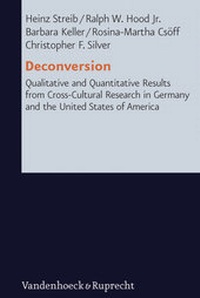
Deconversion
Qualitative and Quantitative Results from Cross-Cultural Research in Germany and the United States of America
1st Edition
Published on 12. July 2011
262 pages
978-3-647-60439-8 (ISBN)
Description

This book presents case studies and empirical data of a phenomenon which increasingly gains popularity in Western societies: deconversion. There is, the authors argue, no better word than deconversion to describe processes of disengagement from religious orientations because these have much in common with conversion. Termination of membership may eventually be the final step of deconversion, but it involves biographical and psychological dynamics which can and need to be reconstructed by qualitative approaches and analyzed by quantitative instruments.In the Bielefeld-based Cross-Cultural Study on Deconversion disengagement processes from a variety of religious backgrounds in the USA and in Germany were examined, ranging from well-established religious organizations to new religious and fundamentalist groups. Nearly 1,200 persons participated in thestudy and were interviewed from 2002 to 2005. In the focus of the study are 100 deconverts from the USA and from Germany who were examined with narrative interviews, faith development interviews and an extensive questionnaire. For case study elaboration, the study followed a research design with an innovative triangulation of qualitative and quantitative data. Four chapters, corresponding to four types of deconversion, present 21 case studies. The highlights of the research project are new data on spirituality - the deconverts in particular appear to prefer a »more spiritual than religious« self-identification - and in-depth analyses of a variety of deconversion narratives with special focus on personality factors, motivation, attitudes, religious development, psychological well-being and growth, religious fundamentalism and right-wing authoritarianism. The results of this project which was funded by the Deutsche Forschungsgemeinschaft are of special relevance for counselling and pastoral care, for religious education and for people concerned with administration and management of religious groups and churches, but also for a wider audience interested in contemporary changes in the religious fields in the USA and Germany.
More details
Other editions
Additional editions
Heinz Streib | Ralph W. Hood | Barbara Keller
Deconversion
Qualitative and Quantitative Results from Cross-Cultural Research in Germany and the United States of America
Book
07/2011
1st Edition
Vandenhoeck & Ruprecht
from
€89.00
Shipment within 5-7 days
Persons
Author
Dr. theol. Heinz Streib ist Professor für Praktische Theologie, Religionspädagogik, Religionspsychologie und Biographische Religionsforschung an der Universität Bielefeld.
Christopher F. Silver promoviert in Religionspädagogik und ist Lehrbeauftragter für Psychologie an der Universität von Tennessee in Chattanooga.
Rosina-Martha Csöff ist Diplom-Soziologin und wissenschaftliche Assistentin an der Evangelischen Fachhochschule Ludwigsburg-Reutlingen.
Dr. Barbara Keller ist Diplom-Psychologin und arbeitet am Zentrum für Psychotraumatologie in Krefeld.
Ralph W. Hood, Jr., PhD, ist Professor für Psychologie an der Universität von Tennessee in Chattanooga.
Foreword
Content
- Front Cover
- Title Page
- Copyright
- Table of Contents
- Body
- Foreword by James T. Richardson
- Introduction
- 1 What is Deconversion? - Profiling the Concept
- 1.1 From Conversion to Deconversion
- 1.2 Conceptualizing Deconversion
- 1.3 The Religious Styles Perspective on Deconversion
- 1.4 The Variety of Deconversion Trajectories
- 1.5 Deconversion as Migration in the Religious Field
- 2 Empirical Studies on Deconversion
- 2.1 Deconversion in the United States: Survey Results
- 2.2 Deconversion in Germany: Survey Results
- 2.3 Deconversion in Cross-Cultural Perspective
- 2.4 Previous Interview Research on Deconversion
- 3 Our Study: Design, Methods and Sample Characteristics
- 3.1 The Qualitative Core of our Design
- 3.2 The Basic Unit of Research
- 3.3 Methods and Instruments
- 3.4 Sample Description and Levels of Analysis
- 3.5 Summary of Research Questions and Hypotheses
- 4 Characteristics and Predictors of Deconversion in Germany and the United States: Quantitative Results
- 4.1 Reliabilities and Intercorrelations among the Scales
- 4.2 How Deconverts Differ from In-Tradition Members
- 4.3 Cross-Cultural Differences: Indications of a Loss for Deconverts in Germany?
- 4.4 "More Spiritual than Religious" Self-Identification and Deconversion
- 4.5 Summary of Scale Analyses and Group Differences
- 4.6 Regression Analysis to Predict Deconversion
- 5 The Variety of Deconversion Narratives: An Overview from Qualitative Results
- 5.1 Qualitative Sample Characteristics and the Evaluation Procedures
- 5.2 General Characteristics of the Deconversion Narratives
- 5.3 Where Did the Deconverts Go? - Deconversion Trajectories Quantified
- 5.4 Deconversion: Transformation in Faith Development and Religious Styles
- 5.5 Preparing for Case Study Analyses and our Typology Construction
- 6 Pursuit of Autonomy
- 6.1 "Church for Me right now is Non-existent:" Gina
- 6.2 "Now I'm Kind of just Exploring .:" Samantha
- 6.3 "It Took Me a Long Time after I Left the Religion to Stop Believing in God:" Timothy
- 6.4 Coming-Out and Stepping Out - Issues of (Sexual) Identity: Christoph
- 6.5 "Eventually I Became like More and More Critical of My Religion:" Mehmet
- 6.6 Conclusion
- 7 Debarred from Paradise
- 7.1 Love and Hate for the Guru - and a Recovery: Pia
- 7.2 ". suddenly the Frame of Reference is Missing:" Peter
- 7.3 From Feeling Sheltered to Feeling Cheated: Elisabeth
- 7.4 ". It's like Watching when Your Relatives Die:" Adam
- 7.5 Regretting Lost Years: Franz
- 7.6 "Scientology is Very Godless .:" Fiona
- 7.7 "I ... Noticed a Lot of ... Double Standard Moral and a Lot of Dishonesty:" Celia
- 7.8 Conclusion
- 8 Finding a New Frame of Reference
- 8.1 ". at that Moment God Spoke to Me" - the End of the Search: Sabina
- 8.2 "Inside Myself I have this Certainty.:" Viviane
- 8.3 Discovering Intrinsic Religion: Melina
- 8.4 "I Became Orthodox . Because of that Tradition, the Holy Tradition:" Dan
- 8.5 "The Saints Things . is Really Big with Me": Jasmin
- 8.6 Conclusion
- 9 Life-Long Quests - Late Revisions
- 9.1 Looking Back on a "Cult" of the Seventies: Erica
- 9.2 Midlife Revisions of a Seeker: Tom
- 9.3 Synthetic-Conventional Heresy: Gudrun
- 9.4 Ongoing Quest and Multiple Deconversions: Konrad
- 9.5 Conclusion
- 10 Deconversion in Biographical and Cultural Perspective: Conclusions and Discussion
- 10.1 What is Deconversion?
- 10.2 How Does Deconversion Come About? - Motivations and Causes
- 10.3 What Does One Get Out of Deconversion? - About Gains and Losses
- 10.4 Deconversion Dynamics in the Religious Field
- 10.5 Deconversion and Spiritual Quest - An Outlook
- References
- List of Figures and Tables
- Index of Names
- Index of Subjects
- Author Information
- Back Cover
