

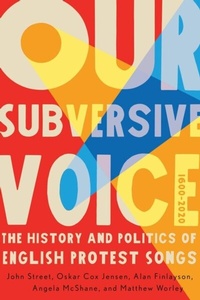
Our Subversive Voice
The History and Politics of English Protest Songs, 1600-2020
1st Edition
Published on 11. March 2025
309 pages
978-0-2280-2401-9 (ISBN)
Description

Whether accompanying a march, a sit-in, or a confrontation with police, songs and protest are inextricably linked. As a tool for political activism, the protest song spells out the issues at the heart of each cause. Over a surprisingly long history, it has been used to spread ideas, inspire political imagination, and motivate political action.
The protest song is - and has always been - a form of political oratory as vital to political representation as it is to performance. Investigating five centuries of English history, Our Subversive Voice establishes that the protest song is not merely the preserve of singer-songwriters; it is a mode of political communication that has been used to confront many systems of oppression across its many genres, from street ballads to art song, grime to hymns, and music hall to punk. Our Subversive Voice traces the history of the protest song, examines its rhetorical forms, and explores the conditions of its genesis. It recounts how these songs have addressed discrimination and inequality, exploitation and the environment, and immigration and identity, and how institutions and organizations have sought both to facilitate and to suppress them. Drawing on a large and diverse corpus of songwriters, this book argues that song does more than accompany protest: it choreographs and communicates it.
The protest song, Our Subversive Voice shows, is an enduring, affecting, and effective means of expression and an essential element in understanding the drive to create political change, in the past and for the future.
The protest song is - and has always been - a form of political oratory as vital to political representation as it is to performance. Investigating five centuries of English history, Our Subversive Voice establishes that the protest song is not merely the preserve of singer-songwriters; it is a mode of political communication that has been used to confront many systems of oppression across its many genres, from street ballads to art song, grime to hymns, and music hall to punk. Our Subversive Voice traces the history of the protest song, examines its rhetorical forms, and explores the conditions of its genesis. It recounts how these songs have addressed discrimination and inequality, exploitation and the environment, and immigration and identity, and how institutions and organizations have sought both to facilitate and to suppress them. Drawing on a large and diverse corpus of songwriters, this book argues that song does more than accompany protest: it choreographs and communicates it.
The protest song, Our Subversive Voice shows, is an enduring, affecting, and effective means of expression and an essential element in understanding the drive to create political change, in the past and for the future.
Reviews / Votes
"Our Subversive Voice is a model of cross-disciplinary conceptualization, treating politics as cultural activity and music-making as political activity. Covering a broad sweep in time period and musical genres, it is a fascinating and wonderfully fruitful contribution." Simon Frith, University of Edinburgh and co-author of The History of Live Music in Britain "These songs are for singing; for marching to or for making sitting on hard concrete for hours more bearable; for bringing people together especially when the opposition can be dangerous or overwhelming. Thanks to all those who made them possible." Peggy Seeger, American singer and songwriter "Our Subversive Voice is thoroughly absorbing. The authors have succeeded in delivering a study of great significance." Michael Brocken, author of The British Folk Revival Second EditionMore details
Series
Language
English
Place of publication
Canada
Canada
Illustrations
18 photos
ISBN-13
978-0-2280-2401-9 (9780228024019)
Copyright in bibliographic data and cover images is held by Nielsen Book Services Limited or by the publishers or by their respective licensors: all rights reserved.
Schweitzer Classification
Other editions
Additional editions
John Street | Oskar Cox Jensen | Alan Finlayson
Our Subversive Voice
The History and Politics of English Protest Songs, 1600-2020
Book
03/2025
McGill-Queen's University Press
€31.00
Shipment within 15-20 days
Persons
John Street is emeritus professor of politics at the University of East Anglia.
Oskar Cox Jensen is a NUAcT Fellow in music at Newcastle University.
Alan Finlayson is professor of political and social theory at the University of East Anglia.
Angela McShane is honorary reader in history at the University of Warwick.
Matthew Worley is professor of modern history at the University of Reading.
Oskar Cox Jensen is a NUAcT Fellow in music at Newcastle University.
Alan Finlayson is professor of political and social theory at the University of East Anglia.
Angela McShane is honorary reader in history at the University of Warwick.
Matthew Worley is professor of modern history at the University of Reading.
Content
- Cover
- OUR SUBVERSIVE VOICE
- Series Page
- Title
- Copyright
- Dedication
- CONTENTS
- Figures
- Acknowledgements
- Authors' Note
- Introduction
- 1 Protest (and) Song's Long History
- 2 The Protest Song as Politics and Political Theory
- 3 The Protest Song as Rhetoric and Oratory
- 4 Performing Protest and Claiming Representation
- 5 Producing the Protest Song
- 6 The Regulation and Repression of the Protest Song
- Conclusion
- Notes
- Index of Songs
- General Index
