

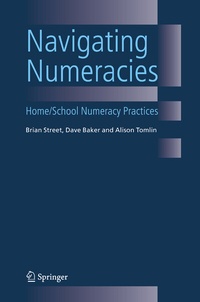
Navigating Numeracies
Description

More details
Other editions
Additional editions
Persons
Dave Baker studied mathematics before becoming a teacher of mathematics in schools. He taught on teacher education programmes and then undertook research into teaching and learning mathematics in schools and its links to children's homes. He has focused on issues of social justice in mathematics and has sought to extend current developments in pedagogy towards widening access and to the need to transform dominant practices in schooling. He has published two books, presented at many conferences and published academic papers on mathematics education.
Prof. Street trained in anthropology and has a longstanding commitment to linking ethnographic-style research on the cultural dimension of language and literacy with contemporary practice in education and in development. He has engaged in this in a number of countries - USA, S. Africa, Nepal, India, Iran etc. and has published 12 books and over 80 academic articles in international contexts. He has recently worked with colleagues in mathematics education to consider the implications of these approaches for numeracy research, pedagogy and curriculum.
Dr. Alison Tomlin has worked as a teacher and manager in adult literacy and numeracy community education settings, and as a manager of an inner city adult education programme which sought to be responsive to demand for education from local communities. Following doctoral research in adult numeracy education organised in collaboration with a group of students of adult numeracy, she was a researcher with the home/school numeracy practices team, and is now researching in adult numeracy. She has published articles relating to home/school numeracy practices research and to adult literacy and numeracy education.
Content
Preface.- Margaret Brown: The Leverhulme Numeracy Programme.- The Context: Section Introduction. Introduction: The research aims and synopsis of book.- Explanations for low achievement; class, poverty, ethnicity.- Theory and Methodology: Section Introduction.- Theoretical Positions: A 'social practice' approach to numeracy; Numeracy events and practices.- Methodology: Exploring the relationship between home and school; domains and sites, case studies and critical incidents.- Case Studies: Section Introduction.- Children: a Seth (Mo)b Kim (Ta) c Antonia (Ro).- Schools a Mountford b Tarnside c Rowan.- Themes: Section Introduction.- Numeracy Practices at School: Engagement, Coded Questions and Switching.- Numeracy Practices at home: Cultural resources.- Numeracy Practices: relations of Home and School.- Conclusion: Explanations for Low achievement.- Implications for Practice, Policy and Research.
