

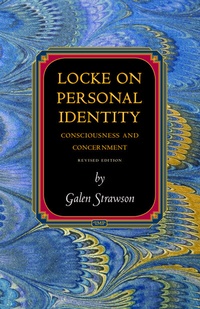
Locke on Personal Identity
Consciousness and Concernment - Updated Edition
1st Edition
Published on 28. July 2015
280 pages
978-1-4008-5184-3 (ISBN)
Description

John Locke's theory of personal identity underlies all modern discussion of the nature of persons and selves-yet it is widely thought to be wrong. In this book, Galen Strawson argues that in fact it is Locke's critics who are wrong, and that the famous objections to his theory are invalid. Indeed, far from refuting Locke, they illustrate his fundamental point.
Strawson argues that the root error is to take Locke's use of the word "person" as merely a term for a standard persisting thing, like "human being." In actuality, Locke uses "person" primarily as a forensic or legal term geared specifically to questions about praise and blame, punishment and reward. This point is familiar to some philosophers, but its full consequences have not been worked out, partly because of a further error about what Locke means by the word "conscious." When Locke claims that your personal identity is a matter of the actions that you are conscious of, he means the actions that you experience as your own in some fundamental and immediate manner.
Clearly and vigorously argued, this is an important contribution both to the history of philosophy and to the contemporary philosophy of personal identity.
Strawson argues that the root error is to take Locke's use of the word "person" as merely a term for a standard persisting thing, like "human being." In actuality, Locke uses "person" primarily as a forensic or legal term geared specifically to questions about praise and blame, punishment and reward. This point is familiar to some philosophers, but its full consequences have not been worked out, partly because of a further error about what Locke means by the word "conscious." When Locke claims that your personal identity is a matter of the actions that you are conscious of, he means the actions that you experience as your own in some fundamental and immediate manner.
Clearly and vigorously argued, this is an important contribution both to the history of philosophy and to the contemporary philosophy of personal identity.
All prices
More details
Edition
Updated Edition
Language
English
Place of publication
Princeton, NJ
Publishing group
De Gruyter
Target group
Professional and scholarly
Edition type
Digital original
Product notice
Reflowable
Illustrations
4 line illus.
File size
3,24 MB
ISBN-13
978-1-4008-5184-3 (9781400851843)
Schweitzer Classification
Other editions
Additional editions
Book
07/2014
Princeton University Press
€31.30
Shipment within 10-20 days
Persons
Galen Strawson is professor of philosophy at the University of Texas at Austin. His many books include Freedom and Belief and Selves: An Essay in Revisionary Metaphysics.
Content
Preface xi
Chapter 1 Introduction 1
Chapter 2 "Person" 5
Chapter 3 "Person . . . is a forensic term" 17
Chapter 4 Concernment 22
Chapter 5 Consciousness 30
Chapter 6 "Consciousness . . . is inseparable from thinking "42
Chapter 7 "From the inside" 50
Chapter 8 "Person"--Locke's Definition 58
Chapter 9 Consciousness Is Not Memory 72
Chapter 10 Personal Identity 77
Chapter 11 Psychological Connectedness 88
Chapter 12 Transition (Butler Dismissed) 93
Chapter 13 "But next . . . ": Personal Identity without Substantial Continuity 97
Chapter 14 "And therefore . . . ": [I]-transfers, [Ag]-transfers, [P]-transfers 110
Chapter 15 "A fatal error of theirs" 119
Chapter 16 A Fatal Error of Locke's? 125
Chapter 17 Circularity? 131
Chapter 18 The Distinction between [P] and [S] 135
Chapter 19 Concernment and Repentance 139
Chapter 20 Conclusion 150
Postface 157
Appendix 1 "Of Identity and Diversity" by John Locke 163
Appendix 2 A Defence of Mr. Locke's Opinion Concerning Personal Identity by Edmund Law 233
References 253
Index 259
Chapter 1 Introduction 1
Chapter 2 "Person" 5
Chapter 3 "Person . . . is a forensic term" 17
Chapter 4 Concernment 22
Chapter 5 Consciousness 30
Chapter 6 "Consciousness . . . is inseparable from thinking "42
Chapter 7 "From the inside" 50
Chapter 8 "Person"--Locke's Definition 58
Chapter 9 Consciousness Is Not Memory 72
Chapter 10 Personal Identity 77
Chapter 11 Psychological Connectedness 88
Chapter 12 Transition (Butler Dismissed) 93
Chapter 13 "But next . . . ": Personal Identity without Substantial Continuity 97
Chapter 14 "And therefore . . . ": [I]-transfers, [Ag]-transfers, [P]-transfers 110
Chapter 15 "A fatal error of theirs" 119
Chapter 16 A Fatal Error of Locke's? 125
Chapter 17 Circularity? 131
Chapter 18 The Distinction between [P] and [S] 135
Chapter 19 Concernment and Repentance 139
Chapter 20 Conclusion 150
Postface 157
Appendix 1 "Of Identity and Diversity" by John Locke 163
Appendix 2 A Defence of Mr. Locke's Opinion Concerning Personal Identity by Edmund Law 233
References 253
Index 259

