

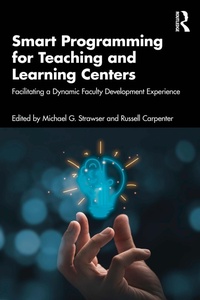
Smart Programming for Teaching and Learning Centers
Facilitating a Dynamic Faculty Development Experience
Published on 2. March 2026
168 pages
978-1-040-59675-3 (ISBN)
Description

Smart Programming for Teaching and Learning Centers offers comprehensive programming suggestions, frameworks, and strategies for creating flexible and effective faculty development experiences.
The pressure for teaching and learning centers to "keep up" and maintain their relevance is compounded by persistent challenges in faculty recruitment, buy-in, and rapidly evolving instructor and student needs. This diverse group of faculty development experts, led by the Managing Editor and Editor-in-Chief of the Journal of Faculty Development, assists readers in tweaking current programming and developing new models. Contributors provide innovative recommendations and detailed case studies, covering topics such as faculty learning communities, mentorship programs, retreats, asynchronous learning, and more. Helpful appendices include survey questions, planning guides, evaluation templates, and other quick-use resources.
This practical guide takes the guesswork out of effective initiatives, serving as an invaluable resource for faculty development professionals seeking an inside look at what centers across the country are doing in terms of programming, culture, and assessment.
The pressure for teaching and learning centers to "keep up" and maintain their relevance is compounded by persistent challenges in faculty recruitment, buy-in, and rapidly evolving instructor and student needs. This diverse group of faculty development experts, led by the Managing Editor and Editor-in-Chief of the Journal of Faculty Development, assists readers in tweaking current programming and developing new models. Contributors provide innovative recommendations and detailed case studies, covering topics such as faculty learning communities, mentorship programs, retreats, asynchronous learning, and more. Helpful appendices include survey questions, planning guides, evaluation templates, and other quick-use resources.
This practical guide takes the guesswork out of effective initiatives, serving as an invaluable resource for faculty development professionals seeking an inside look at what centers across the country are doing in terms of programming, culture, and assessment.
More details
Language
English
Place of publication
London
United Kingdom
Publishing group
Taylor & Francis Ltd
Target group
College/higher education
Professional and scholarly
Illustrations
18 Tables, black and white; 3 Line drawings, black and white; 3 Illustrations, black and white
File size
86,69 MB
ISBN-13
978-1-040-59675-3 (9781040596753)
Copyright in bibliographic data and cover images is held by Nielsen Book Services Limited or by the publishers or by their respective licensors: all rights reserved.
Schweitzer Classification
Other editions
Additional editions
Michael G. Strawser | Russell Carpenter
Smart Programming for Teaching and Learning Centers
Facilitating a Dynamic Faculty Development Experience
Book
approx. 03/2026
1st Edition
Routledge
€211.00
Not yet published
Michael G. Strawser | Russell Carpenter
Smart Programming for Teaching and Learning Centers
Facilitating a Dynamic Faculty Development Experience
Book
approx. 03/2026
1st Edition
Routledge
€51.90
Not yet published
Persons
Michael G. Strawser is an Associate Professor in the Nicholson School of Communication and Media at the University of Central Florida and the Director of Community Engaged Scholarship for UCF Downtown. He earned his Ph.D. in Instructional Communication from the University of Kentucky in 2015. His research interests include communication pedagogy, faculty development, organizational communication, and generational dynamics in the workplace. He has published multiple books and articles on teaching and learning in higher education and frequently presents at national and international conferences.
Russell Carpenter, Ph.D., is Assistant Provost and Professor of English at Eastern Kentucky University. Carpenter also serves as Editor-in-Chief of the Journal of Faculty Development. He is a columnist for the National Teaching & Learning Forum. Articles have appeared in Change: The Magazine of Higher Education, Journal of Excellence in College Teaching and Learning, International Journal for Students as Partners, Learning Communities Journal, and Journal on Excellence in College Teaching among others.
Russell Carpenter, Ph.D., is Assistant Provost and Professor of English at Eastern Kentucky University. Carpenter also serves as Editor-in-Chief of the Journal of Faculty Development. He is a columnist for the National Teaching & Learning Forum. Articles have appeared in Change: The Magazine of Higher Education, Journal of Excellence in College Teaching and Learning, International Journal for Students as Partners, Learning Communities Journal, and Journal on Excellence in College Teaching among others.
Content
1. Teaching and Learning Centers and Their Place on Campus 2. From Bridging to Bonding: Reaching Targeted Faculty Populations 3. Securing Faculty Engagement in Professional Development Programs 4. Assessing Teaching and Learning Centers 5. The Miami University Model for Establishing, Facilitating, and Assessing Faculty Learning Communities 6. Mentorship Programs 7. Workshops and Seminars 8. Asynchronous Learning 9. Hybrid Programming 10. Retreats and Institutes 11. Demonstrating Impact: Writing the Report
