

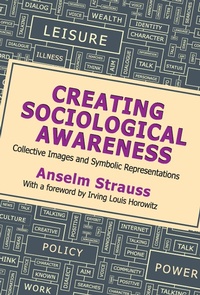
Creating Sociological Awareness
Collective Images and Symbolic Representations
1st Edition
Published on 6. February 2018
458 pages
978-1-351-52525-1 (ISBN)
Description

This volume of papers from the distinguished sociologist Anselm Strauss reflects his self-professed lifelong intention to create sociological awareness in his readers and students. As Irving Louis Horowitz notes in his foreword to the book, at the center of Strauss's effort has been the democratization of sociology. He has achieved this goal by making sure that relativities of status, power, and wealth are acknowledged in the conduct of everyday life, and by recognition that all collective life is subject to negotiation, rearrangement and reconstruction.
Represented here is some of the work for which Strauss is best known, and the principal themes that have captured his imagination throughout his productive career. These include work, leisure, culture, illness, identity, and policy. All are linked by Strauss's "web of negotiation" by which organizational arrangements can be changed. The volume concludes with a selection of his work in problems of method, consultation, and teaching, affirming Strauss's commitment to passing along the sociological awareness reflected in this volume to a next generation.
Squarely in the long tradition of the Chicago School of sociology, the work of Anselm Strauss represents the very best thinking in modem sociological and psychological analysis. Those interested in the development of his major conceptual frameworks, as well as those interested in the development of the specific subject areas to which Anselm Strauss has devoted his career will find this an essential volume. Professionals in the history of sociology, the sociology of knowledge, or medical sociology will find the book of particular interest.
Represented here is some of the work for which Strauss is best known, and the principal themes that have captured his imagination throughout his productive career. These include work, leisure, culture, illness, identity, and policy. All are linked by Strauss's "web of negotiation" by which organizational arrangements can be changed. The volume concludes with a selection of his work in problems of method, consultation, and teaching, affirming Strauss's commitment to passing along the sociological awareness reflected in this volume to a next generation.
Squarely in the long tradition of the Chicago School of sociology, the work of Anselm Strauss represents the very best thinking in modem sociological and psychological analysis. Those interested in the development of his major conceptual frameworks, as well as those interested in the development of the specific subject areas to which Anselm Strauss has devoted his career will find this an essential volume. Professionals in the history of sociology, the sociology of knowledge, or medical sociology will find the book of particular interest.
More details
Edition
1. Auflage
Language
English
Place of publication
London
United Kingdom
Publishing group
Taylor & Francis Ltd
Target group
College/higher education
File size
3,11 MB
ISBN-13
978-1-351-52525-1 (9781351525251)
Copyright in bibliographic data and cover images is held by Nielsen Book Services Limited or by the publishers or by their respective licensors: all rights reserved.
Schweitzer Classification
Other editions
Additional editions
Book
12/2016
1st Edition
Routledge
€62.00
Shipment within 10-15 days

Book
01/1991
1st Edition
Transaction Publishers
€215.41
Article not available at the moment
Content
Contents
Foreword
Irving Louis Horowitz
Preface
Acknowledgments
I. Interaction
1. The Chicago Tradition's Ongoing Theory of Action/Interaction
2. Closed Awareness (With Barney Glaser)
3. Face-to-Face Interaction: Complex and Developmental
4. Structured Interactional Process
II. Work
5. Work and the Division of Labour
6. Th e Articulation of Project Work: An Organizational Process
7. Sentimental Work (With Shizuko Fagerhaugh, Barbara Suczek, and Carolyn Wiener)
III. Trajectory
8. Trajectory Framework for Management of Chronic Illness (With Juliet Corbin)
9. Illness Trajectories (With Shizuko Fagerhaugh, Barbara Suczek, and Carolyn Wiener)
IV. Negotiation
10. Negotiated Order and the Coordination of Work(With Rue Bucher, Danuta Ehrlich, Melvin Sabshin, and Leonard Schatzman)
11. General Considerations: An Introduction
12. Paradigm and Prospects for a General Theory of Negotiation
V. Social Worlds
13. A Social World Perspective
14. Professions in Process (With Rue Bucher)
15. Memo on Science and Policy Arenas: Some Summary Notes
VI. Collective Images and Symbolic Representations
16. The Symbolic Time of Cities
17. Images of Immigration and Ethnicity
VII. Identity
18. Transformations of Identity
VIII. Body and Biography
19. Experiencing Body Failure and a Disrupted Self-Image (With Juliet Corbin)
20. Comeback: Th e Process of Overcoming Disability (With Juliet Corbin)
21. Body, Action-Performance, and Everyday Life
IX. Policy
22. Medical Ghettos
23. Implications for Delivering Safe and Humane Care (With Shizuko Fagerhaugh, Barbara Suczek, and Carolyn Wiener)
24. A Model for Reorganizing Health Care Delivery (With Juliet Corbin)
X. Method, Consultation, and Teaching
25. Criteria for Evaluating a Grounded Theory (With Juliet Corbin)
26. Tracing Lines of Conditional Influence: Matrix and Paths (With Juliet Corbin)
27. Research Consultations and Teaching: Guidelines, Strategies, and Style
Subject Index
Author Index
Foreword
Irving Louis Horowitz
Preface
Acknowledgments
I. Interaction
1. The Chicago Tradition's Ongoing Theory of Action/Interaction
2. Closed Awareness (With Barney Glaser)
3. Face-to-Face Interaction: Complex and Developmental
4. Structured Interactional Process
II. Work
5. Work and the Division of Labour
6. Th e Articulation of Project Work: An Organizational Process
7. Sentimental Work (With Shizuko Fagerhaugh, Barbara Suczek, and Carolyn Wiener)
III. Trajectory
8. Trajectory Framework for Management of Chronic Illness (With Juliet Corbin)
9. Illness Trajectories (With Shizuko Fagerhaugh, Barbara Suczek, and Carolyn Wiener)
IV. Negotiation
10. Negotiated Order and the Coordination of Work(With Rue Bucher, Danuta Ehrlich, Melvin Sabshin, and Leonard Schatzman)
11. General Considerations: An Introduction
12. Paradigm and Prospects for a General Theory of Negotiation
V. Social Worlds
13. A Social World Perspective
14. Professions in Process (With Rue Bucher)
15. Memo on Science and Policy Arenas: Some Summary Notes
VI. Collective Images and Symbolic Representations
16. The Symbolic Time of Cities
17. Images of Immigration and Ethnicity
VII. Identity
18. Transformations of Identity
VIII. Body and Biography
19. Experiencing Body Failure and a Disrupted Self-Image (With Juliet Corbin)
20. Comeback: Th e Process of Overcoming Disability (With Juliet Corbin)
21. Body, Action-Performance, and Everyday Life
IX. Policy
22. Medical Ghettos
23. Implications for Delivering Safe and Humane Care (With Shizuko Fagerhaugh, Barbara Suczek, and Carolyn Wiener)
24. A Model for Reorganizing Health Care Delivery (With Juliet Corbin)
X. Method, Consultation, and Teaching
25. Criteria for Evaluating a Grounded Theory (With Juliet Corbin)
26. Tracing Lines of Conditional Influence: Matrix and Paths (With Juliet Corbin)
27. Research Consultations and Teaching: Guidelines, Strategies, and Style
Subject Index
Author Index
