

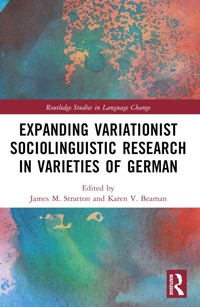
Expanding Variationist Sociolinguistic Research in Varieties of German
1st Edition
Published on 29. November 2024
280 pages
978-1-040-15642-1 (ISBN)
Description

This collection provides a broad account of variationist sociolinguistic research on varieties of German, with the goals to encourage greater geolinguistic diversity in the field and to expand our understanding of language variation and change.
This book illustrates that incorporating a wider variety of language data in sociolinguistic studies provides a broader, more holistic picture of variation and change. On the one hand, this book examines how variationist methods can contribute to the study of varieties of German, with each chapter following the principles of variationist sociolinguistics. On the other hand, the chapters examine how both intra- and extra-linguistic factors can influence variation and change. The volume also seeks to provide a broader understanding of German variation and change across time and space. This book highlights how the study of varieties of German through a variationist lens can offer new insights into language change more broadly, with applications for further research into other languages. This volume will be of most interest to scholars in language change, sociolinguistics, dialectology, and historical linguistics.
This book illustrates that incorporating a wider variety of language data in sociolinguistic studies provides a broader, more holistic picture of variation and change. On the one hand, this book examines how variationist methods can contribute to the study of varieties of German, with each chapter following the principles of variationist sociolinguistics. On the other hand, the chapters examine how both intra- and extra-linguistic factors can influence variation and change. The volume also seeks to provide a broader understanding of German variation and change across time and space. This book highlights how the study of varieties of German through a variationist lens can offer new insights into language change more broadly, with applications for further research into other languages. This volume will be of most interest to scholars in language change, sociolinguistics, dialectology, and historical linguistics.
More details
Series
Edition
1. Auflage
Language
English
Place of publication
London
United Kingdom
Publishing group
Taylor & Francis Ltd
Target group
College/higher education
Illustrations
39 Tables, black and white; 32 Line drawings, black and white; 32 Illustrations, black and white
File size
6,97 MB
ISBN-13
978-1-040-15642-1 (9781040156421)
Copyright in bibliographic data and cover images is held by Nielsen Book Services Limited or by the publishers or by their respective licensors: all rights reserved.
Schweitzer Classification
Other editions
Additional editions
James M. Stratton | Karen V. Beaman
Expanding Variationist Sociolinguistic Research in Varieties of German
Book
05/2026
1st Edition
Routledge
€57.50
Shipment within 10-20 days
James M. Stratton | Karen V. Beaman
Expanding Variationist Sociolinguistic Research in Varieties of German
Book
11/2024
1st Edition
Routledge
€186.40
Shipment within 10-20 days
Persons
James M. Stratton is an assistant professor of German and Linguistics at Pennsylvania State University. He specializes in language variation and change in Germanic languages, both past and present, with a particular emphasis on lexis and discourse-pragmatics.
Karen V. Beaman is a lecturer and post-doctoral fellow in sociolinguistics at the University of Tubingen, Germany. Her research interests concern language variation, coherence, and change, with particular focus on how factors of identity, mobility, and social networks affect change.
Karen V. Beaman is a lecturer and post-doctoral fellow in sociolinguistics at the University of Tubingen, Germany. Her research interests concern language variation, coherence, and change, with particular focus on how factors of identity, mobility, and social networks affect change.
Content
List of contributors
Foreword - Sali A. Tagliamonte
Acknowledgements
1. Variationist sociolinguistics: theoretical and methodological foundations
James M. Stratton and Karen V. Beaman
PART I: Bridging German dialectology and variationist sociolinguistics
2. The social versus the regional: a multivariate analysis of (morpho-)syntactic variation in Austria's rural dialects
Philip C. Vergeiner, Lars Buelow, and Stephan Elspass
3. Dialect maintenance in German Alemannic and the role of pro-Alsatian attitudes and orientations
Peter Auer, Martin Pfeiffer, Goez Kaufmann, and Julia Breuninger
4. Sociolinguistic variation in a non-native variety of Swiss German: Romansh migrants in the city of Berne
Andrin Buechler
PART II : Diving into social-discursive functions
5. Fei schee: the social meaning of intensifier use in Swabian
James M. Stratton and Karen V. Beaman
6. Subjunctive and diminutive use as politeness strategies in German in Austria: comparative evidence from sociolinguistic interviews and conversations among friends
Katharina Korecky-Kroell and Anja Wittibschlager
7. A socio-stylistic analysis of variation in support verb constructions in a corpus of spoken German
Colleen Neary-Sundquist and John D. Sundquist
8. Sociolinguistic variation in German: the case of the modal particles halt and eben
Oliver Bunk, Antje Sauermann, and Fynn Raphael Dobler
PART III: Merging historical and sociolinguistic perspectives
9. Variation in an Austrian winegrower's 19th-century chronicle
Anna D. Havinga and Simon Pickl
10. Socio-historical data and the need for representative historical corpora
Katrin Fuchs
Afterword
Index
Foreword - Sali A. Tagliamonte
Acknowledgements
1. Variationist sociolinguistics: theoretical and methodological foundations
James M. Stratton and Karen V. Beaman
PART I: Bridging German dialectology and variationist sociolinguistics
2. The social versus the regional: a multivariate analysis of (morpho-)syntactic variation in Austria's rural dialects
Philip C. Vergeiner, Lars Buelow, and Stephan Elspass
3. Dialect maintenance in German Alemannic and the role of pro-Alsatian attitudes and orientations
Peter Auer, Martin Pfeiffer, Goez Kaufmann, and Julia Breuninger
4. Sociolinguistic variation in a non-native variety of Swiss German: Romansh migrants in the city of Berne
Andrin Buechler
PART II : Diving into social-discursive functions
5. Fei schee: the social meaning of intensifier use in Swabian
James M. Stratton and Karen V. Beaman
6. Subjunctive and diminutive use as politeness strategies in German in Austria: comparative evidence from sociolinguistic interviews and conversations among friends
Katharina Korecky-Kroell and Anja Wittibschlager
7. A socio-stylistic analysis of variation in support verb constructions in a corpus of spoken German
Colleen Neary-Sundquist and John D. Sundquist
8. Sociolinguistic variation in German: the case of the modal particles halt and eben
Oliver Bunk, Antje Sauermann, and Fynn Raphael Dobler
PART III: Merging historical and sociolinguistic perspectives
9. Variation in an Austrian winegrower's 19th-century chronicle
Anna D. Havinga and Simon Pickl
10. Socio-historical data and the need for representative historical corpora
Katrin Fuchs
Afterword
Index
