

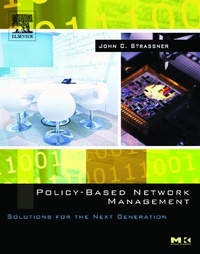
Policy-Based Network Management
Solutions for the Next Generation
Published on 8. September 2003
516 pages
978-0-08-049210-0 (ISBN)
Description

Policy-Based Network Management (PBNM) systems enable business rules and procedures to be translated into policies that configure and control the network and its services. Those who manage network systems are aware that this approach can benefit both network management as well as the development of applications that use network services; however, the details surrounding these systems has been obscured by marketing hype, numerous acronyms, and theoretical complexities. Policy-Based Network Management: Solutions for the Next Generation cuts through the hype surrounding PBNM and makes it approachable for those who really need to understand what it has to offer. The author, founder of the IETF Policy Framework working group, discusses system requirements, information models, and system components for Policy-Based Management. He also provide practitioners with a resource for developing and/or incorporating PBNM systems. As network systems become larger and more complex, creating policies for them has become a crucial step in the management of network systems, and this book is a welcome addition to this exciting approach.
- Presents a completely new approach to PBNM that unites the business, system, and implementation spheres
- As the basis for examples and discussion, uses the DEN-ng information model, an easy-to-understand open standard tied closely to eTOM and NGOSS
- Introduces the Ponder system, then examines Ponder extensions designed to enhance the structure of high-level policies and their application in a PBNM system
- Filled with examples illustrating how policies are most effectively used in a PBNM system and what new directions PBNM is likely to take
More details
Other editions
Additional editions

Book
09/2003
Morgan Kaufmann
€104.81
Article exhausted; check different version
Book
09/2003
Morgan Kaufmann
€92.00
Shipment within 15-20 days
Content
- Front Cover
- Policy-Based Network Management
- Copyright Page
- Contents
- Chapter 1. The Foundation of Policy Management
- 1.1 Introduction-A Retrospective
- 1.2 Where We Are Today
- 1.3 Definition of Policy Management
- 1.4 Introduction and Motivation for Policy Management
- 1.5 The Need for a New Shared Information Model
- 1.6 The Benefits of PBNM
- 1.7 Summary
- 1.8 Recommended Further Readings and References
- Chapter 2. Policy Management Fundamentals
- 2.1 Introduction
- 2.2 The Need for Object-Oriented Analysis, Design, and Modeling in PBNM Systems
- 2.3 Conceptual Policy Model
- 2.4 Definition of a PBM System
- 2.5 Policy Terminology-An Approach
- 2.6 Essential Terminology for PBM Systems
- 2.7 New Terminology Not Covered in RFC3198
- 2.8 Definition of Policy-Based Management
- 2.9 Definition of Policy-Based Network Management
- 2.10 High-Level Requirements of a PBNM System
- 2.11 Using Modeling Used to Solve Information Overload
- 2.12 Policy Used to Express Business Requirements
- 2.13 Summary
- 2.14 Recommended Further Reading and References
- Chapter 3. Policy Management and the Sharing of Data
- 3.1 Introduction
- 3.2 The Need to Express Information in a Common Way
- 3.3 How to Solve Current Problems in Sharing and Reusing Data
- 3.4 Existing Approaches to Sharing Information
- 3.5 How to Express Information in a Common Way
- 3.6 The New DEN-ng Approach
- 3.7 Summary
- 3.8 Recommended Further Reading and References
- Chapter 4. Policy Operation in a PBNM System
- 4.1 Introduction
- 4.2 Policy Communication
- 4.3 General Management Issues
- 4.4 Policy Operation
- 4.5 Musings on Implementation
- 4.6 Summary
- 4.7 Recommended Further Reading and References
- Chapter 5. Representing High-Level Policies
- 5.1 Introduction
- 5.2 High-Level Policy Specification
- 5.3 Basic Policies for Specifying Business-Driven Behavior
- 5.4 DEN-ng Additions to the Ponder Framework of Basic Policies
- 5.5 Composite Policies
- 5.6 Use of High-Level Policies in a PBNM System
- 5.7 High-Level Policy Example
- 5.8 Summary
- 5.9 Recommended Further Reading and References
- Chapter 6. Motivation for the DEN-ng Policy Model
- 6.1 Introduction
- 6.2 Motivation
- 6.3 The New DEN-ng Approach-Functional Requirements
- 6.4 The New DEN-ng Approach-Connecting the Business and System Viewpoints
- 6.5 Summary
- 6.6 Recommended Further Reading and References
- Chapter 7. The DEN-ng Policy Model
- 7.1 Introduction
- 7.2 The DEN-ng Concept of a Policy
- 7.3 The DEN-ng PolicySet
- 7.4 DEN-ng PolicyGroup Class
- 7.5 DEN-ng PolicyRule Class-Basic Concepts
- 7.6 DEN-ng Events and EventSets
- 7.7 DEN-ng PolicyStatements
- 7.8 DEN-ng PolicyConditions
- 7.9 DEN-ng PolicyActions
- 7.10 Reusable versus Ad Hoc Policy Elements
- 7.11 The DEN-ng Policy Model-Interfacing to Other DEN-ng Models
- 7.12 Summary
- 7.13 Recommended Further Reading and References
- Chapter 8. Components of a PBNM System
- 8.1 Introduction
- 8.2 Requirements of Different Policies on the PBNM System
- 8.3 The Life of a Policy
- 8.4 The Building Blocks of a PBNM System
- 8.5 Architecture of a PBNM System
- 8.6 Summary
- 8.7 Recommended Further Reading and References
- Chapter 9. Examples of Using the Policy Continuum
- 9.1 Introduction
- 9.2 Preliminaries
- 9.3 Brief Guide to DEN-ng
- 9.4 The Business View of an MPLS VPN
- 9.5 The System View
- 9.6 The Implementation View
- 9.7 Summary
- 9.8 Recommended Further Reading and References
- Chapter 10. Application of PBNM Concepts
- 10.1 Introduction
- 10.2 Policy Approaches
- 10.3 QoS Policy Usage Examples
- 10.4 Accommodating Changes
- 10.5 Summary
- 10.6 Recommended Further Reading and References
- Chapter 11. New Directions in Policy-Based Management
- 11.1 Introduction
- 11.2 A Sampling of Press and Magazine Articles
- 11.3 Analyst Opinions
- 11.4 Educational and Research Work
- 11.5 Examples of Standards-Driven Applications-The TMF
- 11.6 Product Directions
- 11.7 Recommended Further Reading and References
- Appendix 1. Guide to UML
- Appendix 2. Comments on Non-Essential Policy Terminology from RFC3198
- Index
