

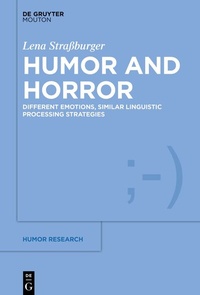
Humor and Horror
Description

Despite their opposite emotional effects, humor and horror are highly similar phenomena. They both can be traced back to (the detection, resolution, and emotional elaboration of) incongruities, understood as semantic violations through unexpected combinations of oppositional information. However, theoretical and experimental comparisons between humor and resolvable incongruities that elicit other emotions than exhilaration have been lacking so far. To gain more insights into the linguistic differences between humor and horror and the cognitive real-time processing of both, a main concern of this book is to discuss the transferability of linguistic humor theories to a systematic horror investigation and directly compare self-paced reading times (SPR), facial actions (FACS), and event-related brain potentials (ERP) of normed minimal quadruplets with frightening and humorous incongruities as well as (in)coherent stimuli. The results suggest that humor and horror share cognitive resources to detect and resolve incongruities. To better distinguish humor from neighboring phenomena, this book refines current humor theories by incorporating humor and horror in a cognitive incongruity processing model.
Reviews / Votes
"Lena Straßburger's monograph [.] is indeed an original and most interesting monograph on an under-researched topic. Its argumentation is supported by an extensive and critical review of the relevant literature as well as on meticulously designed and executed experiments. [.] [T]he book remains a must-read and an inspiration for all those working on incongruity theories not only from a psycholinguistic and cognitive perspective, but also from a pragmatic and sociolinguistic one."
Villy Tsakona in: LINGUIST List 34.1949 (19.06.2023), https://linguistlist.org/issues/34/1949/
More details
Other editions
Additional editions
Person
Content
- Intro
- Acknowledgments
- Contents
- List of figures
- List of tables
- List of abbreviations
- Introduction
- 1 Horror: How to scream because of incongruity
- 2 Humor: How to smile about incongruity
- 3 Humor &
- horror: Processing incongruity
- 4 Humor &
- horror: An experimental comparison
- 5 Discussion &
- conclusion
- References
- Index
