

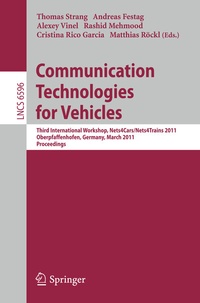
Communication Technologies for Vehicles
Third International Workshop, Nets4Cars/Nets4Trains 2011, Oberpfaffenhofen, Germany, March 23-24, 2011, Proceedings
Published on 23. March 2011
XIII, 239 pages
978-3-642-19786-4 (ISBN)
Description

This book constitutes the joint refereed proceedings of the Third International Workshop on Communication Technologies for Vehicles, Nets4Cars 2011and the First International Workshop on Communication Technologies for Vehicles in the Railway Transportation, Nets4Trains 2011, held in Oberpfaffenhofen, Germany, in March 2011. The 7 full papers of the rail track and 12 full papers of the road track presented together with a keynote were carefully reviewed and selected from 13 and 21 submissions respectively. They provide an overview over the latest technologies and research in the field of intra- and inter-vehicle communication and present original research results in areas relating to communication protocols and standards, mobility and traffic models, experimental and field operational testing, and performance analysis.
More details
Other editions
Additional editions
Thomas Strang | Andreas Festag | Alexey Vinel
Communication Technologies for Vehicles
Third International Workshop, Nets4Cars/Nets4Trains 2011, Oberpfaffenhofen, Germany, March 23-24, 2011, Proceedings
Book
03/2011
1st Edition
Springer
€53.49
Shipment within 7-9 days
Content
- Title
- Preface
- Organization
- Table of Contents
- Keynote
- Requirements for Wireless Technology on Rolling Stock
- Introduction
- Technical and Systems Requirements
- Railway Infrastructure
- Wireless Railway Applications
- Architecture Train Control System
- Business Aspects
- Product Life Cycle
- Business Case
- Standardisation / EU-Projects
- Train Communication Network
- EU-Projects
- Future Standardization
- Summary and Outlook
- References
- Rail Track
- An Experimental Study of Multi-radio Platform Coexistence in the 5 GHz Band for Railway Applications
- Introduction
- WiFi and WiMAX Coexistence
- Case Study
- Experimental Results
- Conclusions
- References
- Train Tracking and Shadowing Estimation Based on Received Signal Strength
- Introduction
- System Model
- Motion Model
- RSS Observation Model
- Shadowing Atlas
- Definition
- Atlas Update
- Bayesian Tracking Solution
- Bayesian Filtering
- Implementation Using Particle Filters
- Simulation Results
- Conclusions
- References
- Delivering Broadband Internet Access for High Speed Trains Passengers Using an Innovative Network Mobility Solution
- Introduction
- The Mobility Architecture
- Complementarity of Networks
- Soft Handover Management
- Intelligent Routing Engine
- QoS Policy
- Conclusion and Perspectives
- References
- Measurement and Analysis of the Direct Train to Train Propagation Channel in the 70 cm UHF-Band
- Introduction
- Measurement Campaign
- Railway Network and Environment
- Measurement Setup
- Measurement Scenarios
- Data Analysis
- Suburban Railway Station and Forest
- Tunnel in Urban Environment
- Hilly Alpine Upland
- Path Loss Model
- Conclusion
- References
- WiMax'ble Pervasive Cloud - Empowering Next Generation Intelligent Railway Infrastructure
- Introduction and Scope
- WiMax'ble Pervasive Cloud
- WiMax
- Pervasive Cloud
- Intelligent Railway Infrastructure
- Example Deployment Scenario - Railway Condition Monitoring
- Discussion
- References
- The MIH (Media Independent Handover) Contribution to Mobility Management in a Heterogeneous Railway Communication Context: A IEEE802.11/802.16 Case Study
- Introduction
- Background and Related Work
- IEEE802.21 Overview
- Design Considerations
- Implementation of MIH in the OPNET Simulation Tool
- Case Study: IEEE802.11/802.16 Handover
- MIH-Enhanced Handover Process
- Handover Performance Evaluation Results
- Conclusions and Further Steps
- References
- Multiple Description Coding and Scalable Video Coding Combined with Multiple Input Multiple Output Techniques: Two Strategies to Enhance Train to Wayside Video Transmissions in Tunnels
- Introduction
- Basics on MIMO Techniques
- MIMO System Principles
- Modeling MIMO Channel in Tunnels
- Basics on Multiple Description Coding and Scalable Video Coding
- MDC Technique
- SVC Technique
- Multiple Description Coding and Scalable Video Coding Associated with MIMO Techniques
- Introduction
- MDC Associated with MIMO
- ROI Coding Associated with MIMO
- Conclusion and Perspectives
- References
- Road Track
- VANET Architectures and Protocol Stacks: A Survey
- Introduction
- VANETs Protocol Stacks
- WAVE by IEEE
- ISO CALM
- Car to Car Consortium (C2C-CC)
- Analysis
- Conclusion and Future Work
- References
- Behavior Specification of a Red-Light Violation Warning Application - An Approach for Specifying Reactive Vehicle-2-X Communication Applications
- Introduction
- Requirements for the Specification Technique
- Related Work
- Continuous-Time State Machine
- Syntax
- Semantics
- Specifying the Red-Light Violation Warning Application
- Conclusion and Future Work
- References
- Wireless Protocol Design for a Cooperative Pedestrian Protection System
- Introduction
- Technological Background
- Architectural Design
- Topologies
- System Design
- Protocol Design
- Simulation
- Topologies
- Model Description
- Scenario
- Results
- Outlook
- References
- A Vehicular Mobility Model Based on Real Traffic Counting Data
- Introduction
- State of the Art
- Model
- Input Data
- Destination Distribution Model
- From Flows to Routes
- Experiments
- The Luxembourgian Testbed
- Microsimulation with SUMO
- Results Analysis
- Conclusion
- References
- Driver-Centric VANET Simulation
- Introduction
- Related Work
- Architecture
- Components
- Data Exchange Protocol
- Data Synchronization
- Mobility Model
- Simulation Platform Applicability
- Virtual Traffic Lights (VTL)
- The See-Through System (STS)
- Conclusion
- References
- Simulative Evaluation of the Potential of Car2X-Communication in Terms of Efficiency
- Introduction
- Related Work
- Traffic Scenarios
- Selection
- Roundabout
- Left Turn on Single Lane Road
- Approaching Congestion on Freeway
- Simulation
- Simulation Setup
- Simulation Execution
- Results and Evaluation
- Roundabout
- Left Turn on Single Lane Road
- Approaching Congestion on Freeway
- Conclusion and Outlook
- References
- Performance Study of an In-Car Switched Ethernet Network without Prioritization
- Introduction
- Related Work
- Performance Study Setup
- Usage of Ethernet
- Topology
- Traffic Characteristics
- Simulation Results and Discussion
- Methodology and Assumptions
- Metrics
- Results
- Summary
- Conclusion and Future Work
- References
- Degradation of Communication Range in VANETs Caused by Interference 2.0 - Real-World Experiment
- Introduction
- Related Work
- Methodology
- Application Scenario
- Scenario Transfer
- Communication Range Calibration
- Equipment and Setup
- Measurement Results and Comparison
- Measurement
- Simulation
- Conclusions and Outlook
- References
- Real-World Measurements of Non-Line-Of-Sight Reception Quality for 5.9GHz IEEE 802.11p at Intersections
- Introduction
- State of the Art
- Test Setup
- Used Hardware
- Intersection Selection
- Parameter Selection
- Measurement Results
- Free Space Test and Antenna Position
- Reception Quality under NLOS - Testing Results
- Conclusion
- References
- Interoperability Testing Suite for C2X Communication Components
- Introduction
- Test Cases
- Physical Layer Testing
- MAC Layer Testing
- Network Layer Testing
- Application Layer Testing
- Conclusions and Future Work
- References
- Towards Standardization of In-Car Sensors
- Introduction
- Background
- Case Study: Tyre Pressure Monitoring System
- Application Development
- Security
- Software Configuration
- Related Work
- Conclusion and Future Work
- References
- Secure Automotive On-Board Protocols: A Case of Over-the-Air Firmware Updates
- Introduction
- Secure On-Board Network Architecture
- Implementing Security Primitives
- Secure Firmware Update Protocol
- OTA Update Requirements
- Protocol Description
- Related Work
- Conclusion
- References
- Author Index
