

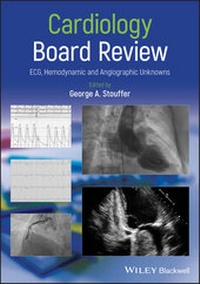
Cardiology Board Review
Description

Cardiology Board Review lays the groundwork for board exam success with its instructive and easy-to-read explanations of the pathophysiology, diagnosis, and treatment of patients with cardiovascular disease. Breaking topics down into case unknowns, this innovative revision aid provides examples of everyday cardiological issues and then explains how best to address the problem at hand. All content is complemented by clinical images and illustrations, as well as helpful summaries and key points.
Featuring 56 different cases, this essential text:
* Places learning in a practical context. Information about disease states is presented in case-based format which leads to better retention.
* Covers topics including congenital heart disease, coronary artery disease, cardiomyopathies, valvular heart disease, arrhythmias, heart failure, peripheral vascular disease, and more
* Designed to present important concepts and information in a unique way to complement textbook learning
* Features electrocardiograms, angiograms, and pressure tracings
* Is applicable to those working towards certification in Cardiovascular Disease from the American Board of Internal Medicine or preparing for board examinations in other countries
* Is also suitable for those requiring MOC recertification
* Features cases on aortic insufficiency, atrial fibrillation, Brugada syndrome, carotid artery disease, myocardial bridging, congenital heart disease, electrolyte abnormalities, apical HCM, mitral regurgitation, RV outflow tract tachycardia, pulmonary hypertension, arrhythmogenic right ventricular dysplasia, aortic stenosis, atrial myxoma, atrial tachycardia, pulmonic insufficiency, Takotsubo, tricuspid regurgitation, Wolfe-Parkinson-White syndrome, pulmonic stenosis, coronary anomalies, ECG changes of hypothermia, endocarditis, pulmonary embolus, ventricular septal defect, hemodynamics of hypertrophic cardiomyopathy, complete heart block, heart failure, coronary artery disease, atrial septal defect, constrictive pericarditis, fractional flow reserve, dextrocardia, STEMI, early repolarization, giant cell myocarditis, peripheral arterial disease, pericardial tamponade, peripheral arterial disease, pericarditis, myocarditis, long QT syndrome, mitral stenosis, tetralogy of Fallot, and supraventricular tachycardia among others.
Cardiology Board Review offers fellows a fresh and engaging approach to the information required to achieve success in board examinations.
More details
Other editions
Additional editions
Person
George A. Stouffer, MD, is Chief of Cardiology and Ernest and Hazel Craige Distinguished Professor of Medicine, University of North Carolina, Chapel Hill, NC, USA. He received his medical degree from University of Maryland School of Medicine and has been in practice for more than 20 years. Dr. Stouffer is the author of Practical ECG Interpretation: Clues to Heart Disease in Young Adults and editor of Cardiovascular Hemodynamics for the Clinician.
Content
Cases compiled with contributions from xi
Preface xiii
Case 1: A 31-Year-Old Man with Fever and Rapidly Progressive Dyspnea 1
Case 2: A Young Man with Palpitations After a Party 5
Case 3: A 45-Year-Old Man with Chest Pain After an Automobile Accident 9
Case 4: A 67-Year-Old Man with Left-Sided Weakness 13
Case 5: A 54-Year-Old Woman with Exertional Angina But No Atherosclerotic Coronary Artery Disease 19
Case 6: A 34-Year-Old Woman with Fatigue 23
Case 7: An Elderly Woman with a Loud Murmur 31
Case 8: A Middle-Aged Woman Who Passes out While Running after her Grandchildren 35
Case 9: A 31-Year-Old Man with Palpitations and Dizziness 39
Case 10: An Unexpected Finding on a Coronary Angiogram 43
Case 11: A 26-Year-Old Man Who Collapses While Talking with Friends 45
Case 12: An Elderly Gentleman Who Passes Out While Working on His Farm 49
Case 13: A 46-Year-Old Woman with Dyspnea on Exertion and Daily Emesis 55
Case 14: A Pregnant Woman with Palpitations 59
Case 15: Is this a Positive Brockenbrough Sign? 63
Case 16: Dyspnea in a Woman Who is Five Months Postpartum 67
Case 17: Can you Identify This Coronary Anomaly? 71
Case 18: Why is this Patient Short of Breath? 73
Case 19: A Clinical Application of Coronary Physiology 79
Case 20: An Asymptomatic Patient with a Very Unusual ECG 85
Case 21: Is This a STEMI? 87
Case 22: Rapidly Progressive Dyspnea, Abdominal Fullness, and Nausea 89
Case 23: A 40-Year-Old Man with Dyspnea on Exertion 93
Case 24: A Recent Immigrant from Mexico with Complaints of Dyspnea 97
Case 25: New Onset Hypertension with Dyspnea and ECG Changes 103
Case 26: A 52-Year-Old Woman on Hemodialysis Who Presents with Shortness of Breath and New ECG Changes 107
Case 27: A 42-Year-Old Man with Hypotension, Diarrhea, Vomiting, and ECG Changes 109
Case 28: A 58-Year-Old Male with Worsening Dyspnea 113
Case 29: A 68-Year-Old Woman with Chest Pain and a Normal Stress Test 117
Case 30: A 29-Year-Old Woman with Shortness of Breath and Leg Swelling 123
Case 31: An ECG Finding You Don't Want to Miss 129
Case 32: An Unusual ECG in a Homeless Man Who is Unconscious 133
Case 33: An 18-Year-Old Student with Fever, Chest Pain, and ST Elevation 137
Case 34: Recurrent Endocarditis in a 26-Year-Old Woman 141
Case 35: A 23-Year-Old Man with a Loud Systolic Murmur 145
Case 36: A 66-Year-Old Woman with Dyspnea for Two Weeks Which Has Now Abruptly Worsened 149
Case 37: An Unusual Ventriculogram 151
Case 38: A 68-Year-Old Male with Generalized Weakness and Dyspnea 153
Case 39: A 66-Year-Old Woman with Chest Pain During a Hurricane 157
Case 40: A 39-Year-Old Woman Who is Found Unconscious 161
Case 41: An Unusual Right Atrial Pressure Tracing 163
Case 42: A 20-Year-Old Man with a Heart Rate of 250 bpm 167
Case 43: A 46-Year-Old Man with Heart Failure and New Onset Palpitations 173
Case 44: Palpitations and Dizziness in a Young Adult with a Very Abnormal ECG 177
Case 45: A 36-Year-Old Man with Long-Standing Hypertension and an Abnormal ECG 181
Case 46: A 46-Year-Old Man with Fatigue 183
Case 47: A 28-Year-Old Runner with Exercise-Induced Palpitations 187
Case 48: A 43-Year-Old Man with Chest Pain and an Episode of Syncope 191
Case 49: A 50-Year-Old Man with Worsening Cough and Dyspnea 197
Case 50: Unsuspected Congenital Heart Disease in a 26-Year-Old Woman 201
Case 51: How Likely is This Patient to Have a Bad Outcome? 203
Case 52: A 55-Year-Old Man with Leg Pain 211
Case 53: An 18-Year-Old High School Student with an Abnormal ECG and a Nervous Parent 217
Case 54: Could This Cardiac Arrest Have Been Prevented? 221
Case 55: Why is This Patient Tachycardic? 229
Case 56: A 31-Year-Old Woman with Palpitations While at Work 233
Index 237
Case 3: A 45-Year-Old Man with Chest Pain After an Automobile Accident
You are asked to see a 45-year-old man with no significant past medical history in the Emergency Department following a motor vehicle collision. He was slowing to a stop in a sedan when his car was hit from behind by a semi-trailer truck traveling 40 mi/h. He was wearing a seat belt and the airbag did not deploy. He denies any head trauma or loss of consciousness surrounding the event. He was able to get out of his car unassisted, and shortly thereafter developed constant, deep, substernal chest pain that he described as dull and 5 out of 10 in severity. He has no other associated symptoms such as shortness of breath, diaphoresis, nausea, or vomiting. The automated 12-lead electrocardiogram () interpretation is read as "ACUTE MI."
What is your interpretation of this ECG (Figure 3.1)?
Figure 3.1 ECG at the time of presentation.
Brugada Syndrome
This patient has Brugada pattern on his ECG which is described as a right bundle branch block (), normal QT internal, and persistent ST-segment elevation in leads V1 to V2-V3 that is not explainable by electrolyte derangements, ischemia, or structural heart disease (Brugada and Brugada 1992). According to the 2013 consensus statement on inherited arrhythmias, this pattern is definitively diagnosed when Brugada type 1 ST-segment elevation is observed either spontaneously or after administration of intravenous sodium channel-blocking agent in at least one precordial lead (V1 and V2) (Priori et al. 2013).
Clinical manifestations vary, and in the case of isolated Brugada pattern on ECG such as in this case, the patient may be asymptomatic. A patient who presents with the Brugada ECG criteria but without the clinical characteristics is said to have the Brugada pattern but not the syndrome. Diagnosis of Brugada Syndrome depends on both characteristic ECG findings (either spontaneous or inducible) and appropriate clinical findings (unexplained syncope, self-terminating polymorphic ventricular tachycardia, documented ventricular fibrillation, family history of sudden cardiac death at less than 45 years of age, Brugada ECG pattern in a family member, and/or inducibility of ventricular tachycardia by electrophysiologic study). The syndrome usually manifests during adulthood with a mean age of sudden death of 41 years. Other common symptoms include ventricular fibrillation or aborted sudden cardiac death, syncope, nocturnal agonal respiration, palpitations, or chest discomfort. These symptoms most frequently occur during rest or sleep, during a febrile state, or with vagotonic conditions. Rarely do symptoms manifest with exercise (Priori et al. 2013). The syndrome appears to be more common in persons of Asian descent (Alings and Wilde 1999), and men are 8-10 times more likely to be affected (Priori et al. 2013). These patients are at an increased risk of ventricular tachyarrhythmias and sudden cardiac death (Priori et al. 2013).
In this case, Brugada Syndrome was unrelated to the motor vehicle accident (the patient had no palpitations or loss of consciousness and the accident was not attributable to his error). Recognition of this pattern on ECG is very important however for at least two reasons: (i) interpretation of the ST elevation as an acute injury pattern would result in the faulty diagnosis of acute myocardial infarction or cardiac contusion; and (ii) individuals with Brugada Syndrome are at risk of sudden cardiac death and this patient should be further evaluated to see if he would benefit from primary prevention.
The Brugada Syndrome was initially described in 1992 by Brugada and Brugada who reported eight patients with a history of cardiac arrest and ECG findings of RBBB and ST-segment elevation in the right precordial leads and no evidence of any structural heart disease. Prior to that, the Centers for Disease Control and Prevention had reported cases of sudden death in young immigrants from Southeast Asia, described as Sudden Unexplained Death Syndrome () which has subsequently been shown to be closely related to, if not the same as, the Brugada syndrome.
The Brugada Syndrome is an autosomal dominant genetic disorder with variable penetrance characterized by abnormal electrophysiologic activity in the right ventricular epicardium. Approximately one-fourth of cases are caused by loss of function mutations in the cardiac sodium channel SCN5A (abnormalities in this gene have also been linked to Long QT Syndrome 3). This gene encodes the a-subunit of the sodium ion channel and, when abnormal, results in increased inactivation of the sodium channel with a prolonged recovery time.
Three ECG patterns have been described in the Brugada Syndrome, with all three types having in common ST elevation (=2 mm at the J point) in the right precordial leads. In the "classic" Brugada ECG (type 1) the ST segment is continuously downsloping from the top of the R wave, is not elevated above baseline at the terminal portion and ends with an inverted T wave (such as in this patient). Types 2 and 3 have a "saddle-back" ST-T wave configuration (Figure 3.1). The ST segment descends toward the baseline with upward concavity and then rises again to an upright or biphasic T wave. Type 2 is defined by the terminal portion of the ST segment being elevated =1 mm whereas in type 3 the terminal portion of the ST segment is elevated <1 mm. The ECG changes can be dynamic, with the same patient manifesting all three types at various points in time.
In some patients, complete or incomplete RBBB is present. In others, high take-off ST-segment elevation (accentuated J-point elevation) in the right precordial leads mimics the pattern of RBBB, but wide S waves in leads I, aVL, V5, and V6 typically seen in RBBB are absent (such as in this case). In these cases, the R in V1 is thought to be due to early repolarization of the right ventricular epicardium rather than a RBBB.
The Brugada pattern on ECG can be either persistent or inducible. Medications (including sodium channel blockers, cocaine, antidepressants, and antihistamines), electrolyte abnormalities, and acute illnesses may elicit ST-segment elevation in leads V1 to V3 in susceptible patients. To aide in the diagnosis, provocation testing by infusion of selected class IC antiarrhythmic drugs (e.g. flecainide or procainamide) can unmask the Brugada ECG pattern in affected subjects.
It is important to risk stratify patients based on clinical characteristics, as high-risk patients benefit from (implantable cardioverter defibrillator) placement. The risk of lethal or near-lethal arrhythmic episodes among previously asymptomatic patients with Brugada pattern on ECG is estimated between 1 and 8% depending on the study. Irrespective of other predictors of outcome, patients with history of ventricular fibrillation are inherently high risk (Priori et al. 2013). Additionally, patients presenting with syncopal episodes in the presence of spontaneous Brugada type I ST elevation in leads V1-V2 have high rates of cardiac events in follow-up (Priori et al., 2002). These first two patient groups have a strong indication for ICD placement. Other indicators of increased risk are the presence of fragmented QRS, a refractory period of <200 ms, and male sex (Priori et al. 2013).
At this time, the only effective strategy for prevention of sudden cardiac death in patients with Brugada Syndrome is placement of an ICD. Please see Figure 3.2 for indications for ICD placement. Lifestyle modifications are also important for survival in Brugada Syndrome. There are numerous medications that may induce or aggravate ST-segment elevation in precordial leads, and patients with Brugada Syndrome are advised to avoid these. A complete list can be found at https://www.brugadadrugs.org. Additionally, all patients should avoid excessive alcohol intake, and immediately treat fevers with antipyretic drugs (Marquez et al. 2012).
Figure 3.2 Consensus recommendations for ICD placement in patients with Brugada Syndrome.
Source: Reproduced with the permission of Priori et al. (2013).
Pharmacologic therapy focuses on inhibition of the transient outward potassium current or increasing the sodium and calcium currents. Isoproterenol increases the L-type calcium current and is useful in treatment of electrical storm in Brugada Syndrome (Priori et al. 2013). Quinidine is a class 1a antiarrhythmic drug that has been shown to prevent the induction of (ventricular fibrillation) and suppress spontaneous ventricular arrhythmias. Quinidine is used in patients with ICD who have been shocked multiple times, cases where ICD is contraindicated, and to suppress supraventricular arrhythmias (Marquez et al. 2012; Priori et al. 2013).
Catheter ablation of malignant arrhythmias is a promising future therapeutic avenue in Brugada Syndrome. Similar to pharmacologic treatment, there have been no randomized controlled trials addressing this issue, but Nademanee et al. (2011) completed a case series which showed that epicardial substrate ablation in the right...
