

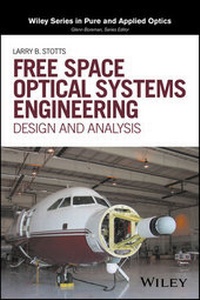
Free Space Optical Systems Engineering
Description

More details
Other editions
Additional editions
Person
Content
Preface xii
About the Companion Website xvi
1 Mathematical Preliminaries 1
1.1 Introduction 1
1.2 Linear Algebra 1
1.2.1 Matrices and Vectors 2
1.2.2 Linear Operations 2
1.2.3 Traces, Determinants, and Inverses 3
1.2.4 Inner Products, Norms, and Orthogonality 7
1.2.5 Eigenvalues, Eigenvectors, and Rank 8
1.2.6 Quadratic Forms and Positive Definite Matrices 8
1.2.7 Gradients, Jacobians, and Hessians 8
1.3 Fourier Series 9
1.3.1 Real Fourier Series 9
1.3.2 Complex Fourier Series 10
1.3.3 Effects of Finite Fourier Series Use 11
1.3.4 Some Useful Properties of Fourier Series 14
1.4 Fourier Transforms 15
1.4.1 Some General Properties 15
1.5 Dirac Delta Function 20
1.6 Probability Theory 21
1.6.1 Axioms of Probability 21
1.6.2 Conditional Probabilities 23
1.6.3 Probability and Cumulative Density Functions 25
1.6.4 Probability Mass Function 27
1.6.5 Expectation and Moments of a Scalar Random Variable 28
1.6.6 Joint PDF and CDF of Two Random Variables 29
1.6.7 Independent Random Variables 29
1.6.8 Vector-Valued Random Variables 30
1.6.9 Gaussian Random Variables 31
1.6.10 Quadratic and Quartic Forms 33
1.6.11 Chi-Squared Distributed Random Variable 34
1.6.12 Binomial Distribution 35
1.6.13 Poisson Distribution 37
1.6.14 Random Processes 38
1.7 Decibels 40
1.8 Problems 42
References 48
2 Fourier Optics Basics 51
2.1 Introduction 51
2.2 The Maxwell Equations 52
2.3 The Rayleigh-Sommerfeld-Debye Theory of Diffraction 55
2.4 The Huygens-Fresnel-Kirchhoff Theory of Diffraction 59
2.5 Fraunhofer Diffraction 68
2.6 Bringing Fraunhofer Diffraction into the Near Field 76
2.7 Imperfect Imaging 82
2.8 The Rayleigh Resolution Criterion 84
2.9 The Sampling Theorem 85
2.10 Problems 89
References 93
3 Geometrical Optics 95
3.1 Introduction 95
3.2 The Foundations of Geometrical Optics - Eikonal Equation and Fermat Principle 96
3.3 Refraction and Reflection of Light Rays 98
3.4 Geometrical Optics Nomenclature 101
3.5 Imaging System Design Basics 103
3.6 Optical Invariant 109
3.7 Another View of Lens Theory 111
3.8 Apertures and Field Stops 113
3.8.1 Aperture Stop 113
3.8.2 Entrance and Exit Pupils 114
3.8.3 Field Stop and Chief and Marginal Rays 115
3.8.4 Entrance and Exit Windows 117
3.8.5 Baffles 119
3.9 Problems 119
References 121
4 Radiometry 123
4.1 Introduction 123
4.2 Basic Geometrical Definitions 124
4.3 Radiometric Parameters 127
4.3.1 Radiant Flux (Radiant Power) 129
4.3.2 Radiant Intensity 130
4.3.3 Radiance 130
4.3.4 Étendue 132
4.3.5 Radiant Flux Density (Irradiance and Radiant Exitance) 135
4.3.6 Bidirectional Reflectance Distribution Function 135
4.3.7 Directional Hemispheric Reflectance 136
4.3.8 Specular Surfaces 136
4.4 Lambertian Surfaces and Albedo 137
4.5 Spectral Radiant Emittance and Power 138
4.6 Irradiance from a Lambertian Source 139
4.7 The Radiometry of Images 143
4.8 Blackbody Radiation Sources 145
4.9 Problems 151
References 151
5 Characterizing Optical Imaging Performance 153
5.1 Introduction 153
5.2 Linearity and Space Variance of the Optical System or Optical Channel 154
5.3 Spatial Filter Theory of Image Formation 156
5.4 Linear Filter Theory of Incoherent Image Formation 160
5.5 The Modulation Transfer Function 162
5.6 The Duffieux Formula 167
5.7 Obscured Aperture OTF 174
5.7.1 Aberrations 179
5.8 High-Order Aberration Effects Characterization 184
5.9 The Strehl Ratio 191
5.10 Multiple Systems Transfer Function 193
5.11 Linear Systems Summary 195
References 198
6 Partial Coherence Theory 201
6.1 Introduction 201
6.2 Radiation Fluctuation 202
6.3 Interference and Temporal Coherence 205
6.4 Interference and Spatial Coherence 214
6.5 Coherent Light Propagating Through a Simple Lens System 219
6.6 Partially Coherent Imaging Through any Optical System 231
6.7 Van Cittert-Zernike Theorem 233
6.8 Problems 235
References 237
7 Optical Channel Effects 239
7.1 Introduction 239
7.2 Essential Concepts in Radiative Transfer 239
7.3 The Radiative Transfer Equation 245
7.4 Mutual Coherence Function for an Aerosol Atmosphere 251
7.5 Mutual Coherence Function for a Molecular Atmosphere 255
7.6 Mutual Coherence Function for an Inhomogeneous Turbulent Atmosphere 256
7.7 Laser Beam Propagation in the Total Atmosphere 262
7.8 Key Parameters for Analyzing Light Propagation Through Gradient Turbulence 272
7.9 Two Refractive Index Structure Parameter Models for the Earth's Atmosphere 278
7.10 Engineering Equations for Light Propagation in the Ocean and Clouds 282
7.11 Problems 294
References 295
8 Optical Receivers 299
8.1 Introduction 299
8.2 Optical Detectors 300
8.2.1 Performance Criteria 300
8.2.2 Thermal Detectors 302
8.2.3 Photoemissive Detectors 302
8.2.4 Semiconductor Photodetectors 305
8.2.5 Photodiode Array and Charge-Coupled Devices 325
8.3 Noise Mechanisms in Optical Receivers 325
8.3.1 Shot Noise 326
8.3.2 Erbium-Doped Fiber Amplifier (EDFA) Noise 330
8.3.3 Relative Intensity Noise 331
8.3.4 More Conventional Noise Sources 333
8.4 Performance Measures 335
8.4.1 Signal-to-Noise Ratio 336
8.4.2 The Optical Signal-to-Noise Ratio 338
8.4.3 The Many Faces of the Signal-to-Noise Ratio 345
8.4.4 Noise Equivalent Power and Minimum Detectable Power 346
8.4.5 Receiver Sensitivity 347
8.5 Problems 350
References 353
9 Signal Detection and Estimation Theory 355
9.1 Introduction 355
9.2 Classical Statistical Detection Theory 356
9.2.1 The Bayes Criterion 358
9.2.2 The Minimax Criterion 360
9.2.3 The Neyman-Pearson Criterion 361
9.3 Testing of Simple Hypotheses Using Multiple Measurements 365
9.4 Constant False Alarm Rate (CFAR) Detection 374
9.5 Optical Communications 375
9.5.1 Receiver Sensitivity for System Noise-Limited Communications 375
9.5.2 Receiver Sensitivity for Quantum-Limited Communications 381
9.6 Laser Radar (LADAR) and LIDAR 389
9.6.1 Background 389
9.6.2 Coherent Laser Radar 392
9.6.3 Continuous Direct Detection Intensity Statistics 398
9.6.4 Photon-Counting Direct Detection Intensity Statistics 401
9.6.5 LIDAR 404
9.7 Resolved Target Detection in Correlated Background Clutter and Common System Noise 408
9.8 Zero Contrast Target Detection in Background Clutter 415
9.9 Multispectral Signal-Plus-Noise/Noise-Only Target Detection in Clutter 416
9.10 Resolved Target Detection in Correlated Dual-Band Multispectral Image Sets 427
9.11 Image Whitener 434
9.11.1 Orthogonal Sets 434
9.11.2 Gram-Schmidt Orthogonalization Theory 435
9.11.3 Prewhitening Filter Using the Gram-Schmidt Process 436
9.12 Problems 437
References 440
10 Laser Sources 443
10.1 Introduction 443
10.2 Spontaneous and Stimulated Emission Processes 444
10.2.1 The Two-Level System 444
10.2.2 The Three-Level System 451
10.2.3 The Four-Level System 453
10.3 Laser Pumping 454
10.3.1 Laser Pumping without Amplifier Radiation 454
10.3.2 Laser Pumping with Amplifier Radiation 455
10.4 Laser Gain and Phase-Shift Coefficients 456
10.5 Laser Cavity Gains and Losses 463
10.6 Optical Resonators 466
10.6.1 Planar Mirror Resonators - Longitudinal Modes 466
10.6.2 Planar Mirror Resonators - Transverse Modes 471
10.7 The ABCD Matrix and Resonator Stability 474
10.8 Stability of a Two-Mirror Resonator 477
10.9 Problems 479
References 482
Appendix A STATIONARY PHASE AND SADDLE POINT METHODS 485
A.1 Introduction 485
A.2 The Method of Stationary Phase 485
A.3 Saddle Point Method 487
Appendix B EYE DIAGRAM AND ITS INTERPRETATION 489
B.1 Introduction 489
B.2 Eye Diagram Overview 489
Appendix C VECTOR-SPACE IMAGE REPRESENTATION 491
C.1 Introduction 491
C.2 Basic Formalism 491
Reference 493
Appendix D PARAXIAL RAY TRACING - ABCD MATRIX 495
D.1 Introduction 495
D.2 Basic Formalism 495
D.2.1 Propagation in a Homogeneous Medium 497
D.2.2 Propagation Against a Curved Interface 498
D.2.3 Propagation into a Refractive Index Interface 499
References 502
Index 503
Preface
Just before graduating from the college, I took a job at a Navy Laboratory because there were not any research grants to help pay for my future graduate school work. As it turned out, it was a very rewarding experience, allowing me to work on many fascinating projects during my time there. They ranged from fiber optic communications, integrated optics in II-VI compounds, optical signal processing, data storage in electro-optical crystals, laser communications, and atmospheric and space remote sensing. Although I had a very good education in undergraduate applied physics from UCSD, many of these projects involved new optical technologies, as well as engineering concepts, that I had not been exposed to previously. My first two years in graduate school concentrated on graduate physics, which also did not cover these areas. Consequently, I had to spend a large amount of time in the library reading books and papers in order to come up to speed in these areas. I often wished that UCSD offered undergraduate and graduate classes in optical system engineering with an accompanying textbook(s) covering the breadth of the engineering basics necessary to tackle these various engineering areas. As it turned out, the mathematical foundations of each area were common, but many times the definitions and concept descriptions of one area masked its commonality with other topics in optics. In addition, the details were often absent and/or hard to find. In the absence of classes, it would have been nice to have an introductory reference to use to review the basic foundation concepts in optics and to find some of the original key references with the derivations of important equations at the time. This would have made it easier to move among a plethora of ever changing engineering projects.
Since then, several comprehensive books on optics have been written, for example, Fundamentals of Photonics by Saleh and Teich, the SPIE Encyclopedia of Optics, Electro-Optics Handbook by Waynant and Ediger. Although excellent in their content, these are written for a conversant researcher who has done graduate work, and/or been working, in optics for several years in order to fill in the blanks or to understand the nuances contained within the text. Unfortunately, this leaves junior, senior, and first/second year graduate students behind the power curve, requiring additional time, work, and consultation with their advisor or seasoned colleague, to understand what is written. Even with the Internet, this can be a formidable task. Thus, it appears that they are in the same situation as I was at the beginning of my career. In looking across the literature, there also are introductory textbooks focused on certain aspects of optics such as lens design, lasers, detectors, optical communications, and remote sensing, but none of which seem to encompass the breadth of free space optical systems engineering at a more basic level.
This textbook is an attempt to fulfill this need. It is intended to be the reference book for the engineer changing fields, and at the same time, to be an introduction to the field of electro-optics for upper division undergraduates and/or graduate students. Many of the original papers for the field are referenced, and an (comprehensive) introduction and overview of the topic has been attempted. Presentation and integration of physical (quantum mechanical), mathematical, and technological concepts, where possible, hopefully assists in the students' understanding.
It has been suggested that this material is too advanced for upper division undergraduate students. I think not for two reasons. First, today's students have been exposed to advanced subjects since middle/junior high school, for example, calculus and differential equations. They are used to being challenged. Second, and more importantly, the book provides the details of complex calculations in the many examples and discussions, so the students can become comfortable with complex mathematical manipulations. I never thought the concepts and calculations described by professors as "obvious to the most casual observer" were, and my fellow students and I struggled because of our lack of confidence, experience, and familiarity in figuring complex things out. Professors Booker and Lohmann independently taught me that if I understood the mathematical details, it would be easier to understand experimental results and to invent and explain complex concepts. This has helped me greatly over my career. However, getting this understanding sooner over a broader range of subjects in optics would have benefited me a lot and I hope to achieve that for readers of this book. I also believe students will be better prepared for graduate school and jobs by seeing complex subjects with this foundation. This book breaks down as follows:
- Chapter 1 provides the background mathematics for the rest of the book. Specific topics include linear algebra, Fourier series, Fourier transforms, Dirac Delta function, and probability theory.
- In Chapter 2, we discuss Fourier Optics, which includes sections on (1) Maxwell Equations, (2) Rayleigh-Sommerfeld-Debye Theory of Diffraction, (3) The Huygens-Fresnel-Kirchhoff Theory of Diffraction, (4) Fresnel Diffraction, and (5) Fraunhofer Diffraction. The Huygens-Fresnel-Kirchhoff formalism is the workhorse of laser propagation analysis, as the reader will soon find out. Examples and comments are also provided, so the reader gets insights on the application of Fourier Optics in typical engineering problems.
- Geometrical Optics uses the concept of rays, which have direction and position but no phase information, to model the way light travels through space or an optical system. This is the subject of Chapter 3. In this chapter, we focus on imaging systems, which cover a broad class of engineering applications. We begin by summarizing the first-order lens design approaches. Key concept and definitions are explained, so the student can understand the key aspects of lens design. We also discuss the basic elements in an optical system such as windows, stops, baffles, and pupils that are sometimes confusing to the new optical engineer.
- In Chapter 4, we outline the field of Radiometry, which is the characterization of the distribution of the optical power or energy in space. It is distinct from the quantum processes such as photon counting because this theory uses "ray tracing" as its means for depicting optical radiation transfer from one point to another. It ignores the dual nature of light.
- Chapter 5 deals with the convolutional theory of image formation. Specifically, the reader will find that convolution process can characterize the effects of an imperfect optical system or those of an optical channel such as the optical scatter channel or turbulent channel on an input distribution. Most of the engineering analyses one finds in the literature exploit this mathematical theory.
- Chapter 6 focuses on partial coherence theory. It covers the situation where the resulting light interference is barely visible, exhibiting only low contrast effects. Partial coherence theory is considered the most difficult subject in optics. Much is written on this subject; sometimes successfully, sometimes not. This chapter looks at this theory from the most basic level, clarifying the definitions and concepts with examples, so the reader will better understand the theory, compared to others, after completing this chapter.
- In Chapter 7, we address the characterization of optical channel effects. We begin a discussion of radiative transfer through particulate media, then move to the development of the mutual coherence function (MCF) for aerosols and molecules, and then turbulence. Finally, we provide a set of engineering equations useful in understanding and characterizing light propagation in those same channels.
- In Chapter 8, we provide a first-order overview of the various optical detector mechanisms and devices. We next look at the possible noise sources in an optical receiver that influence the quality of signal reception. When these detector and noise mechanisms are combined with the received signal, we obtain the arguably key parameter in detection theory, the electrical signal-to-noise ratio (SNR). The construction of this particular metric connects it with RF engineering, so the synergism between the two areas can be easily exploited. Finally, we discuss the various forms of SNR and include some detection sensor/receiver examples to illustrate their variation.
- Chapter 9 reviews the classical statistical detection theory and then shows its applicability to optical communications and remote sensing. This is not found in many introductory optics books and discusses two of the key detection concepts: the probabilities of detection and false alarm. Both the signal-plus-additive-noise and replacement model hypothesis testing approaches are discussed. Examples of the theory's application to communications and remote sensing system are given.
- In the early chapters, we emphasized blackbody sources, which are based on the concept of the spontaneous emission of light from materials such as gases and solids. An alternative source concept was proposed in 1917 by Albert Einstein. It is called the simulated emission of light. Although it was almost 60 years before it became a reality, the laser, which is an acronym for Light Amplification by Stimulated Emission of Radiation, has revolutionized optical system design. The final chapter of this textbook, Chapter 10, provides an overview of the fundamentals of laser theory, the key...
