

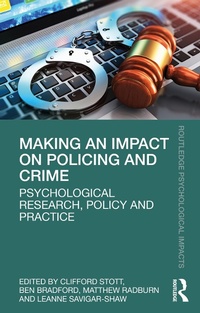
Making an Impact on Policing and Crime
Psychological Research, Policy and Practice
1st Edition
Published on 19. October 2020
254 pages
978-1-000-20353-0 (ISBN)
Description

Making an Impact on Policing and Crime: Psychological Research, Policy and Practice applies a range of case studies and examples of psychological research by international, leading researchers to tackle real-world issues within the field of crime and policing.
Making an Impact on Policing and Crime documents the application of cutting-edge research to real-world policing and explains how psychologists' insights have been adapted and developed to offer effective solutions across the criminal justice system. The experts featured in this collection cover a range of psychological topics surrounding the field, including the prevention and reduction of sexual offending and reoffending, the use of CCTV and 'super-recognisers', forensic questioning of vulnerable witnesses, the accuracy of nonverbal and verbal lie detection interview techniques, psychological 'drivers' of political violence, theoretical models of police-community relations, and the social and political significance of urban 'riots'.
This collection is a vital resource for practitioners in policing fields and the court system and professionals working with offenders, as well as students and researchers in related disciplines.
Making an Impact on Policing and Crime documents the application of cutting-edge research to real-world policing and explains how psychologists' insights have been adapted and developed to offer effective solutions across the criminal justice system. The experts featured in this collection cover a range of psychological topics surrounding the field, including the prevention and reduction of sexual offending and reoffending, the use of CCTV and 'super-recognisers', forensic questioning of vulnerable witnesses, the accuracy of nonverbal and verbal lie detection interview techniques, psychological 'drivers' of political violence, theoretical models of police-community relations, and the social and political significance of urban 'riots'.
This collection is a vital resource for practitioners in policing fields and the court system and professionals working with offenders, as well as students and researchers in related disciplines.
Reviews / Votes
"This is a really important and impressive collection of the best of recent psychological research applied to crime and policing. The benchmark of using the Research Evaluation Framework has focused the book on high quality research with demonstrated impact which makes this collection both relevant and compelling for both students and practitioners." -Dr Peter Neyroud, former Chief Constable of Thames Valley, CEO of the National Policing Improvement Agency, University of Cambridge, UK"Across the world, police and criminal justice systems are wrestling with demanding issues of sexual offending, facial recognition, terrorism, rehabilitation, peaceful order maintenance, securing the truth and legitimacy. For those inside or outside those systems who want to make a difference, this collection of ideas and research, supported by promising or more convincing evidence of real impact, is a great starting point." -Sir Denis O'Connor, HM Chief Inspector of Constabulary 2009-12, Institute of Criminology Cambridge, UK
More details
Series
Edition
1. Auflage
Language
English
Place of publication
London
United Kingdom
Publishing group
Taylor & Francis Ltd
Target group
College/higher education
Professional and scholarly
Illustrations
1 Tables, black and white
ISBN-13
978-1-000-20353-0 (9781000203530)
Copyright in bibliographic data and cover images is held by Nielsen Book Services Limited or by the publishers or by their respective licensors: all rights reserved.
Schweitzer Classification
Other editions
Additional editions
Clifford Stott | Ben Bradford | Matthew Radburn
Making an Impact on Policing and Crime
Psychological Research, Policy and Practice
Book
10/2020
1st Edition
Routledge
€62.90
Shipment within 15-20 days
Clifford Stott | Ben Bradford | Matthew Radburn
Making an Impact on Policing and Crime
Psychological Research, Policy and Practice
Book
10/2020
1st Edition
Routledge
€206.10
Shipment within 15-20 days
Making an Impact on Policing and Crime
Pyschological Research, Policy and Practice
Book
10/2020
Routledge
Unfortunately, price unknown
Available (delivery time upon request)
Persons
Clifford Stott is currently a Professor of Social Psychology at Keele University and founder and Director of the Keele Policing Academic Collaboration (KPAC). His interdisciplinary research expertise focuses on issues of social identity, procedural justice, human rights and group level dynamics as these relate to crowds, riots, hooliganism and policing.
Ben Bradford is Professor of Global City Policing at University College London (UCL). He is also Director of the Institute for Global City Policing, which is funded by UCL, the Metropolitan Police Service and the Mayor's Office for Policing and Crime to conduct policing research in London. His research focuses on police-community relations, with a particular emphasis on procedural justice theory and questions of trust, legitimacy, cooperation and compliance.
Matthew Radburn is currently a Post-Doctoral Research Fellow at Keele University working on a range of policing-related projects as part of the academic team within the Keele Policing Academic Collaboration (KPAC). This includes the ESRC funded project 'From coercion to consent: social identity, legitimacy, and a process model of police procedural justice (CONSIL)'.
Leanne Savigar-Shaw is a Lecturer in Policing at Staffordshire University. She is currently involved in ethnographic research concerning police-public interaction, procedural justice and fairness within policing. Her research interests also include road safety, driver education and, in particular, mobile phone use by drivers.
Ben Bradford is Professor of Global City Policing at University College London (UCL). He is also Director of the Institute for Global City Policing, which is funded by UCL, the Metropolitan Police Service and the Mayor's Office for Policing and Crime to conduct policing research in London. His research focuses on police-community relations, with a particular emphasis on procedural justice theory and questions of trust, legitimacy, cooperation and compliance.
Matthew Radburn is currently a Post-Doctoral Research Fellow at Keele University working on a range of policing-related projects as part of the academic team within the Keele Policing Academic Collaboration (KPAC). This includes the ESRC funded project 'From coercion to consent: social identity, legitimacy, and a process model of police procedural justice (CONSIL)'.
Leanne Savigar-Shaw is a Lecturer in Policing at Staffordshire University. She is currently involved in ethnographic research concerning police-public interaction, procedural justice and fairness within policing. Her research interests also include road safety, driver education and, in particular, mobile phone use by drivers.
Content
1. Preventing and reducing sexual abuse 2. CCTV and the super-recognisers 3. Forensic questioning 4. Detecting deception 5. Political violence 6. Sport and physical activity in prisons 7. Procedural justice - the impact of a theory 8. Policing crowds
