

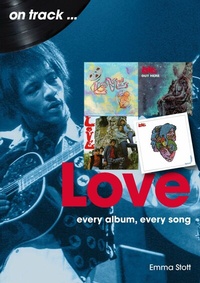
Love
Description

As Love's most revered album is titled Forever Changes, it's little wonder that their superior back catalogue encompasses a multitude of genres: folk rock, garage, jazz rock, baroque, psychedelia, soul, funk, and reggae - or certainly Arthur Lee's does. But who can separate Love from their beleaguered yet brilliant front man? Love On Track explores the many embodiments of both his group and his solo work. Love were the first rock signing to folk label Elektra, and something of this contradiction inhabits their work. From the raw beat of their eponymous debut to the sweetly ruminative songs on Da Capo, to the ultimate comment on the counter-culture in Forever Changes, onto Four Sail's auguring of the hard rocking 1970s, these albums represent Love's best known work. But the Love story doesn't end there. There's the epic double album Out Here, collaborations with Jimi Hendrix, vegetarian protest songs, and a gorgeously romantic revival in Five String Serenade. There are also stops along the way to recall the solo work of Bryan MacLean et al, a new interview with Berton Averre, who played with Lee in the 1990s, and a detailed look at live recordings, making this book a real labour of Love.
Emma Stott is the author of two previous Sonicbond titles: Jimi Hendrix On Track, and The Zombies on Track. She also writes about education, particularly linguistics and literature; and she is a poet and short story writer, too. Her last work reimagined The Great Gatsby as a folk horror starring The Rolling Stones - or at least a band that closely resembles them. She lives in Manchester, UK.
All prices
More details
Other editions
Additional editions
Content
Introduction
On the one side he who thinks our lives can be improved with axes and knives
Or the one who'd submerge in his imagination seeking a personal annihilation
So for me the last word can never be spoken I am left with a question that is always open.
Marquis de Sade, Marat/Sade - Peter Weiss (1964)
'I'd never seen a handgun before, and I wasn't even sure if it was a real one - it looked like a replica. So I pulled it out, walked through to the patio and said, 'Hey, Arthur! Arriba!' The second time I pulled the trigger, it went off, making the biggest noise I've ever heard.' (As told to Barney Hoskyns.)
Arthur Lee and his mate Thomas are watching the film The Three Amigos. Lee asks Thomas to help him look through some boxes to find old recordings of his band, Love. As Thomas is rifling, he finds a gun. Later, Lee explains that it's been left behind by one of his ex-girlfriends. But not before Thomas has fired it, and Lee is arrested. He is eventually sent to prison for 12 years, convicted of negligent discharge of a firearm.
The idea of searching for a Love artefact but instead uncovering a Magnum .44 sums up the band's and, in particular, Lee's paradox almost too neatly: on the one hand, a group with the ultimate 1960s name, who crafted some of the decade's most elegantly seductive music; but on the other, a band who produced a trove of songs that pulse with mistrust and disgust. It is not novel to point out the irony of the group's name - and neither is it what makes their work fascinating; nor that they fought over women and money; were dominated by a charismatic lead singer, or possibly by an unsympathetic record company; or may or may not have been 'do-nut bandits', but the fascination is in the music itself. Lee viewed Peter Brooks' cinematic version of the play Marat/Sade in early 1967, in which revolutionary Jean Paul Marat must defend his radical ideology: one of removing inequities in whatever way may be needed. His ideas are juxtaposed with those of De Sade, which advocate personal freedom, whether that means resisting the status quo or resisting its counter-movements. Love's music works within the system, without the system and against the system.
And even as if there is no system at all, embodying Marat and De Sade's oppositions in one. The band are held up as icons of the counter-culture, but later Love, perhaps because of chasing commercial appeal and piggybacking on trends, is sometimes seen as an embarrassing coda. Many critics express disappointment with the works after Forever Changes, as though Lee's realising of a different sound had to be him failing the masses and not, instead, serving his own imagination.
Despite an attempt at appealing the prison sentence, Lee served nearly six years of it - almost double the lifespan of the first lineup of Love. Yet, despite numerous controversies, it is still the songs, not just the legend, that have endured. Speaking in the 2006 documentary Love Story, the band's original lead guitarist, Johnny Echols, explained: 'The sound was the medium that was driving the show.'
On the night of the Brexit referendum (23 June 2016), I saw Echols perform with Baby Lemonade as Love Revisited at Manchester's Ruby Lounge: Californian sunshine dappled the melodies, guitar solos unwound like victory ribbons and beneath everything was a gorgeous foreboding...
Almost a decade on, Echols and Baby Lemonade are currently touring, and though lauded for their authenticity and energy, reviewers still can't help commenting on how sexagenarian songs speak not just of now but next... Ian Kingsbury, reviewing a 2024 show in Nottingham for Leftlion, noted the most potent moment being when an iconic lyric from 'The Red Telephone' was updated to: 'They're locking them up today, They're throwing away the key. I wonder who it will be tomorrow, Trump or me?'
The sound is still the medium driving the show.
Love
Arthur Porter Taylor (7 March 1945, Memphis, Tennessee) was only four when he first stood on a stage - performing a poem about a red telephone, no less. The red telephone, of course, would reappear on Love's defining album, Forever Changes, as a symbol of doom. Alas, the young Lee's poem doesn't survive, but there was little in Lee's early childhood to suggest a leaning towards the apocalyptic. His mum, Agnes, was a schoolteacher and his dad, Chester Taylor, played cornet in jazz bands. However, when Lee was around six years old, Agnes filed for divorce, citing Taylor's neglect; whilst he was at work, she and Arthur left for California. After eventually settling in Los Angeles, Agnes married Clinton Lee, who adopted Arthur. Despite the upheaval, there are elements of serendipity: Lee was mixed race - California had been more active in desegregation than Memphis, at least ostensibly. He also wound up in prime position to be part of the West Coast sound, and, even more significantly, would be in the right place to reunite with old pal Johnny Echols - a boon to Love not only for his distinctive guitar playing, but because he was one of few people who seems to have genuinely been respected by Lee, and who could stand up to him. Echols had more musical experience when Lee asked if he could join Echols' band, which included keyboardist Billy Preston, who was reluctant because Lee didn't seem able to play anything. Thankfully, Echols was more amenable.
John Marshall Echols (21 February 1947, Memphis, Tennessee) learned to play the trumpet as a child, but had an epiphany when friend Danny Oaken brought a guitar to 'show and tell' at school. Echols told Record Collector in 2016:
He brought in an acoustic guitar - a Harmony Sovereign. He was called to the nurse's office and asked if I would hold his guitar for him while he was there. I said, 'Of course', and I held the guitar, and I started strumming it, and something just magical happened. I could feel it vibrating in my soul, basically, and I was in love from that moment on.
After receiving some tips from The Coasters' Adolph Jacobs, Echols mastered Bill Doggett's 1956 two-part instrumental hit, 'Honky Tonk', also the first record that he'd bought. Ironically, it's rumoured that Lee and Echols would occasionally pretend to be The Coasters in order to secure gigs later on. They also resorted to drawing on moustaches to make them appear more senior! Echols had known Lee as a young child back in Memphis, but reunited with him when they both enrolled at Dorsey High School. Lee and Echols made their debut at a school assembly, playing The Mar-key's (mostly) instrumental 'Last Night', a top three hit in the US in 1961, but probably better known in the UK as the music playing over the closing credits of the sitcom Bottom. Lee played organ, whilst Echols was on guitar.
This embryonic Love moved through various band names, which in their evolution are revealing of Lee's desire to make his mark - from The House Rockers to ALJE (as in Arthur Lee Johnny Echols, not in alphabetical order) to Arthur Lee and the LAGs, now with Echols's name removed, and Los Angeles Group in its place. In light of Lee's later conviction, it's lucky that the LAGs moniker was dropped ... but not before they recorded Lee's 'The Ninth Wave' in 1963 for Capitol Records, which owed an obvious debt to 'Last Night'. Lee plays the organ again, with Echols on guitar, William 'Crimson' Crout on lead guitar, Roland Davies drumming and Alan Goldman and Allan Talbert playing saxophone. On the B-side is Lee's 'Rumble-Still-Skins', another instrumental, this time blending the feel of Fats Domino with the rhythms of The Surfaris. Several sources cite Lee as slating these recordings and giving the explanation that he didn't trust the companies enough to give them his best work. This may simply be a very Arthur way to mitigate some potentially embarrassing early attempts, but it also indicates the pulses of paranoia that would attack Lee's career several times in the future.
After Echols had seen The Beatles play The Hollywood Bowl, he and Lee donned wigs and became The American Four, recording for Selma Records. Being joined by John Fleckenstein on bass and John Jacobson on drums, this turned the band into a mix of black and white members - especially significant in the year when the Civil Rights Act was passed. LA folk-rockers The Rising Sons had white and black members, too, famously Taj Mahal and Ry Cooder, and Lee had watched them play at The Ash Grove in 1965. Lee told Barney Hoskyns that they were an influence, but 'we were the first integrated rock band because The Rising Sons weren't a rock band.' The Rising Sons are remembered mostly for solid blues covers that are competent if lacking real grit. However, the sound of their bouncy 'Candy Man' would be 'revisited' on some later Love songs.
In October 1964, The American Four were in the studio working on Lee's 'Luci Baines', which is a flagrant 'Twist And Shout' rip-off that commemorates Lyndon Johnson's daughter Luci: her Watusi with Steve McQueen at a barbecue earned her the nickname Luci Watusi. Lee's vocal is confident and distinctive; therefore, the most successful aspect of the track. Its B-side, which Lee co-wrote with Echols, is the Booker T-inspired 'Soul Food'...
