

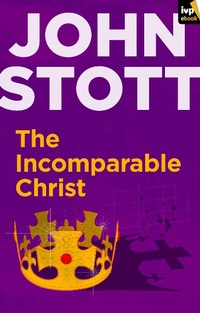
The Incomparable Christ
Published on 17. December 2012
256 pages
978-1-78359-109-1 (ISBN)
Description

Jesus Christ has been the dominant figure in the history of Western culture for two millennia, and his birth the pivot of our calendar.
He is the focus of Scripture: as Luther declared, 'The entire Scripture deals only with Christ everywhere.' He is the heart of mission, the message that countless Christians cross land and sea, continents and cultures, to deliver.
In masterly surveys, John Stott looks at the New Testament witness, at the way the church has portrayed Christ down through the centuries, and at the influence Christ has had on individuals over the last two millennia. Finally, turning to the book of Revelation, he asks what Jesus Christ should mean to us today. Here is the fruit of a lifetime of biblical study, rigorous Christian thought and devotion to the person of Jesus Christ.
'John Stott paints a picture of the incomparable Christ on a huge canvas. He applies his incisive mind, his commitment to Scripture and his sense of awe at God's purpose in human history, focusing with humility on the Jesus he knew and loved throughout his life. The result is a rare combination of wisdom and inspiration.' - Roy McCloughry
He is the focus of Scripture: as Luther declared, 'The entire Scripture deals only with Christ everywhere.' He is the heart of mission, the message that countless Christians cross land and sea, continents and cultures, to deliver.
In masterly surveys, John Stott looks at the New Testament witness, at the way the church has portrayed Christ down through the centuries, and at the influence Christ has had on individuals over the last two millennia. Finally, turning to the book of Revelation, he asks what Jesus Christ should mean to us today. Here is the fruit of a lifetime of biblical study, rigorous Christian thought and devotion to the person of Jesus Christ.
'John Stott paints a picture of the incomparable Christ on a huge canvas. He applies his incisive mind, his commitment to Scripture and his sense of awe at God's purpose in human history, focusing with humility on the Jesus he knew and loved throughout his life. The result is a rare combination of wisdom and inspiration.' - Roy McCloughry
More details
Language
English
Place of publication
Nottingham
United Kingdom
Product notice
Reflowable
ISBN-13
978-1-78359-109-1 (9781783591091)
Copyright in bibliographic data and cover images is held by Nielsen Book Services Limited or by the publishers or by their respective licensors: all rights reserved.
Schweitzer Classification
Other editions
Additional editions
Book
02/2012
Inter-Varsity Press
€14.40
Shipment within 3-4 weeks
Person
The Revd Dr John Stott, CBE, was for many years Rector of All Souls Church, Langham Place, London, and chaplain to the Queen. Stott's global influence is well established, mainly through his work with Billy Graham and the Lausanne conferences - he was one of the principal authors of theLausanne Covenant in 1974. In 2005, Time magazine ranked Stott among the100 most influential people in the world. He passed away on July 27, 2011.
Content
- Intro
- CONTENTS
- PART I: THE ORIGINAL JESUS (or how the New Testament witnesses to him)
- PART II: THE ECCLESIASTICAL JESUS (or how the church has presented him)
- PART III: THE INFLUENTIAL JESUS (or how he has inspired people)
- PART IV: THE ETERNAL JESUS (or how he challenges us today)
- FOREWORD
- ACKNOWLEDGMENTS
- INTRODUCTION
- 1. The centrality of Jesus
- 2. History and theology
- PART I: THE ORIGINAL JESUS (or how the New Testament witnesses to him)
- The four Gospels
- 1. The Gospel of Matthew: Christ the fulfilment of Scripture
- 2. The Gospel of Mark: Christ the Suffering Servant
- 3. Luke's Gospel and the Acts: Christ the Saviour of the world
- 4. The Gospel and letters of John: Christ the Word made flesh
- 5. The fourfold gospel
- 6. Jesus and Paul
- The thirteen letters of Paul
- 7. A polemical letter (Galatians): Christ the liberator
- 8. The early letters (1 & 2 Thessalonians): Christ the coming judge
- 9. The major letters (Romans, 1 & 2 Corinthians): Christ the Saviour
- Romans
- 1 Corinthians
- 2 Corinthians
- 10. The prison letters (Colossians, Philemon, Ephesians and Philippians): Christ the supreme Lord
- 11. The pastoral letters (1 Timothy, Titus and 2 Timothy): Christ the head of the church
- Three more Jewish authors
- 12. The letter of James: Christ the moral teacher
- 13. The letter to the Hebrews: Christ our great high priest
- 14. The letters of Peter: Christ the exemplary sufferer
- Conclusion: Diversity in unity
- PART II: THE ECCLESIASTICAL JESUS (or how the church has presented him)
- Introduction: 'Another Jesus'
- 1. Christ the complete fulfilment: Justin Martyr
- The prophets and the philosophers
- 2. Christ the unique God-man: the early councils
- The importance of Christology
- 3. Christ the perfect monk: St Benedict
- Two questions about monasticism
- 4. Christ the feudal debtor: Anselm
- Medieval atonement theology
- 5. Christ the heavenly bridegroom: Bernard of Clairvaux
- Christian mysticism
- 6. Christ the ethical exemplar: Thomas à Kempis
- An ascetic imitation of Christ
- 7. Christ the gracious Saviour: Martin Luther
- Justification by faith alone
- 8. Christ the human teacher: Ernst Renan and Thomas Jefferson
- Enlightenment scepticism
- 9. Christ the tragic victim: John Mackay
- Good Friday without Easter
- 10. Christ the social liberator: Gustavo Gutiérrez
- Good news for the poor
- 11. Christ the Jewish Messiah: N. T. Wright
- Exile and exodus
- 12. Christ the global Lord: Mission in the twentieth century
- From Edinburgh 1910 to Lausanne 1974
- Conclusion: Authenticity versus accommodation
- PART III: THE INFLUENTIAL JESUS (or how he has inspired people)
- Introduction: The story of Jesus
- 1. The Bethlehem stable: Francis of Assisi
- The nativity of the poor king
- 2. The carpenter's bench: George Lansbury
- The dignity of manual labour
- 3. The ministry of compassion: Father Damien and Wellesley Bailey
- Touching untouchables
- 4. The Sermon on the Mount: Leo Tolstoy, Mahatma Gandhi and Martin Luther King, Jr
- The challenge of non-resistance
- 5. The love for children: Thomas Barnardo
- 'An ever-open door'
- 6. The washing of feet: Samuel Logan Brengle
- A necessary lesson in humility
- 7. The cross: Toyohiko Kagawa
- The revelation of the love of God
- 8. The resurrection: Joni Eareckson Tada
- 'I'll be on my feet dancing'
- 9. The exaltation: Henry Martyn
- Zeal for the honour of Christ's name
- 10. The gift of the Spirit: Roland Allen
- The Holy Spirit is a missionary Spirit
- 11. The second coming: Anthony Ashley Cooper (Lord Shaftesbury)
- A programme of social reform
- 12. The last judgment: William Wilberforce
- The abolition of slavery and the slave-trade
- Conclusion: The radical nature of Christ's influence
- PART IV: THE ETERNAL JESUS (or how he challenges us today)
- Introduction: 'The Revelation of Jesus Christ'
- Four principles of interpretation
- 1. Christ claiming to be the First and the Last, and the Living One (Rev. 1)
- A vision of the resurrected and eternal Christ
- 2. Christ supervising his churches on earth (Rev. 2 - 3)
- Seven marks of an ideal church
- 3. Christ sharing God's throne in heaven (Rev. 4 - 5)
- The throne, the scroll and the Lamb
- John's vision of a throne (4:1-11)
- John's vision of a scroll (5:1-6)
- John's vision of the Lamb (5:7-14)
- 4. Christ controlling the course of history (Rev. 6 - 7)
- The seven seals and the two communities
- 5. Christ calling the world to repentance (Rev. 8 - 11)
- The seven trumpets, the little scroll and the two witnesses
- The little scroll and the two witnesses
- 6. Christ overcoming the devil and his allies (Rev. 12 - 13)
- The woman, the dragon, the male child and the two beasts
- Three visions (12:1-17)
- The beast out of the sea
- The beast out of the earth
- Babylon the harlot
- 7. Christ standing on Mt Zion with his redeemed people (Rev. 14:1 - 15:4)
- The radical alternative: salvation and judgment
- The Lamb and the 144,000 (14:1-13)
- The harvest and the vintage (14:14-20)
- The song of Moses and of the Lamb (15:1-4)
- 8. Christ coming like a thief in the night (Rev. 15:5 - 19:10)
- The call to be ready
- The seven bowls (15:5 - 16:21)
- The identity of Babylon (17:1-18)
- The fall of Babylon (18:1-24)
- Five hallelujahs (19:1-10)
- 9. Christ riding in triumph on a white horse (Rev. 19:11 - 20:15)
- The doom of the beast and of Satan
- His description and his names
- The two beasts are destroyed
- Satan's doom (20:1-15)
- 10. Christ coming as the bridegroom to claim his bride (Rev. 21 - 22)
- The new universe, the city and the garden
- All things new (21:1-8)
- The city (21:9-21)
- The garden (22:1-6)
- Epilogue (Rev. 22:6-21)
- 'I am coming soon!'
- The wedding
- CONCLUSION
- One book in four parts
- NOTES
- Introduction
- Part I: The original Jesus
- Part II: The ecclesiastical Jesus
- Part III: The influential Jesus
- Part IV: The eternal Jesus
