

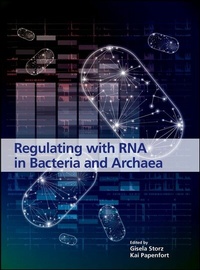
Regulating with RNA in Bacteria and Archaea
Description

For decades after the discoveries of messenger RNA, transfer RNA, and ribosomal RNA, it was largely assumed that the role of RNA in the cell was limited to shuttling the genomic message, chaperoning amino acids, and toiling in the ribosomes.
Eventually, hints that RNA molecules might have regulatory roles began to appear. With the advent of genomics and bioinformatics, it became evident that numerous other RNA forms exist and have specific functions, including small RNAs (sRNA), RNA thermometers, and riboswitches to regulate core metabolic pathways, bacterial pathogenesis, iron homeostasis, quorum sensing, and biofilm formation.
All of these functions, and more, are presented in Regulating with RNA in Bacteria and Archaea, written by RNA biologists from around the globe. Divided into eight sections-RNases and Helicases, Cis-Acting RNAs, Cis Encoded Base Pairing RNAs, Trans-Encoded Base Pairing RNAs, Protein Titration and Scaffolding, General Considerations, Emerging Topics, and Resources-this book serves as an excellent resource for established RNA biologists and for the many scientists who are studying regulated cellular systems.
It is no longer a fair assumption that gene expression regulation is the provenance of proteins only or that control is exerted primarily at the level of transcription. This book makes clear that regulatory RNAs are key partners along with proteins in controlling the complex interactions and pathways found within prokaryotes.
More details
Other editions
Additional editions
Persons
Gisela Storz is an NIH Distinguished Investigator in the Eunice Kennedy Shriver National Institute of Child Health and Human Development in Bethesda, Maryland. She carried out graduate work with Dr. Bruce Ames at the University of California, Berkeley and postdoctoral work with Dr. Sankar Adhya at the National Cancer Institute and Dr. Fred Ausubel at Harvard Medical School. As a result of the serendipitous discovery of the peroxide-induced OxyS RNA in E. coli, one of the first small, regulatory RNAs to be found, much of the work in her lab has focused on the genome-wide identification of small RNAs and their characterization.
Kai Papenfort is a Professor of Microbiology at the Ludwig Maximilians University of Munich, Germany. He received a diploma in biology from the University of Marburg and carried out graduate work with Dr. Jörg Vogel at the Max Planck Institute for Infection Biology and the Humboldt University of Berlin. In his postdoctoral work at the University of Würzburg and Princeton University, Dr. Papenfort studied the regulatory functions of small RNA in bacterial pathogens and their involvement in bacterial communication processes such as quorum sensing. His laboratory focuses on the molecular mechanisms underlying the regulation by small RNAs in the major human pathogen, Vibrio cholerae.
Content
Contributors
Foreword
Preface
Acknowledgments
About the Editors
Section I: RNases and Helicases
1. RNase E and the High-Fidelity Orchestration of RNA Metabolism
Katarzyna J. Bandyra and Ben F. Luisi
2. Enzymes Involved in Posttranscriptional RNA Metabolism in Gram-Negative Bacteria
Bijoy K. Mohanty and Sidney R. Kushner
3. RNases and Helicases in Gram-Positive Bacteria
Sylvain Durand and Ciarán Condon
Section II: Cis-acting RNAs
4. RNA Thermometers in Bacterial Pathogens
Edmund Loh, Francesco Righetti, Hannes Eichner, Christian Twittenhoff, Franz Narberhaus
5. Small Molecule-Binding Riboswitches
Thea S. Lotz and Beatrix Suess
6. The T-Box Riboswitch: tRNA as an Effector to Modulate Gene Regulation
Kiel D. Kreuzer and Tina M. Henkin
7. rRNA Mimicry in RNA Regulation of Gene Expression
Michelle M. Meyer
8. Processive Antitermination
Jonathan R. Goodson and Wade C. Winkler
9. Genes within genes in bacterial genomes
Sezen Meydan, Nora Vázquez-Laslop, and Alexander S. Mankin
10. Leaderless mRNAs in the Spotlight: Ancient but Not Outdated!
Heather J. Beck and Isabella Moll
Section III: Cis-encoded base pairing RNAs
11. Type I Toxin-Antitoxin Systems: Regulating Toxin Expression via Shine-Dalgarno Sequence Sequestration and Small RNA Binding
Sara Masachis and Fabien Darfeuille
12. Widespread Antisense Transcription in Prokaryotes
Jens Georg and Wolfgang R. Hess
Section IV: Trans-encoded base pairing RNAs
13. Small Regulatory RNAs in the Enterobacterial Response to Envelope Damage and Oxidative Stress
Kathrin S. Fröhlich and Susan Gottesman
14. Carbohydrate Utilization in Bacteria: Making the Most Out of Sugars with the Help of Small Regulatory RNAs
Svetlana Durica-Mitic, Yvonne Göpel, Boris Görke
15. Small RNAs Involved in Regulation of Nitrogen Metabolism
Daniela Prasse and Ruth A. Schmitz
16. Bacterial Iron Homeostasis Regulation by sRNAs
Sylvia Chareyre and Pierre Mandin
17. Small-RNA-Based Regulation of Bacterial Quorum Sensing and Biofilm Formation
Sine Lo Svenningsen
18. Regulatory RNAs in Virulence and Host-Microbe Interactions
Alexander J. Westermann
Section V: Protein titration and scaffolding
19. Global Regulation by CsrA and Its sRNA Antagonists
Tony Romeo and Paul Babitzke
20. 6S RNA, a Global Regulator of Transcription
Karen M. Wassarman
21. Bacterial Y RNAs: Gates, Tethers, and tRNA Mimics
Soyeong Sim and Sandra L. Wolin
Section VI: General considerations
22. Proteins That Chaperone RNA Regulation
Sarah A. Woodson, Subrata Panja, and Andrew Santiago-Frangos
23. Epitranscriptomics: RNA Modifications in Bacteria and Archaea
Katharina Höfer and Andres Jäschke
24. RNA Localization in Bacteria
Jingyi Fei and Cynthia M. Sharma
25. Sponges and Predators in the Small RNA World
Nara Figueroa-Bossi and Lionello Bossi
26. Bacterial Small RNAs in Mixed Regulatory Networks
Anaïs Brosse and Maude Guillier
27. Dual-Function RNAs
Medha Raina, Alisa King, Colleen Bianco, and Carin K. Vanderpool
28. Origin, Evolution, and Loss of Bacterial Small RNAs
H. Auguste Dutcher and Rahul Raghavan
Section VII: Emerging topics
29. Cross-regulation between bacteria and phages at a posttranscriptional Level
Shoshy Altuvia, Gisela Storz, Kai Papenfort
30. Large Noncoding RNAs in Bacteria
Kimberly A. Harris and Ronald R. Breaker
31. Synthetic Biology of Small RNAs and Riboswitches
Jordan K. Villa, Yichi Su, Lydia M. Contreras, Ming C. Hammond
Section VIII: Resources
32. Functional Transcriptomics for Bacterial Gene Detectives
Blanca Perez-Sepulveda and Jay C.D. Hinton
33. Structure and Interaction Prediction in Prokaryotic RNA Biology
Patrick R. Wright, Martin Mann, Rolf Backofen
Index
Contributors
- Shoshy Altuvia
Department of Microbiology and Molecular Genetics, IMRIC
The Hebrew University-Hadassah Medical School
Jerusalem, Israel
- Paul Babitzke
Department of Biochemistry and Molecular Biology
Center for RNA Molecular Biology
The Pennsylvania State University
University Park, Pennsylvania
- Rolf Backofen
Bioinformatics Group
Center for Biological Signaling Studies (BIOSS)
University of Freiburg
Freiburg, Germany
- Katarzyna J. Bandyra
Department of Biochemistry
University of Cambridge
Cambridge, United Kingdom
- Heather J. Beck
Max F. Perutz Laboratories, Center for Molecular Biology
Department of Microbiology, Immunology and Genetics
University of Vienna
Vienna Biocenter
Vienna, Austria
- Colleen Bianco
Department of Microbiology
University of Illinois
Urbana, Illinois
- Lionello Bossi
Institute for Integrative Biology of the Cell (I2BC)
CEA, CNRS, University of Paris-Sud
University of Paris-Saclay
Gif-sur-Yvette, France
- Ronald R. Breaker
Howard Hughes Medical Institute
Department of Molecular, Cellular and Developmental Biology
Department of Molecular Biophysics and Biochemistry
Yale University
New Haven, Connecticut
- Anaïs Brosse
CNRS UMR8261
Associated with University Paris Diderot, Sorbonne Paris Cité
Institut de Biologie Physico-Chimique
Paris, France
- Sylvia Chareyre
Aix Marseille Université-CNRS
Institut de Microbiologie de la Méditéranée
Laboratoire de Chimie Bactérienne
Marseille, France
- Ciaran Condon
UMR8261 CNRS
Université Paris Diderot (Sorbonne Paris Cité)
Institut de Biologie Physico-Chimique
Paris, France
- Lydia M. Contreras
Institute of Cellular and Molecular Biology
Department of Chemical Engineering
The University of Texas at Austin
Austin, Texas
- Fabien Darfeuille
ARNA Laboratory
INSERM U1212, CNRS UMR 5320
University of Bordeaux
Bordeaux, France
- Sylvain Durand
UMR8261 CNRS
Université Paris Diderot (Sorbonne Paris Cité)
Institut de Biologie Physico-Chimique
Paris, France
- Svetlana Durica-Mitic
Department of Microbiology, Immunobiology and Genetics
Max F. Perutz Laboratories
University of Vienna
Vienna Biocenter
Vienna, Austria
- H. Auguste Dutcher
Department of Biology and Center for Life in Extreme Environments
Portland State University
Portland, Oregon
- Hannes Eichner
Microbiology, Tumor and Cell Biology
Karolinska Institutet
Stockholm, Sweden
- Jingyi Fei
Department of Biochemistry and Molecular Biology
Institute for Biophysical Dynamics
The University of Chicago
Chicago, Illinois
- Nara Figueroa-Bossi
Institute for Integrative Biology of the Cell (I2BC)
CEA, CNRS, University of Paris-Sud
University of Paris-Saclay
Gif-sur-Yvette, France
- Kathrin S. Fröhlich
Department of Biology I, Microbiology
LMU Munich
Martinsried, Germany
- Jens Georg
University of Freiburg, Faculty of Biology
Institute of Biology III
Genetics and Experimental Bioinformatics
Freiburg, Germany
- Jonathan R. Goodson
The University of Maryland
Department of Cell Biology and Molecular Genetics
College Park, Maryland
- Yvonne Göpel
Department of Microbiology, Immunobiology and Genetics
Max F. Perutz Laboratories
University of Vienna
Vienna Biocenter
Vienna, Austria
- Boris Görke
Department of Microbiology, Immunobiology and Genetics
Max F. Perutz Laboratories
University of Vienna
Vienna Biocenter
Vienna, Austria
- Susan Gottesman
Laboratory of Molecular Biology
Center for Cancer Research
National Cancer Institute
Bethesda, Maryland
- Maude Guillier
CNRS UMR8261
Associated with University Paris Diderot, Sorbonne Paris Cité
Institut de Biologie Physico-Chimique
Paris, France
- Ming C. Hammond
Department of Chemistry
Department of Molecular & Cell Biology
University of California, Berkeley
Berkeley, California
- Kimberly A. Harris
Howard Hughes Medical Institute
Department of Molecular, Cellular and Developmental Biology
Yale University
New Haven, Connecticut
- Tina M. Henkin
Department of Microbiology and Center for RNA Biology
The Ohio State University
Columbus, Ohio
- Wolfgang R. Hess
University of Freiburg, Faculty of Biology
Institute of Biology III
Genetics and Experimental Bioinformatics
Freiburg, Germany
- Jay C.D. Hinton
Institute of Integrative Biology
University of Liverpool
Liverpool, United Kingdom
- Katharina Höfer
Institute of Pharmacy and Molecular Biotechnology
Im Neuenheimer Feld 364
Heidelberg University
Heidelberg, Germany
- Andres Jäschke
Institute of Pharmacy and Molecular Biotechnology
Im Neuenheimer Feld 364
Heidelberg University
Heidelberg, Germany
- Alisa King
Department of Microbiology
University of Illinois
Urbana, Illinois
- Kiel D. Kreuzer
Department of Microbiology and Center for RNA Biology
Molecular, Cellular and Developmental Biology Graduate Program
The Ohio State University
Columbus, Ohio
- Sidney R. Kushner
Department of Genetics
Department of Microbiology
University of Georgia
Athens, Georgia
- Edmund Loh
Microbiology, Tumor and Cell Biology
Karolinska Institutet
Stockholm, Sweden
SCELSE
Nanyang Technological University
Singapore
- Thea S. Lotz
Synthetic Genetic Circuits
Department of Biology
TU Darmstadt
Darmstadt, Germany
- Ben F. Luisi
Department of Biochemistry
University of Cambridge
Cambridge, United Kingdom
- Pierre Mandin
Aix Marseille Université-CNRS
Institut de Microbiologie de la Méditéranée
Laboratoire de Chimie Bactérienne
Marseille, France
- Alexander S. Mankin
Center for Biomolecular Sciences
University of Illinois at Chicago
Chicago, Illinois
- Martin Mann
Bioinformatics Group
University of Freiburg
Freiburg, Germany
- Sara Masachis
ARNA Laboratory
INSERM U1212, CNRS UMR 5320
University of Bordeaux
Bordeaux, France
- Sezen Meydan
Center for Biomolecular Sciences
University of Illinois at Chicago
Chicago, Illinois
- Michelle M. Meyer
Department of Biology
Boston College
Chestnut Hill, Massachusetts
- Bijoy K. Mohanty
Department of Genetics
University of Georgia
Athens, Georgia
- Isabella Moll
Max F. Perutz Laboratories, Center for Molecular Biology
Department of Microbiology, Immunology and Genetics
University of Vienna
Vienna Biocenter
Vienna, Austria
- Franz Narberhaus
Microbial Biology
Ruhr University
Bochum, Germany
- Subrata Panja
T.C. Jenkins Department of Biophysics
Johns Hopkins University
Baltimore, Maryland
- Kai Papenfort
Faculty of Biology
Department of Microbiology
Ludwig-Maximilians-University of Munich
Martinsried, Germany
- Blanca M. Perez-Sepulveda
Institute of Integrative Biology
University of Liverpool
Liverpool, United Kingdom
- Daniela Prasse
Christian-Albrechts-University Kiel
Institute of General Microbiology
Kiel, Germany
- Rahul Raghavan
Department of Biology and Center for Life in Extreme Environments
Portland State University
Portland, Oregon
- Medha Raina
Division of Molecular and Cellular Biology
Eunice Kennedy Shriver National Institutes of Child Health and Human Development
Bethesda, Maryland
- Francesco Righetti
Microbiology, Tumor and Cell Biology
Karolinska Institutet
Stockholm, Sweden
- Tony Romeo
Department of Microbiology and Cell Science
Institute of Food and Agricultural Sciences
University of Florida
Gainesville, Florida
- Andrew Santiago-Frangos
Program in Cell, Molecular and Developmental Biology and Biophysics
Johns Hopkins...
