

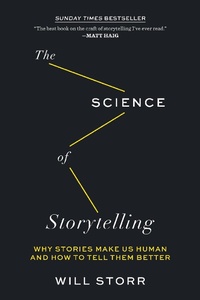
The Science of Storytelling
Description

The compelling, groundbreaking guide to creative writing that reveals how the brain responds to storytelling
Stories shape who we are. They drive us to act out our dreams and ambitions and mold our beliefs. Storytelling is an essential part of what makes us human. So, how do master storytellers compel us? In The Science of Storytelling, award-winning writer and acclaimed teacher of creative writing Will Storr applies dazzling psychological research and cutting-edge neuroscience to our myths and archetypes to show how we can write better stories, revealing, among other things, how storytellers-and also our brains-create worlds by being attuned to moments of unexpected change.
Will Storr's superbly chosen examples range from Harry Potter to Jane Austen to Alice Walker, Greek drama to Russian novels to Native American folk tales, King Lear to Breaking Bad to children's stories. With sections such as "The Dramatic Question," "Creating a World," and "Plot, Endings, and Meaning," as well as a practical, step-by-step appendix dedicated to "The Sacred Flaw Approach," The Science of Storytelling reveals just what makes stories work, placing it alongside such creative writing classics as John Yorke's Into the Woods: A Five-Act Journey into Story and Lajos Egri's The Art of Dramatic Writing. Enlightening and empowering, The Science of Storytelling is destined to become an invaluable resource for writers of all stripes, whether novelist, screenwriter, playwright, or writer of creative or traditional nonfiction.
More details
Other editions
Additional editions
Person
Content
- Cover
- Title Page
- Copyright Page
- Dedication
- Contents
- Introduction
- Chapter One: Creating a World
- 1.0 Where does a story begin?
- 1.1 Moments of change
- the control-seeking brain
- 1.2 Curiosity
- 1.3 The model-making brain
- how we read
- grammar
- filmic word order
- simplicity
- active versus passive language
- specific detail
- show-not-tell
- 1.4 World-making in fantasy and science fiction
- 1.5 The domesticated brain
- theory of mind in animism and religion
- how theory-of-mind mistakes create drama
- 1.6 Salience
- creating tension with detail
- 1.7 Neural models
- poetry
- metaphor
- 1.8 Cause and effect
- literary versus mass-market storytelling
- 1.9 Change is not enough
- Chapter Two: The Flawed Self
- 2.0 The flawed self
- the theory of control
- 2.1 Personality and plot
- 2.2 Personality and setting
- 2.3 Personality and point of view
- 2.4 Culture and character
- Western versus Eastern story
- 2.5 Anatomy of a flawed self
- the ignition point
- 2.6 Fictional memories
- moral delusions
- antagonists and moral idealism
- antagonists and toxic self-esteem
- the hero-maker narrative
- 2.7 David and Goliath
- 2.8 How flawed characters create meaning
- Chapter Three: The Dramatic Question
- 3.0 Confabulation and the deluded character
- the dramatic question
- 3.1 Multiple selves
- the three-dimensional character
- 3.2 The two levels of story
- how subconscious character struggle creates plot
- 3.3 Modernist stories
- 3.4 Wanting and needing
- 3.5 Dialogue
- 3.6 The roots of the dramatic question
- social emotions
- heroes and villains
- moral outrage
- 3.7 Status play
- 3.8 King Lear
- humiliation
- 3.9 Stories as tribal propaganda
- 3.10 Antiheroes
- empathy
- 3.11 Origin damage
- Chapter Four: Plots, Endings and Meaning
- 4.0 Goal directedness
- constriction and release
- video games
- personal projects
- eudaemonia
- 4.1 The story event
- the standard five-act plot
- plot as recipe versus plot as symphony of change
- 4.2 The final battle
- 4.3 Endings
- control
- the God moment
- 4.4 Story as a simulacrum of consciousness
- transportation
- 4.5 The power of story
- 4.6 The value of story
- 4.7 The lesson of story
- 4.8 The consolation of story
- Appendix: The Sacred Flaw Approach
- A Note on the Text
- Acknowledgments
- Notes and Sources
- Index of Searchable Terms
