

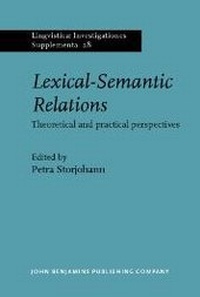
Lexical-Semantic Relations
Theoretical and practical perspectives
1st Edition
Published on 23. June 2010
VIII, 188 pages
978-90-272-8816-5 (ISBN)
Description

This collection of articles sketches the complexity of the subject of lexical-semantic relations and addresses semantic, lexicographic and computational issues on an array of meaning relations in different languages. It brings together a variety of linguistic studies on the contextualised construction of synonymy and antonymy in discourse. It shows that research on language and cognition calls for empirical evidence from different sources. This volume demonstrates how the internet, corpus data, as well as psycholinguistic methods contribute profitably to gain insights into the nature of the paradigmatics in actual language use. Furthermore, the volume is concerned with practical and application-oriented research on lexical databases, and it includes explorations of sense-related items in dictionaries from both a text-technological and lexicographic perspective.
More details
Other editions
Additional editions
Book
06/2010
John Benjamins Publishing Co
€111.30
Shipment within 10-15 days
Person
Content
- Lexical-Semantic Relations
- Editorial page
- Title page
- LCC data
- Table of contents
- Preface
- Introduction
- Lexico-semantic relations in theory and practice
- 1. Lexicology: From structural to cognitive approaches
- 1.1 Structuralist approaches
- 1.2 Cognitive approaches
- 1.3 Corpus material and language in use
- 2. Lexicography
- 3. Computational linguistics - lexical databases and corpus tools
- References
- Swedish opposites
- 1. Introduction
- 2. Methodological considerations
- 3. Data extraction
- 3.1 Method
- 3.2 Result
- 4. Elicitation experiment
- 4.1 Results
- 5. Judgement experiment
- 5.1 Results
- 6. Discussion
- 6.1 Data extraction
- 6.2 Elicitation experiment
- 6.3 Judgement experiment
- 6.4 Dichotomy vs. continuum
- 6.5 Methodological remarks
- 7. Conclusion
- References
- Using web data to explore lexico-semantic relations
- 1. Introduction
- 2. Discourse functions of antonymy
- 2.1 Ancillary Antonymy
- 2.2 Coordinated Antonymy
- 2.3 Minor categories
- 2.4 Distribution of discourse functions
- 3. Antonym Canonicity: A web-as-corpus approach
- 4. Ancillary Antonymy: A complementary approach
- 5. Research limitations and conclusions
- Acknowledgements
- References
- Synonyms in corpus texts
- 1. Introduction
- 1.1 Preliminaries
- 1.2 Synonymy: A usage-based approach
- 2. Synonymy and conceptualisation
- 2.1 Cause-effect conceptualisation
- 2.2 Conceptualising conditionality
- 2.3 Conceptualisation of purpose/goal-orientation
- 2.4 Conceptualising implication through superordination
- 2.5 Part-of-whole synonymy
- 3. Contextual construction
- 3.1 Coordinated synonymy
- 3.2 Clusters
- 3.3 Subordinated synonymy
- 3.4 Further indications of conceptualising implication
- 4. Conclusion
- References
- Antonymy relations
- 1. Introduction
- 2. The meaning of speech act verbs
- 3. Complementarity and gradable antonymy: Traditional definitions
- 4. Antonymy relations of speech act verbs
- 4.1 Some apparently typical examples
- 4.2 A less typical example
- 4.3 A special case
- 4.4 Word-internal oppositeness of meaning
- 5. Conclusion
- References
- An empiricist's view of the ontology of lexical-semantic relations
- 1. Introduction
- 2. An empiricist's view of lexical meaning
- 2.1 The emergent nature of lexical meaning
- 2.2 Types of context
- 2.3 Similarity
- 2.4 Denotation and beyond
- 3. Capturing local context
- 3.1 Higher-order collocations and syntagmatic patterns
- 3.2 Collocation profile
- 3.3 Collecting collocation profiles
- 4. Capturing global context
- 4.1 General methodological considerations
- 4.2 Comparison of two collocation profiles
- 4.3 Comparison of multiple collocation profiles
- 4.4 Example analyses
- 5. Conclusion
- References
- The consistency of sense-related items in dictionaries
- 1. Introduction
- 2. The term consistency
- 3. Consistency of sense-related items in dictionaries: A short insight into the current status
- 4. Proposals for modelling sense-related items (and cross-reference structures in general)
- 5. Future perspectives
- References
- Reference works
- Lexical-semantic and conceptual relations in GermaNet
- 1. Lexical-semantic resources in natural language applications
- 2. The relational structure of lexical-semantic wordnets
- 2.1 GermaNet - a German wordnet
- 2.2 EuroWordNet - a polylingual wordnet
- 3. Adding syntagmatic relations
- 3.1 Motivation
- 3.2 Related work
- 3.3 The corpora
- 3.4 The acquisition experiment
- 3.5 Measurable local effects of the new relations
- 3.6 From collocation to semantic preference
- References
- Index
- The series Lingvisticæ Investigationes Supplementa
