

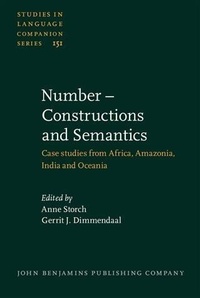
Number - Constructions and Semantics
Case studies from Africa, Amazonia, India and Oceania
1st Edition
Published on 19. March 2014
XV, 366 pages
978-90-272-7063-4 (ISBN)
Description

This book is the outcome of several decades of research experience, with contributions by leading scholars based on long-term field research. It combines approaches from descriptive linguistics, anthropological linguistics, socio-historical studies, areal linguistics, and social anthropology. The key concern of this ground-breaking volume is to investigate the linguistic means of expressing number and countable amounts, which differ greatly in the world's languages. It provides insights into common number-marking devices and their not-so-common usages, but also into phenomena such as the absence of plurals, or transnumeral forms. The different contributions to the volume show that number is of considerable semantic complexity in many languages worldwide, expressing all kinds of extendedness, multiplicity, salience, size, and so on. This raises a number of challenging questions regarding what exactly is described under the slightly monolithic label of 'number' in most descriptive approaches to the languages of the world.
More details
Other editions
Additional editions
Anne Storch | Gerrit J. Dimmendaal
Number - Constructions and Semantics
Case studies from Africa, Amazonia, India and Oceania
Book
03/2014
John Benjamins Publishing Co
€111.30
Shipment within 10-15 days
Persons
Content
- Number - Constructions and Semantics
- Editorial page
- Title page
- LCC data
- Table of contents
- List of tables, maps and figures
- Tables
- Table I.1. Major nominal subcategories (Rijkhoff 2002:?54)
- Table II.1. Classifiers in Tariana (a selection) (adapted from Table 5.1 in Aikhenvald 2003:?89-92)
- Table II.2. How classifiers help disambiguate a polysemous noun in Tariana
- Table II.3. Number distinctions, and number marking in Tariana
- Table II.4. Personal agreement markers in Tariana
- Table II.5. Personal pronouns in Tariana
- Table II.6. Number values for inanimates in Tucano and in Tariana: an illustration
- Table III.1. Examples of constructions, varying in size and complexity
- Table IV.1. Proforms in Kharia
- Table IV.2. Markers for tam and basic voice
- Table IV.3. Enclitic subject markers in the Tam/Person-syntagma
- Table V.1. Two exemplary nominal declensions
- Table V.2. Number terminology
- Table V.3. Personal pronouns
- Table V.4. Proximal ('this') demonstrative pronouns
- Table V.5. Discontinuous subject agreement on affirmative indicative main verbs
- Table VI.1. Numeral classifiers in Teiwa
- Table VI.2. Human classifier pronouns in Teiwa
- Table VI.3. Long and short subject pronouns in Teiwa
- Table VI.4. Fruit/tuber classifiers in Teiwa (repeated from Table VI.1)
- Table VI.5. Seeds, grains and fruits counted with bag
- Table VI.6. Fruits and bunches of fruit counted without bag
- Table VI.7. Dowry/bride prize items counted with bag
- Table VI.8. Other artifacts counted with bag
- Table VI.9. Artifacts NOT counted with bag
- Table VI.10. Wooden/natural objects with long/pointed shape counted with bag
- Table VI.11. Wooden/natural objects with long/pointed shape NOT counted with bag
- Table VI.12. Animals counted with bag
- Table VI.13. Animals NOT counted with bag
- Table VI.14. The use of bag per speaker, ordered by year of birth
- Table VI.15. Teiwa part-of-whole nouns with their meaning and the object they refer to
- Table VI.16. Plural number words in Alor Pantar (Klamer, Schapper & Corbett to appear)
- Table VI.17. Austronesian languages with numeral classifiers in eastern Indonesia
- Table VII.1. Properties of count and mass nouns
- Table VII.2. Numeral and possessive classifiers in Nêlêmwa and Zuanga
- Table VII.3. Numeral classifiers in Nêlêmwa
- Table VII.4. Pre-NP deictic and anaphoric determiners or pronouns in Nêlêmwa (salient)
- Table VII.5. Post-NP determiners in Nêlêmwa (already referential, bckg)
- Table VII.6. Examples of post-NP, pre-NP determiners and pronouns in Nêlêmwa
- Table VIII.1. Different strategies for integrating loanwords in Baïnounk Gubëeher (GB), with one contrasting form from Baïnounk Guñaamolo (GN) and Gujaher (GJ)
- Table VIII.2. Suffixed plurals and animacy in Gubëeher
- Table VIII.3. Multiply marked plurals and alternative paradigm with human terms
- Table VIII.4. Derivational vs. inflectional characteristics of number-marking strategies
- Table VIII.5. The paradigmatic network of the Gubëeher root rac
- Table VIII.6. The Gubëeher root ceen 'red' in different syntactic frames
- Table VIII.7. The semantic contribution of noun class prefixes with nouns and verbal nouns in Gubëeher
- Table VIII.8. Person/number morphology in the verbal paradigm
- Table IX.1. Vowel quality gradation system*
- Table IX.2. Distribution of the singular members of a sample of 326 nouns in the Agar dialect of Dinka
- Table IX.3. The most frequent singular-plural patterns in a sample of 326 simple native nouns in the Agar dialect of Dinka
- Table IX.4. Nouns with originally morphologically marked plural
- Table IX.5. Nouns with originally morphologically marked singular
- Table IX.6. Nouns with originally morphologically marked singular and plural
- Table IX.7. Inflection of simple transitive verbs with a basically monomoraic root vowel in Dinka and Surkum
- Table IX.8. Inflection of simple transitive verbs with a basically dimoraic root vowel in Dinka and Surkum
- Table IX.9. Dinka cognates of Surkum nouns with an unmarked singular and a marked plural
- Table IX.10. Dinka cognates of Surkum nouns with a marked singular and an unmarked plural
- Table IX.11. Nouns with a morphologically collective form
- Table X.1. Pairings of singulative, singular and plural-marking suffixes
- Table XI.1. SBW independent pronouns
- Table XI.2. Noun plurals in the Northern SBW sub-group
- Table XI.3. Geji demonstratives
- Table XI.4. Geji genitive pronouns
- Table XI.5. Southern SBW noun plurals
- Table XI.6a. Sigidi noun plurals: -s? suffix
- Table XI.6b. Sigidi noun plurals: -e?s suffix
- Table XI.6c. Sigidi noun plurals: apophony
- Table XI.7a. Zaar regular noun plurals
- Table XI.7b. Zaar irregular noun plurals
- Table XI.8a. Sigidi noun plurals
- Table XI.8b. Sigidi noun plurals: apophony
- Table XI.8c. Sigidi noun plurals: -a?s? suffix
- Table XI.9. Zaar kinship terms
- Table XI.10. Zaar adjectival forms
- Table XI.11. Polci imperatives
- Table XI.12. Chaari imperatives
- Table XI.13. Sigidi imperatives
- Table XI.14a. Geji imperatives, CV verbs
- Table XI.14b. Geji imperatives, CVC verbs
- Table XI.15. Sigidi pluractional verbs
- Table XI.16. Chaari pluractional verbs
- Table XI.17. Ambiguity in SBW pronouns
- Table XI.18. Proto-SBW pronouns
- Table XI.19. SBW aorist subject pronouns
- Table XI.20. Number in SBW
- Table XII.1. Personal pronouns
- Table XIII.1. The Digul Wambon body-part system
- Table XIII.2. Wambon of the Winiktit area
- Table XIII.3. The Mandobo numeral system
- Table XIII.4. Aghu numbers
- Table XIII.5. Sjiagha-Jenimu numbers
- Table XIII.6. Pisa numbers
- Table XIII.7. The Kombai body-part system
- Table XIII.8. The Korowai body-part system
- Table XIII.9. Tsaukambo and Komyandaret numerals
- Table XIII.10.
- Abbreviations
- Preface
- Chapter 1. One size fits all?
- 1. Introduction
- 2. The meanings of number
- 2.1 Variation
- 2.2 Aspect
- 3. Constructs and the non-canonical marking of number
- 4. Social and cultural aspects
- 4.1 Honorifics
- 4.2 Numerals
- 4.3 Trade and diplomacy
- 5. How this volume is organised
- References
- Chapter 2. Number and noun categorisation
- 1. Introducing the topic
- 2. Number and reference classification in north-west Amazonia: A bird's eye view
- 3. Number, animacy and reference classification in Tariana
- 3.1 Number distinctions and the categorisation of nominals
- 3.2 More on number agreement
- 3.3 Multiple number marking
- 4. Interim summary: What is special about the Tariana number system?
- 5. Tariana and its areal context
- 6. Looking further afield
- 7. To sum up
- References
- Chapter 3. Pluractionality and the distribution of number marking across categories
- 1. Background to the present study
- 2. Plural arguments and plural events in Maban (Nilo-Saharan)
- 3. From iterative marking to number marking in Maasai (Nilo-Saharan)
- 4. Pluractional marking as non-canonical number marking
- References
- Chapter 4. Figuratively speaking - number in Kharia
- 1. Introduction
- 1.1 The Case-syntagma
- 1.2 The tam/Person-syntagma
- 2. Number
- 2.1 The dual and plural in Kharia
- 3. Number and indexical order
- 3.1 Associative functions of the dual and plural
- 3.2 Honorificity
- 3.3 Approximative plural
- 4. Summary and outlook
- References
- Chapter 5. Number in Kambaata
- 1. Introduction
- 2. Number marking on common nouns
- 2.1 Number terminology
- 2.2 Number morphology
- 2.3 Functions of number morphemes
- 2.4 Summary
- 3. Number marking on proper nouns
- 4. Number marking on pronouns
- 5. Number agreement on nominal modifiers
- 6. Number agreement on verbs
- 7. Number in Kambaata: Derivation vs. inflection
- References
- Chapter 6. The history of numeral classifiers in Teiwa (Papuan)
- 1. Introduction
- 2. Overview of Teiwa classifiers
- 2.1 The human classifier -man
- 2.2 The fruit shape classifiers
- 2.3 The general classifier bag 'clf' & 'seed'
- 2.4 Summary
- 3. The development of Teiwa classifiers
- 4. Classifiers and number neutral nouns
- 5. Teiwa classifiers in their areal context
- 6. Summary and conclusions
- References
- Chapter 7. Number and numeration in Nêlêmwa and Zuanga (New Caledonia)
- 1. Introduction
- 1.1 A brief presentation of Nêlêmwa and Zuanga
- 1.2 Number and numeration
- 2. Numeration and noun categories
- 2.1 Mass and count nouns
- 2.2 Paired entities
- 2.3 Collective NPs in Nêlêmwa
- 2.4 Associative NPs in Nêlêmwa
- 3. Classifiers and quantifiers
- 3.1 Count nouns: Classifiers and numerals
- 3.2 A brief note on the numeral system
- 3.3 Classifiers: Sortal, mensural-configurational and partitive
- 3.4 Choice and variation of classifier
- 4. Number, indefiniteness, genericity and referentiality
- 4.1 Bare nouns, indefinites and generics in Nêlêmwa
- 4.2 Plural nouns and indefiniteness in Nêlêmwa
- 4.3 Hyperonyms, generic nouns and indefiniteness in Nêlêmwa
- 5. Existential predications and indefinite nouns in Nêlêmwa
- 6. The morphology of number marking on NPs and VPs in Nêlêmwa and Zuanga
- 6.1 Semantics of reduplication
- 6.2 Number marking on NPs
- 6.3 Number marking on VPs
- 6.4 Number marking in some other Austronesian languages: Contrastive perspectives
- 7. The syntax of NP determiner phrases
- 7.1 Pre-NP and post-NP determiners in Nêlêmwa: Pragmatic aspects
- 7.2 Comparison of pre-NP and post-NP determiners in Nêlêmwa
- 7.3 Combination of pre-NP and post-NP determiners in Nêlêmwa
- 8. The syntax of numerals
- 8.1 Numerals as predicates or arguments
- 8.2 Numerals as determiners: Pre-NP or post-NP positions
- 9. Relation of the numeral 'one' to specificity: 'one' vs. 'an'
- 9.1 The numeral 'one' with indefinite NPs
- 9.2 The numeral 'one' with definite NPs
- 9.3 The numeral 'one' in factive and irrealis relative clauses
- 10. To conclude on the role of numeral and number specifiers
- Appendix: List of classifiers in Nêlêmwa and Zuanga
- References
- Chapter 8. When number meets classification
- 1. Introduction
- 1.1 The Baïnounk languages
- 1.2 Introduction to noun class and number in Baïnounk languages
- 2. Two ways of expressing number
- 2.1 Number in the nominal classification system
- 2.2 The plural suffix
- 3. The semantics of the plural suffix
- 4. Classification, derivation, and number
- 5. Word class and number
- 6. Conclusion
- References
- Chapter 9. Number in Dinka
- 1. Introduction
- 2. Number inflection of simple native nouns
- 3. Number agreement
- 4. Singular-plural patterns
- 5. Internal reconstruction
- 6. Comparative evidence
- 7. The singular as basic synchronically
- 7.1 Number inflection of borrowed and derived nouns
- 7.2 Free variation in the plural
- 7.3 Singular used for reference to a plural set
- 7.4 Nouns modified by numerals
- 7.5 Typological change
- 8. Pluralia tantum
- 9. Morphologically collective nouns
- 10. Associative plural
- 11. Plurality in verbs
- 12. Conclusion
- References
- Chapter 10. Counting chickens in Luwo
- 1. Nouns and their structure
- 1.1 Number marking on nouns
- 1.2 Classifiers
- 2. Quantifiers and numerals
- 2.1 Quantifiers
- 2.2 Numerals
- 3. Nominal aspect
- 4. Accumulation of semantic properties and affix renewal
- 4.1 Don't count your chickens before they're hatched
- References
- Appendix
- Chapter 11. Number in South-Bauchi West languages (Chadic, Nigeria)
- 1. Introduction
- 2. Overview of SBW languages
- 3. Number in the noun phrase
- 3.1 Northern SBW, plus Zo?i
- 3.2 Southern SBW
- 4. Number in the verb phrase
- 4.1 Subject-verb agreement in the left periphery of the verb
- 4.2 The Imperative plural
- 4.3 Plural verbs ("pluractionals")
- 4.4 Second person Plural verbal suffix
- 5. Number and other related categories
- 5.1 Honorifics, avoidance, etc.
- 5.2 Number and associative
- 5.3 Number and diminutive
- 6. Conclusion
- References
- Annex 1: SBW languages
- Annex 2: Internal Classification of SBW languages
- Chapter 12. Number and numerals in Zande
- 1. Introduction
- 2. Zande, an overview
- 3. Number marking on personal pronouns
- 3.1 Number mismatch in possessive constructions
- 3.2 The deferential plural pronoun
- 3.3 Associative plural with personal pronouns
- 4. Morphological number marking on nouns
- 4.1 Associative plural nouns
- 4.2 Quantifiers and numerals adjacent to the noun
- 5. The universal quantifier and numerals nonadjacent to the noun
- 5.1 Quantifying the subject
- 5.2 Quantifying the object
- 6. Quantifiers and numerals as predicates
- 7. Numerals as self-standing adverbials
- 8. Pluractional and intensive verb forms
- 9. Conclusions
- References
- Chapter 13. Numerals in Papuan languages of the Greater Awyu family
- 1. Introduction
- 2. Counting and numerals in the Dumut subgroup of the Awyu-Dumut branch
- 2.1 Digul Wambon
- 2.2 Wambon of the Winiktit area
- 2.3 Mandobo
- 3. Counting and numerals in the Awyu subgroup of the Awyu-Dumut branch
- 3.1 Aghu
- 3.2 Some data on the Sjiagha, Jenimu and Pisa numbers
- 4. Counting and numerals in the Ndeiram subgroup
- 5. Counting and numerals in the Becking-Dawi branch
- 5.1 Korowai
- 5.2 Tsaukambo and Komyandaret
- 6. Conclusions and discussion
- References
- Author index
- Language index
- Subject index
