

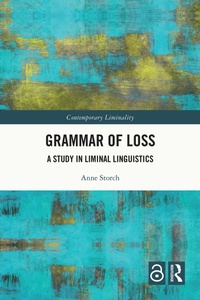
Grammar of Loss
A Study in Liminal Linguistics
1st Edition
Published on 15. December 2025
186 pages
978-1-040-80349-3 (ISBN)
Description

This book explores how language and linguistic knowledge can be encountered through walks, shared meals, conversations, and daily life rather than being written about in the style and genre of western academic grammar.
Through an innovative exploration of the multivocal forms of knowledge transmission about a disappearing language within a small, diverse community in Nigeria, the book reveals a revolutionary perspective on linguistic research by uncovering hidden dimensions of language through stories of both the living and the dead. The author presents valuable insights into how language knowledge persists and transforms in liminal spaces, including ruined sites. Readers will gain fresh understanding of linguistic description that transcends traditional academic boundaries, revealing magical properties of language and meanings that conventional approaches might miss. In decidedly treading on liminal grounds, the author offers insights into what remains in terms of knowledge after loss.
It will therefore be of strong interest to scholars and researchers in linguistics, particularly those focused on endangered languages and linguistic anthropology. It will also appeal to academics working in liminality studies and those interested in alternative approaches to language documentation.
Chapters 3, 4 and 10 of this book are freely available as a downloadable Open Access PDF at http://www.taylorfrancis.com under a Creative Commons Attribution-Non Commercial-No Derivatives (CC BY-NC-ND) 4.0 license.
Through an innovative exploration of the multivocal forms of knowledge transmission about a disappearing language within a small, diverse community in Nigeria, the book reveals a revolutionary perspective on linguistic research by uncovering hidden dimensions of language through stories of both the living and the dead. The author presents valuable insights into how language knowledge persists and transforms in liminal spaces, including ruined sites. Readers will gain fresh understanding of linguistic description that transcends traditional academic boundaries, revealing magical properties of language and meanings that conventional approaches might miss. In decidedly treading on liminal grounds, the author offers insights into what remains in terms of knowledge after loss.
It will therefore be of strong interest to scholars and researchers in linguistics, particularly those focused on endangered languages and linguistic anthropology. It will also appeal to academics working in liminality studies and those interested in alternative approaches to language documentation.
Chapters 3, 4 and 10 of this book are freely available as a downloadable Open Access PDF at http://www.taylorfrancis.com under a Creative Commons Attribution-Non Commercial-No Derivatives (CC BY-NC-ND) 4.0 license.
Reviews / Votes
'This innovative book offers a deeply human and refreshingly honest approach to linguistic scholarship. Its focus on the largely defunct Nigerian Hone language and blends rigorous research with storytelling techniques. The book's structure defies traditional grammar formats, instead presenting a logical, accessible, and emotionally resonant journey through language, culture, and identity. The author challenges Western academic norms by foregrounding indigenous spirituality, lived experience, and the realities of her own fieldwork experience. Rich in interdisciplinary insight, Anne Storch writes with compassion and scholarly precision and crafts both a critical academic contribution and a powerful act of cultural preservation. The Grammar of Loss provides valuable insight for researchers, educators, and students across disciplines and is a must-read for anyone interested in the transformative power of language.'Sally J. Delgado, University of Puerto Rico at Cayey
'A vivid and poignant account of a disappearing language, which captures how language is situated in a place and embedded in a community of speakers, rather than treating it as data to be extracted for academic analysis and dissection.'
Paul O'Connor, Associate Professor, United Arab Emirates University
'Every now and then a rare gem of a book comes along, bold, pioneering and rigorously argued in a narrative, almost playful style that means you just can't put it down.
Grammar of Loss by Anne Storch is just such a book. Prof Storch takes on the debates around decolonising language study by doing decolonising and telling the story of how it can be done, the pitfalls, partnerships and the narrative power of anti-extractive, imaginative approaches as a living, creative decoloniality.
The book is a tour de force, the kind that only the very best of scholars, at the height of their analytic and narrative powers can pull off. You are in for a treat. Expect to be changed by this book.'
Alison Phipps, UNESCO Chair for Refugee Integration through Education, Languages and Arts
More details
Series
Edition
1. Auflage
Language
English
Place of publication
London
United Kingdom
Publishing group
Taylor & Francis Ltd
Target group
College/higher education
Professional and scholarly
Illustrations
1 Line drawings, black and white; 4 Halftones, color; 9 Halftones, black and white; 4 Illustrations, color; 10 Illustrations, black and white
File size
13,64 MB
ISBN-13
978-1-040-80349-3 (9781040803493)
Copyright in bibliographic data and cover images is held by Nielsen Book Services Limited or by the publishers or by their respective licensors: all rights reserved.
Schweitzer Classification
Other editions
Additional editions
Book
approx. 12/2025
1st Edition
Routledge
€224.00
Not yet published
Person
Anne Storch teaches African Studies at the University of Cologne, Germany. Her research focuses on various languages of Nigeria, South Sudan, Kenya, and Uganda, resulting in contributions to the cultural and social context of languages, the semiotics of linguistic practices, and Indigenous linguistic theories.
Content
1. Introduction 2. Extractivism 3. Levitating backwards 4. Ghosts 5. Roasted chicken and the motorpark 6. Nothing is numerous or few in itself 7. Confucianists 8. You and me 9. Wandering 10.What can no longer be known 11. Crackles and glitches 12. Colonialism
