

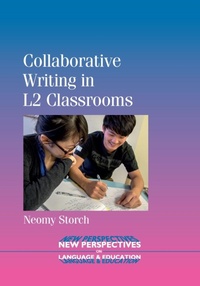
Collaborative Writing in L2 Classrooms
Published on 4. July 2013
200 pages
978-1-84769-996-1 (ISBN)
Description

In this first book-length treatment of collaborative writing in second language (L2) classrooms, Neomy Storch provides a theoretical, pedagogical and empirical rationale for the use of collaborative writing activities in L2 classes, as well as some guidelines about how to best implement such activities in both face-to-face and online mode. The book discusses factors that may impact on the nature and outcomes of collaborative writing, and examines the beliefs about language learning that underpin learners' and teachers' attitudes towards pair and group work. The book critically reviews the available body of research on collaborative writing and identifies future research directions, thereby encouraging researchers to continue investigating collaborative writing activities.
Reviews / Votes
At last, a definitive treatment of collaborative writing in second language classrooms! Storch lays out compelling theoretical, empirical and pedagogical rationales for collaborative writing, convincing the reader of its positive impact on language learning. Aware of the challenges teachers face in implementing in-class and online (e.g. wikis) collaborative activities, she provides practical suggestions about task choice, and the collaborative relationships most conducive to language learning. She addresses both cognitive and social-emotive aspects of pair/group work, calling for longitudinal, qualitative research in diverse language learning contexts. -- Merrill Swain and Sharon Lapkin, The Ontario Institute for Studies in Education, Canada In this accessible yet authoritative book, Neomy Storch has provided the field with an illuminating, comprehensive, and novel understanding of the role that collaboration (through writing) and L2 writing (in collaborative environments) can play in advancing L2 competencies. The book is therefore a most welcome addition to the expanding SLA-oriented L2 writing scholarship. -- Rosa M. Manchon, University of Murcia, Spain Collaborative writing is one of the most exciting new directions in second language writing research and instruction. In this book, Neomy Storch, a leader in this important development, lays a foundation by providing a clear and succinct overview of theoretical and research insights from a wide range of intellectual traditions, including second language acquisition, sociocultural theory, composition studies and, of course, second language writing. This book is a great introduction for teachers who wish to understand the rationale behind collaborative writing and for researchers who wish to identify questions for further explorations of this relatively young yet promising research area with practical implications. -- Paul Kei Matsuda, Arizona State University, USA This new publication will be undoubtedly welcomed by practitioners as an authoritative book in the field of L2 writing, especially for those interested in practical methods of incorporating collaborative writing in class. Researchers too may benefit from the identification of questions for further exploration in an area that is still, by and large, underexplored and in which, according to the author, only a small number of published studies have appeared to date. -- Brett Cumming, Aichi Prefectural University, Japan * JALT Journal, 37.1 * Grounded in a very thorough knowledge of this field, this volume, by one of its leading researchers who is also an experienced ESL and EAP teacher, is a valuable resource. I am happy to recommend it to both teachers and researchers with an interest in collaborative writing. -- Rosemary Wette, University of Auckland, New Zealand in TESOLANZ Journal (2015)More details
Series
Language
English
Place of publication
Bristol
United Kingdom
Publishing group
Channel View Publications Ltd
Target group
College/higher education
Professional and scholarly
Product notice
Reflowable
ISBN-13
978-1-84769-996-1 (9781847699961)
Copyright in bibliographic data and cover images is held by Nielsen Book Services Limited or by the publishers or by their respective licensors: all rights reserved.
Schweitzer Classification
Other editions
Additional editions
Neomy Storch
Collaborative Writing in L2 Classrooms
Book
07/2013
Multilingual Matters
€42.00
Shipment within 10-20 days
Person
Neomy Storch is Senior Lecturer in Applied Linguistics and ESL, at the School of Languages and Linguistics, The University of Melbourne. Her research interests include second language writing, peer interaction, feedback on writing, writing development, and the use of the first language in second language learning. She has presented and published widely on these issues, and is co-editor of the Australian Review of Applied Linguistics.
Content
Preface
Chapter 1: Introduction
Chapter 2: Theoretical and Pedagogical Rationale for Collaborative L2 Writing
Chapter 3: Collaborative Writing: L2 Learning and Practice Opportunities
Chapter 4: Factors Affecting Languaging in Collaborative Writing
Chapter 5: Collaborative Writing and Language Learning
Chapter 6: Learners' Perspectives of Collaborative Writing
Chapter 7: Computer Mediated Collaborative Writing
Chapter 8: Conclusion: Pedagogical Implications and Research Directions
Chapter 1: Introduction
Chapter 2: Theoretical and Pedagogical Rationale for Collaborative L2 Writing
Chapter 3: Collaborative Writing: L2 Learning and Practice Opportunities
Chapter 4: Factors Affecting Languaging in Collaborative Writing
Chapter 5: Collaborative Writing and Language Learning
Chapter 6: Learners' Perspectives of Collaborative Writing
Chapter 7: Computer Mediated Collaborative Writing
Chapter 8: Conclusion: Pedagogical Implications and Research Directions
