

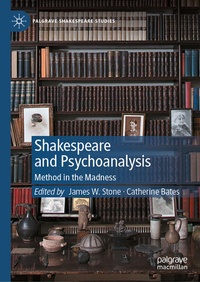
Shakespeare and Psychoanalysis
Description

This edited volume presents a collection of new essays on Shakespeare and Psychoanalysis from leading figures in the field, making a strong statement about the ongoing relevance of contemporary psychoanalytic theory and method to the study of literary texts in general, and to Shakespeare's poems and plays in particular. Drawing from a vibrant and diverse dialogue with psychoanalysis, this collection manages to interrogate Shakespeare's treatment of gender, social customs, history, trauma, and the construction of the self.
More details
Other editions
Additional editions
Persons
James W. Stone is a lecturer on Shakespeare and early modern literature at American University and on Shakespeare at the Osher Institute at Johns Hopkins University, USA. He taught at the American University in Cairo and at the National University of Singapore. He is the author of Crossing Gender in Shakespeare: Feminist Psychoanalysis and the Difference Within (2010) and articles on Shakespeare, Milton, the Renaissance Ovid, film theory, and contemporary Egyptian art. In 2023 he and James Newlin co-edited the essay collection New Psychoanalytic Readings of Shakespeare: Cool Reason and Seething Brains .
Catherine Bates is Research Professor in the Centre for the Study of the Renaissance at the University of Warwick, UK. She is author of The Rhetoric of Courtship in Elizabethan Language and Literature (1992) Play in a Godless World: The Theory and Practice of Play in Shakespeare, Nietzsche, and Freud (1999); Masculinity, Gender and Identity in the English Renaissance Lyric (2007); Masculinity and the Hunt: Wyatt to Spenser (2013), winner of the 2015 British Academy Rose Mary Crawshay Prize; and On Not Defending Poetry: Defence and Indefensibility in Sidney's 'Defence of Poesy' (2017), winner of the 2019 Studies in English Literature, 1500-1900 Elizabeth Dietz Award. She is also editor of The Cambridge Companion to the Epic (2010), A Companion to Renaissance Poetry (2018), Sixteenth-Century British Poetry (2022), co-edited with Patrick Cheney, The Oxford Handbook of Philip Sidney (2024), and The Routledge Companion to Renaissance Literature (2026).
Content
Chapter 1: Introduction.- Part I : Shakespeare and Psychoanalysis.- Chapter 2 : The Role of Shakespeare in the Development of Freud's Theory.- Chapter 3 :The readiness for transference: Hamlet's lesson.- Chapter 4 : Representing Subjectivity in Shakespeare's Romeo and Juliet.- Chapter 5 : Wilfred R. Bion and the Psychoanalytic Study of Thinking in Measure for Measure.- Chapter 6:Coriolanus.- Part II. Psychoanalysis and Shakespeare.- Chapter 7 : The Imaginary and the Symbolic in Shakespeare's Venus and Adonis.- Chapter 8:Antithetical Words, Rape, and Ekphrasis in Shakespeare's The Rape of Lucrece.- Chapter 9 : Hamlet, Freud, Laplanche: a Copernican reading.- Chapter 10 : Emulous Fidelity: Shakespeare, Jack Spicer, and Troilus.- Chapter 11 : Skepticism and Dysphoria: On Two Tales of Winter.
